Introduction
Tenants rarely announce why they’re leaving. They say, “My plans changed” or “I’m moving closer to work,” pack up on a weekend, and that’s the end of it. You refill the bed and move on. Then three months later, another tenant leaves for a reason that sounds oddly familiar.
Understanding why PG tenants leave is one of the cheapest ways to protect your income, because every empty bed costs you rent while your fixed costs keep running. This guide covers nine reasons owners often miss, how to spot each one early, and a simple way to track exits. If you already use PG and hostel management software, you can keep tenant records, complaints and occupancy data in one place and spot patterns faster.
The Short Answer
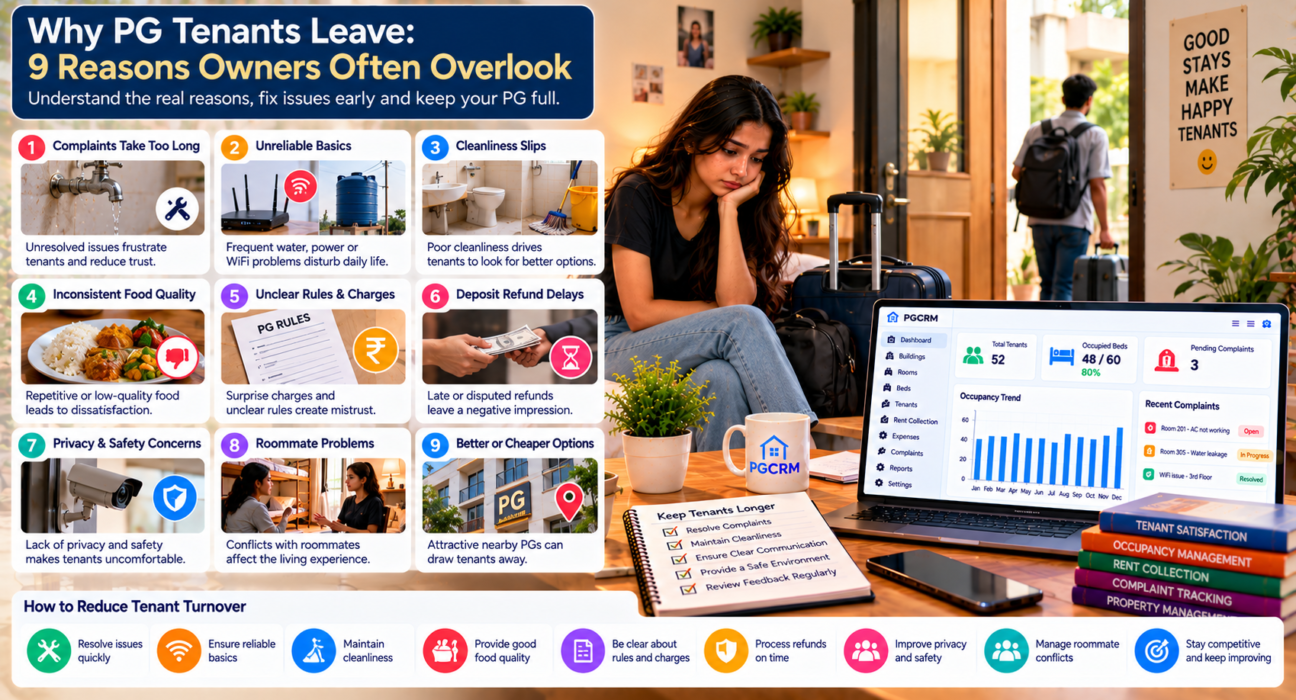
Most PG tenants leave because of a problem that felt small to the owner but not to them: complaints that stayed open, unreliable basics like water or WiFi, unclear charges, slow deposit refunds, or a lack of privacy and safety. Better or cheaper options nearby make the decision easier, but they rarely cause it alone.
Some tenants leave for reasons you can’t control, like a job change, graduation or a move to another city. The nine below are the ones you can influence.
1. Complaints That Take Too Long to Fix
This is the most common one, and the easiest to miss. A tenant mentions a leaking tap on Monday. You say you’ll send someone. By Friday, nothing has happened. The tenant doesn’t remind you again. They just quietly start looking at other PGs.
What matters isn’t only the repair. It’s whether the tenant feels heard.
What helps:
- Record every complaint with the room, date and issue
- Set a priority, so leaks and electrical problems come first
- Give a rough fix time, even if it’s “by tomorrow evening”
- Close the loop by telling the tenant it’s done
PGCRM lets you log complaints, set priority and keep a clear status trail until they’re closed, which helps when a manager or caretaker handles repairs for you.
2. Unreliable Basics: Water, Power and WiFi
Tenants forgive an old building. They don’t forgive cold showers, empty tanks and WiFi that drops during work calls. These basics shape daily life, and people notice them every single day.
What helps:
- Ask tenants once a month which basics bother them
- Fix recurring supply problems at the root, instead of patching them
- Keep power backup for lights, fans and the router if outages are common in your area
- Check WiFi in the rooms farthest from the router, not just near it
3. Cleanliness That Slips Slowly
PGs rarely become dirty overnight. Standards slip a little each week: a washroom cleaned every other day, corridors swept less often, a smell that nobody deals with. By the time you see it, tenants have been putting up with it for a month.
What helps:
- Set a simple cleaning schedule and put it on the wall
- Walk through the building yourself, regularly and unannounced
- Pay attention to washrooms and the kitchen first, since tenants judge you on them
- Give the cleaning staff clear tasks, not just “keep it clean”
4. Inconsistent Food Quality
If you serve meals, food is the topic tenants talk about most. One bad week of watery dal, repeated menus or undercooked rice can undo months of goodwill. Inconsistency does more damage than a modest menu that’s always decent.
What helps:
- Keep a repeating menu and stick to it
- Taste the food yourself, regularly
- Ask for feedback in a low-pressure way, such as a short chat at dinner
- Keep an eye on hygiene in the kitchen and the storage area
5. Unclear Rules and Surprise Charges
Few things frustrate tenants more than a bill that doesn’t match what they expected. Electricity charges appear that nobody mentioned. A deposit deduction arrives without explanation. Rent goes up with no reason given.
It isn’t always the amount. It’s the surprise.
What helps:
- Put every charge in writing at move-in: rent, electricity, AC, meals, fines and notice period
- Explain deposit deductions clearly, before they happen
- If you increase rent, give notice and a short reason. Check your agreement and local practice on notice periods
- Use the same rules for everyone
6. Deposit Refund Delays and Disputes
The deposit is where a tenant’s last impression of you gets formed. If it’s refunded promptly and fairly, they leave on good terms and may recommend you. If they have to chase you for weeks, they tell everyone about it.
What helps:
- Do a move-in inspection and note any existing damage
- Do a move-out inspection while the tenant is still there
- Share the settlement calculation in writing
- Refund within the time you agreed, and say what that time is up front
PGCRM supports deposits, fines, room shifts, vacates and settlements, which gives you a record to work from when it’s time to settle.
7. Privacy and Safety Concerns
Safety matters to every tenant, and especially in women’s PGs and to parents who live far away. But privacy matters too. Staff who walk into rooms without knocking, visitors who wander in freely or a caretaker who shares tenant details casually can all make people uncomfortable.
What helps:
- Keep entry points controlled, with a visitor register
- Use CCTV in common areas and entrances, not in private spaces
- Set rules for staff entering rooms, such as a knock and a notice
- Keep tenant documents and KYC details in a secure place instead of scattered across phones and chat groups
8. Roommate Problems With No Way Out
Sharing a room is where PG life gets personal. Different sleep schedules, noise, cleanliness habits and the odd conflict can all make a tenant miserable. If they can’t move to another room or bed, the only option left is to leave the PG entirely.
What helps:
- Ask about habits at move-in, such as early sleeper or late worker
- Keep a few flexible beds where you can
- Make it easy for tenants to request a room change
- Step in early when two roommates clash, before it grows
Knowing which beds are free helps here. PGCRM shows room and bed status across your buildings, so shifting a tenant is quicker when you can see what’s available.
9. Poor Communication and a “Rent Collector” Attitude
Some tenants leave because of how they feel treated, not because of the building. If the only time they hear from you is when rent is due, it’s easy to feel like a payment, not a person.
What helps:
- Reply to messages promptly, even if only to say “I’ll check and get back to you”
- Greet new tenants and check in after the first week
- Send rent reminders politely and on time. Automatic reminders can help, so you’re not chasing people by hand
- Tell tenants about changes in advance, such as water cuts or repairs
- Train managers and caretakers to be respectful, since they’re the face of your PG
How to Find Out Why Your Tenants Are Actually Leaving
You can guess at reasons, or you can ask. Here’s a simple way to do it.
- Have a short exit conversation. Ask one open question: “What could we have done better?” People are more honest when it’s casual and the deposit is already settled.
- Note the reason in a simple log. Record the tenant’s room, how long they stayed and the main reason they gave.
- Group reasons every quarter. Look for repeats.
- Check against your complaint records. If a tenant left because of “slow repairs,” see whether their complaints stayed open for long.
- Fix the biggest repeat first. One recurring issue usually matters more than five rare ones.
An exit log can be a notebook or a spreadsheet. PGCRM keeps tenant records, complaints and occupancy reports in one place, but it doesn’t list a field for move-out reasons on its site, so keep that note in your own sheet and compare it with the system’s records.
Quick reference: reason, warning sign and fix
| Reason | Early warning sign | First fix |
|---|---|---|
| Slow complaints | Tenants stop reporting problems | Log every complaint and close each one with a note |
| Unreliable basics | Repeated water, power or WiFi complaints | Fix the root cause, not the symptom |
| Cleanliness slipping | Comments about washrooms or smells | Set a schedule and check it yourself |
| Food quality | Meals left uneaten | Keep a repeating menu and taste it daily |
| Surprise charges | Arguments over bills | Put every charge in writing at move-in |
| Deposit disputes | Tenants chasing refunds | Do move-out inspections and settle on time |
| Privacy and safety | Questions about locks, visitors or staff | Set entry and visitor rules |
| Roommate conflict | Requests to change rooms | Make room shifts easy |
| Poor communication | Unanswered messages | Reply quickly and check in with tenants |
What Leaving Costs You
Tenant turnover is expensive in ways that aren’t obvious. Here’s a simple way to think about it, with assumed figures.
If a bed rents for ₹6,000 a month and stays empty for 20 days before the next tenant joins, you lose about ₹4,000 in rent. Add the time spent showing the room, cleaning it, doing paperwork and any listing costs. Even a few extra move-outs a year add up, especially because costs like building rent and salaries don’t shrink when a bed is empty.
That’s why keeping a good tenant is almost always cheaper than finding a new one.
FAQ
Why do PG tenants leave?
Most leave because of problems that stayed unresolved: slow complaint handling, unreliable water, power or WiFi, poor cleanliness, inconsistent food, unclear charges, deposit disputes, or privacy and safety concerns. Some leave for personal reasons like a job change or graduation, which you can’t control.
How can I reduce tenant turnover in my PG?
Fix the basics, respond to complaints quickly, be clear about every charge at move-in, settle deposits on time and keep communication respectful. Track why tenants leave and fix the most common reason first. Small, steady improvements usually do more than one big change.
How do I find out the real reason a tenant is leaving?
Ask in a relaxed exit conversation, ideally after the deposit is settled, and ask one open question like what you could have done better. Then record the answer. Over a few months, patterns will show you which problems actually cost you tenants.
Is high tenant turnover normal in a PG?
Some turnover is normal, because PGs serve students and working professionals whose plans change. But if tenants leave quickly or for the same reasons again and again, that’s a sign something fixable is going wrong, such as repairs, charges or communication.
How do complaints affect PG tenant retention?
Complaints that stay open for long make tenants feel ignored, and many stop reporting problems and quietly look elsewhere. Logging each complaint, setting priorities and telling tenants when an issue is closed shows that you take problems seriously and helps keep them.
Should I lower rent to stop tenants from leaving?
Not as a first step. If tenants leave over repairs, cleanliness, safety or unclear charges, a lower rent won’t fix the real problem. Find out why they’re leaving first. Price matters, but compare your rent with similar PGs nearby before changing it.
Conclusion
Understanding why PG tenants leave is mostly about paying attention to small things before they become reasons to move out: open complaints, unreliable basics, unclear charges, slow refunds and the way tenants feel treated. Ask people why they’re leaving, keep a simple log and fix the biggest repeat issue first.
Organised records make this easier. If you’d like tenant details, complaints, rent and occupancy in one place, explore PGCRM to simplify your PG and hostel management.