First Time Fix Rate Tracking Software: How to Improve First-Visit Resolution in Field Service
Every repeat visit costs you a technician’s day, fuel, a rescheduled slot and some customer trust. Most service managers know their teams make return trips. Few can say how many, on which jobs, or why.
That gap is where first time fix rate tracking software helps. It records whether each job was resolved on the first visit, links the result to proof from the field, and shows where failures cluster. This guide explains what first-visit resolution is, why first visits fail, and how to improve the rate step by step.
What Is First-Time Fix Rate?
First-time fix rate (FTFR) is the percentage of service jobs fully resolved on the first visit, with no return trip needed for parts, information or a second technician.
Formula: FTFR = (jobs resolved on the first visit ÷ total jobs) × 100
Example: Your team completes 200 service jobs in a month, and 150 are resolved on the first visit. Your FTFR is 150 ÷ 200 × 100 = 75%.
Two definitions matter before you start measuring:
- A “fix” means the issue is resolved, not that a visit happened. A technician who visits and closes the ticket but leaves the fault in place has not fixed it first time.
- Use a consistent follow-up window. Aquant recommends a 30-day window. Shorter windows can split a repeat visit into a separate ticket and make performance look better than it is.
What Is a Good First-Time Fix Rate?
Published benchmarks vary by industry and method, so treat them as reference points and not targets to copy.
| Source | Figure | Note |
|---|---|---|
| Aberdeen Group | About 75% average; about 89% best-in-class | Older research, widely cited |
| Aquant, 2025 Field Service Benchmark | 75% median; 86% for the top 20% | Measured over 30 days |
Aberdeen’s research puts the average first-time fix rate near 75%, with best-in-class firms around 89%. Aquant’s 2025 report, measured over 30 days, found a median of 75% and a top-20% figure of 86%. The practical goal is to measure your own baseline and improve it month on month. aberdeen group report repairing field efficiency +2
Why First-Visit Resolution Matters
A failed first visit has a cost beyond the extra trip.
- More visits, more delay. Aquant’s 2025 report found that a failed first visit adds two further visits on average and extends resolution by 14 days. ventavid
- Customer retention. Aberdeen research reported by Kerridge found customer retention of 86% for companies above 70% FTFR, against 76% below it. kerridgecs
- Customer complaints. Aberdeen research also found that unfinished jobs were the most common customer complaint, ahead of late arrivals. retrievercommunications
- SLA risk. Repeat visits eat into response and resolution windows.
- Capacity. Every return trip uses a slot that could have gone to a new job.
Why First Visits Fail
Aberdeen research, as summarised by Kognitos, points to missing or wrong parts, technicians lacking the right skills, and insufficient time allocated as leading causes. Incomplete job information and weak proof of work are also common. kognitos
| Cause | What it looks like | Who owns the fix |
|---|---|---|
| Wrong or missing parts | Technician arrives, cannot complete the repair | Operations / stores |
| Skill mismatch | Job needs a specialist the visiting technician is not | Dispatch |
| Not enough time | Visit runs out of slot before the work is done | Scheduling |
| Incomplete job details | Technician learns the real fault on site | Customer support / intake |
| Unclear closure | Job closed without proof the issue was resolved | Field manager |
This is why a single FTFR percentage is not enough. It tells you that jobs fail, but not which cause to fix first.
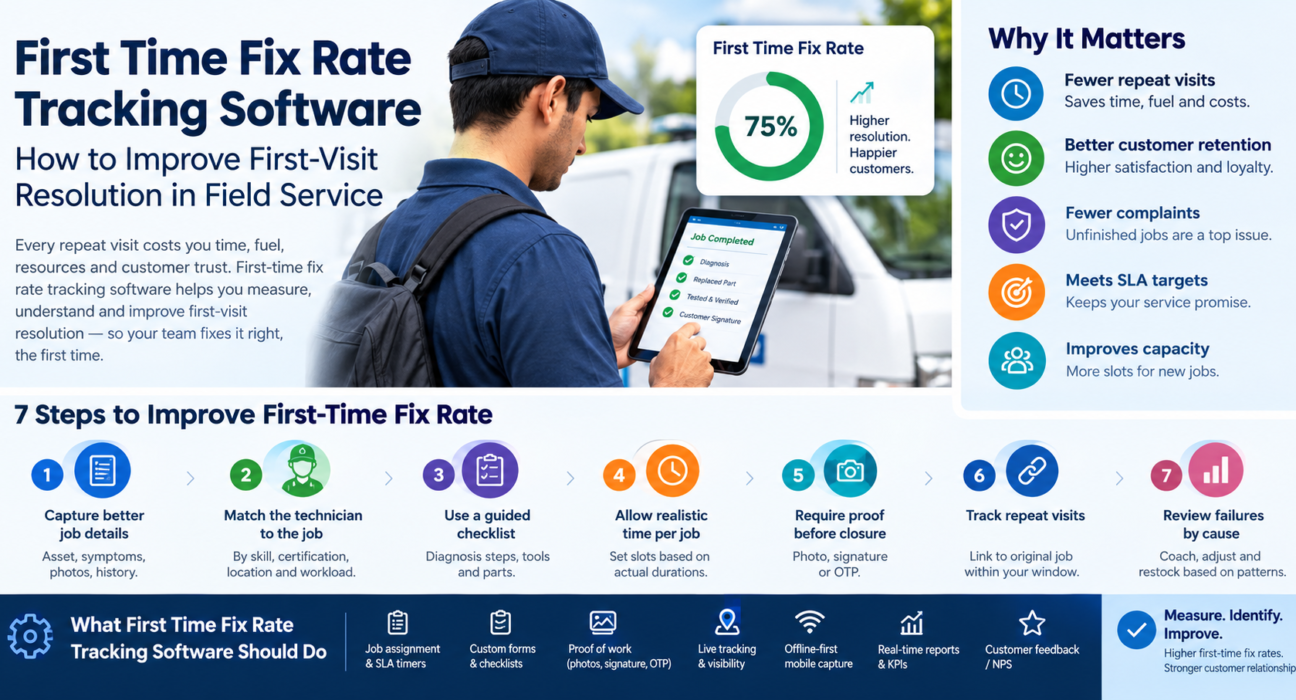
7 Steps to Improve First-Time Fix Rate
1. Capture better job details before dispatch
Record the asset, the symptoms, photos from the customer if possible, and any previous visit history. Use a structured form so technicians don’t depend on a one-line description.
2. Match the technician to the job
Assign by skill, certification, location and workload, not just who is free. A skill-matched first visit is the cheapest fix available.
3. Give technicians a guided job checklist
A checklist that covers diagnosis steps, required tools and parts to confirm before leaving for the site reduces avoidable return trips.
4. Allow realistic time per job type
If one job type regularly overruns, the slot is wrong and the technician is not. Use actual job durations to reset estimates.
5. Require proof before a job can close
Photo, signature or customer OTP at closure makes “resolved” a verified outcome. It also separates real fixes from jobs closed early to meet an SLA.
6. Track repeat visits against the original job
Flag any return visit to the same customer or asset within your chosen window, and link it to the original job. This is what makes your FTFR figure trustworthy.
7. Review failures by cause, every week
Look at failed first visits grouped by cause, technician, job type and area. Coach, adjust scheduling or change stocking based on the pattern.
What First Time Fix Rate Tracking Software Should Do
First time fix rate tracking software records job outcomes, links repeat visits to original jobs, and reports resolution rates by technician, job type and cause. When you evaluate tools, check for these capabilities:
- Job assignment with priority and SLA timers, so urgent work reaches the right person.
- Custom forms and checklists, so the “resolved on first visit?” outcome is captured as data and not as free text.
- Proof of work (photos, signatures, OTP) tied to each job.
- Live visibility of where technicians are and what they are working on.
- Offline-first mobile capture, because many service sites have weak connectivity.
- Real-time reports and KPIs you can filter by team, job type and date.
- Customer feedback or NPS, to compare your FTFR with how customers actually rated the visit.
How FieldExecutives Can Help
Businesses looking to simplify these processes can use field force management software such as FieldExecutives. It is built for sales, delivery, collections and service teams, with live GPS tracking, proof of visit, SLA monitoring and real-time KPIs in one platform.
For first-visit resolution, these capabilities are the most relevant:
- Assign and dispatch with SLAs. Managers create tasks with checklists, priority and an SLA, and the job reaches the right rep’s phone instantly.
- Guided job execution. Reps follow a job card showing where to go, whom to meet and what to do, with checklists and SLA timers.
- Verified closure. Photo, signature and OTP capture can be required before a job closes.
- Auto check-in by geofence and live map. Managers see who is on site and what stage each job has reached.
- Custom forms and workflows. You can build your own job types, checklists and approvals without code. A “resolved on first visit” field and a “reason for return” field can sit in the closure form.
- Offline-first app. Reps can finish jobs and capture proof without a network, and data syncs when they reconnect.
- Real-time KPIs and reports, plus customer NPS, for weekly review.
An honest note on scope: FieldExecutives is a field force management platform and not a spare-parts inventory system. Use checklists to confirm parts and tools before dispatch, and confirm with the team how best to set up your first-time fix reporting for your workflow.
For teams in repair, AMC and installation, the field service and repair industry page shows how the platform fits those workflows.
Common Mistakes When Measuring First-Time Fix Rate
- Counting closed tickets as fixes. Only count jobs that stayed resolved within your window.
- Changing the window to improve the number. Pick one window and keep it.
- Ignoring non-fault visits. A well-executed visit to a problem that doesn’t exist counts as a “fix” on paper but wastes a truck roll.
- Blaming technicians first. Many failures start in intake, scheduling or stocking.
- Not tracking at all. Aberdeen research cited by Retriever Communications found 17% of companies did not track the metric. retrievercommunications
Conclusion
Improving first-visit resolution is mostly about preparation and proof: better job details, the right technician, realistic time, a guided checklist and a verified closure. None of it works if you can’t measure the result.