Introduction
Running a PG (paying guest) business comes with unique operational challenges – from tracking multiple tenants and collecting rent consistently to managing occupancy rates and maintaining property standards. Whether you own a single property or manage multiple PGs, understanding how to manage a PG business effectively is crucial for profitability and growth. Many PG owners struggle with tenant coordination, payment delays, and administrative work that consumes valuable time. This guide provides actionable strategies to simplify your PG operations, reduce administrative burden, and create a sustainable business model. You’ll discover practical approaches to tenant management, rent collection, occupancy improvement, and operational excellence. For property managers looking to scale, using PG and hostel management software can significantly simplify daily tasks and provide data-driven insights into your business performance.
Understanding PG Business Management
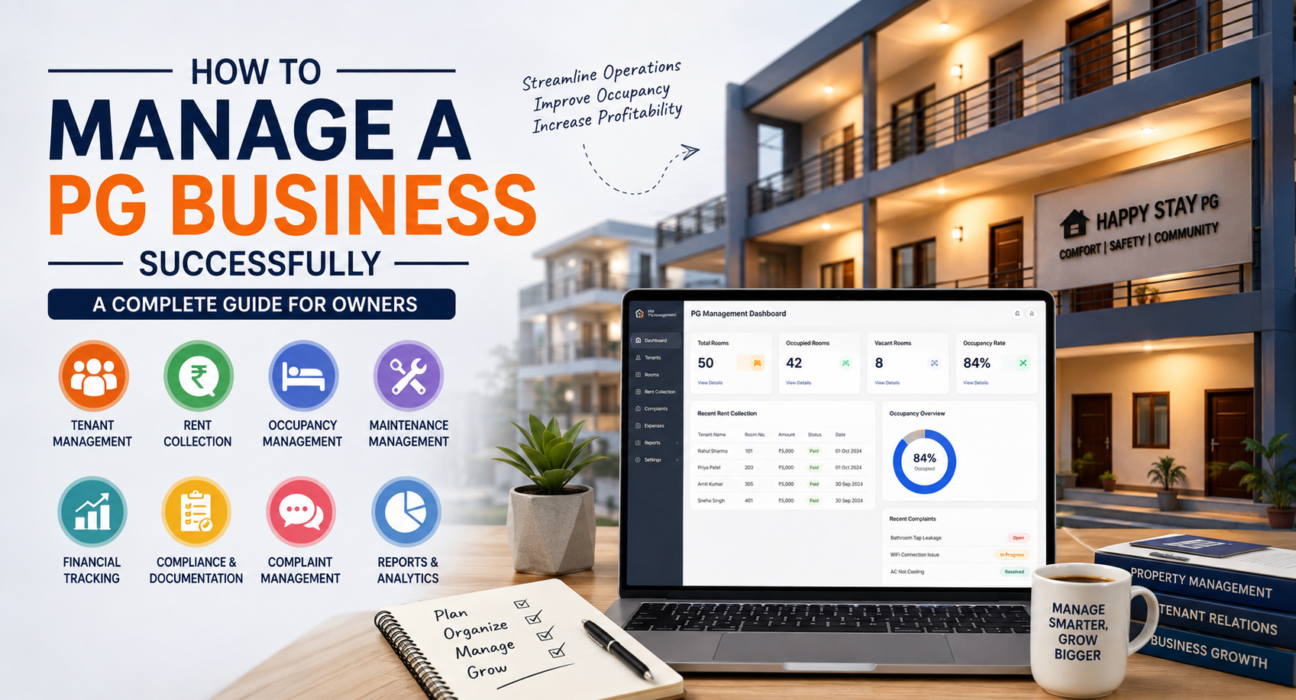
PG business management is fundamentally about balancing multiple operational areas at the same time. A successful PG business requires:
- Efficient tenant management – keeping tenant records organised, handling complaints, and ensuring smooth relationships
- Reliable rent collection – tracking payments, sending reminders, and managing payment methods
- Occupancy improvement – filling vacant rooms quickly while reducing turnover costs
- Property maintenance – keeping the property in good condition to attract quality tenants
- Financial tracking – monitoring income, expenses, and profits
- Compliance management – following local regulations and maintaining proper documentation
Moreover, the complexity increases when managing multiple properties or dealing with high tenant turnover. Therefore, many PG owners find that manual processes – spreadsheets, notebooks, and phone calls – create bottlenecks and increase the risk of missed rent payments or administrative errors.
Key Challenges in Running a PG Business
Understanding common obstacles helps you prepare solutions before problems arise.
Tenant Management Complexity
Managing diverse tenants with varying needs, backgrounds, and communication preferences is challenging. Additionally, you need to:
- Keep accurate tenant profiles and contact information
- Track lease agreements and renewal dates
- Handle complaints and maintenance requests quickly
- Manage move-ins and move-outs efficiently
- Address conflicts between tenants
When tenant data is spread across multiple sources, you risk losing important information and failing to respond to critical issues fast. As a result, tenant satisfaction decreases.
Rent Collection Issues
Delayed or missed payments directly impact your cash flow and business success. Additionally, common problems include:
- Tenants forgetting payment dates
- Uncertainty about who has paid and who hasn’t
- Manual reminder processes that take too much time
- Difficulty tracking payments across multiple channels (cash, UPI, bank transfer)
- Payment disputes and confusion
Furthermore, late payments can strain your finances and limit your ability to maintain the property.
Occupancy Fluctuations
Vacant rooms represent lost money. Therefore, managing occupancy effectively requires:
- Real-time visibility into room availability
- Quick turnaround on vacancy notifications to potential tenants
- Understanding seasonal occupancy patterns
- Tracking how long rooms remain vacant
- Adjusting pricing or marketing strategy based on occupancy data
Essential Steps to Manage a PG Business Successfully
1. Set Clear House Rules and Policies
First, establishing and communicating clear expectations prevents conflicts and creates a professional environment.
Key policies to document:
- Guest policies and overnight visitor restrictions
- Noise and disturbance guidelines
- Common area usage and cleanliness standards
- Parking and vehicle policies
- Check-in and check-out times
- Pet policies (if applicable)
- Utility consumption expectations
- Complaint resolution process
Additionally, distribute a written document to every tenant at move-in. Clear rules minimise disputes, ensure tenant satisfaction, and protect your property.
2. Implement Systematic Tenant Screening
Quality tenants reduce future problems. Therefore, a structured screening process should include:
- Background check – verify identity and employment
- Reference verification – contact previous landlords or employers
- Financial capability assessment – ensure the tenant can afford rent consistently
- In-person meeting – evaluate reliability and professionalism
- Document review – collect government ID, contact details, and emergency contacts
As a result, investing time upfront in tenant selection saves significant headaches later.
3. Streamline Rent Collection Process
Efficient rent collection maintains cash flow and reduces administrative work. Additionally, streamlining this process is critical for your business success.
Best practices:
- Set a fixed payment date – consistency reduces confusion and helps tenants remember
- Offer multiple payment methods – UPI, bank transfers, and cash provide flexibility
- Automate reminders – send payment reminders 3-5 days before the due date
- Maintain transparent records – keep a clear log of who paid, when, and how much
- Follow up promptly – contact tenants immediately if payment is overdue
- Document agreements – have written rent agreements specifying payment terms
Furthermore, many PG owners find that implementing systematic rent tracking reduces delays significantly. In fact, organised payment systems can improve collection rates by up to 30%.
4. Maintain Detailed Tenant Records
Comprehensive tenant records are essential for compliance, dispute resolution, and operational efficiency. Therefore, proper record-keeping is non-negotiable.
Critical information to maintain:
- Full name, contact number, and emergency contacts
- Government ID proof and copies
- Current address and previous addresses
- Employment details and workplace contact
- Rent amount, payment date, and lease duration
- Lease agreement and terms
- Move-in date and property condition (with photos)
- Any complaints, maintenance requests, or incidents
- Payment history
Additionally, digital record-keeping is more reliable than physical files and enables quick access when needed. As a result, you can resolve disputes faster and support tenant requests promptly.
5. Track Occupancy and Room Availability
Real-time occupancy visibility helps you identify vacant rooms quickly and reduce lost money. Therefore, tracking this data is essential for profitability.
Track:
- Current occupancy rate (percentage of rooms occupied)
- Vacancy duration for each empty room
- Average time to fill a vacant room
- Seasonal occupancy patterns
- Tenant turnover rates
Moreover, understanding these numbers helps you:
- Identify operational problems
- Plan maintenance during low-occupancy periods
- Adjust pricing strategy based on demand
- Forecast money more accurately
6. Monitor Expenses and Profitability
Successful PG management requires understanding your financial performance. Therefore, tracking expenses is critical for long-term success.
Key expenses to track:
- Maintenance and repairs
- Utilities (electricity, water, internet)
- Staff salaries (if applicable)
- Property taxes and insurance
- Cleaning and housekeeping
- Marketing and tenant acquisition
Additionally, calculate your profit margin by subtracting total expenses from total rental income. Surprisingly, many PG owners neglect expense tracking and therefore don’t know their true profitability.
Using Technology for PG Business Management
Managing a PG business manually becomes increasingly difficult as your property grows. Therefore, technology simplifies operations significantly.
What PG management software can help with:
- Centralised tenant database – Store all tenant information in one secure location
- Automated rent reminders – Send payment reminders automatically on fixed dates
- Payment tracking – Record and monitor rent payments across multiple channels
- Occupancy management – Track vacant and occupied rooms in real time
- Complaint management – Log, assign, and track resolution of tenant complaints
- Expense tracking – Record and sort expenses for accurate profit analysis
- Reports and insights – Generate data on occupancy, money, and operational performance
- KYC management – Keep compliant tenant documentation organised
Furthermore, PGCRM provides PG and hostel management software designed to address these operational needs. As a result, owners can bring together information, automate rent tracking, and gain visibility into property performance-all from a single platform. This helps you save time and make better business decisions.
Common Mistakes to Avoid
Learning from others’ mistakes accelerates your success. Here are the most common errors:
- Ignoring proper documentation – Lack of written agreements leads to disputes. Therefore, always maintain clear lease agreements.
- Poor tenant screening – Rushing through tenant selection often results in problematic occupants. Additionally, invest time in verification upfront.
- Inconsistent rent collection – Allowing flexible payment dates creates confusion. Therefore, maintain a consistent payment schedule.
- Neglecting property maintenance – Small issues become expensive repairs. Therefore, address maintenance quickly and proactively.
- Not tracking expenses – Without expense monitoring, you won’t understand your true profitability. Additionally, you may overspend without realising it.
- Avoiding communication – Regular tenant communication prevents misunderstandings and builds trust. Moreover, it improves tenant satisfaction and retention.
- Manual-only operations – Spreadsheets and notebooks scale poorly. Therefore, use technology early to avoid operational chaos as you grow.
FAQ
Q1: How should I set the rent amount for my PG?
Research local market rates for similar properties in your area. Additionally, consider location, amenities, tenant demographics, occupancy rates, and maintenance costs. Therefore, price competitively to attract tenants while ensuring profitability. Finally, monitor market trends quarterly and adjust rates for new tenants accordingly.
Q2: What should I do if a tenant consistently pays rent late?
First, send a formal written notice specifying the payment due date and consequences of non-payment. Moreover, if the pattern continues, discuss it directly with the tenant to identify obstacles. Additionally, include late payment penalties in your lease agreement. Finally, if issues persist, consider non-renewal when the lease expires.
Q3: How can I reduce vacancy periods?
Maintain property quality, set competitive pricing, and market actively on local platforms. Additionally, respond quickly to enquiries and build a waiting list of potential tenants during high-occupancy periods. Furthermore, offer incentives like a discounted first month for referrals.
Q4: What legal documents do I need for a PG business?
You need a written lease agreement, property registration documents, house rules, KYC forms for tenants, maintenance logs, and financial records. Moreover, consult a local legal professional to ensure compliance with local regulations.
Q5: Should I hire staff for my PG?
For a small PG (5-10 rooms), you might manage operations yourself. However, beyond that, hiring help for cleaning, maintenance, and tenant coordination becomes necessary. Therefore, assess your workload and growth plans before hiring.
Q6: How often should I increase rent?
Annual rent reviews are standard in most markets. Additionally, increases typically range from 5-10% depending on local inflation, property improvements, and market conditions. Therefore, provide advance notice as required by local law.
Q7: What’s the best way to handle tenant complaints?
First, document all complaints with dates and details. Additionally, respond promptly—ideally within 24-48 hours. Moreover, resolve legitimate issues quickly to maintain tenant satisfaction. Finally, track complaint patterns to identify systemic problems.
Conclusion
Successfully managing a PG business requires balancing tenant satisfaction, financial discipline, operational efficiency, and strategic growth. Therefore, by implementing clear policies, simplifying rent collection, maintaining organised records, and tracking key numbers, you create a sustainable business model that attracts quality tenants and generates consistent income.
Moreover, the operational complexity of PG management increases significantly as your property grows. Therefore, many successful PG owners use technology to automate administrative tasks, bring together information, and gain real-time visibility into their business performance. Explore PGCRM to discover how PG and hostel management software can simplify your daily operations, reduce administrative burden, and help you focus on growth and tenant satisfaction.
Remember: the foundation of a successful PG business is organised operations, clear communication, and a commitment to maintaining both your property and tenant relationships.