Introduction
Most PG owners know their total monthly expenses. Far fewer know what it costs to keep a single bed running. That number matters, because it tells you the minimum rent you need to stay profitable, and it shows which buildings are quietly losing money. Your PG operating cost per bed is the total cost of running a property for a month, divided by its number of beds.
This guide walks you through which costs to include, the exact formula, and a worked example with real-looking numbers. You will also learn how to use the result to set rent and cut waste. Keeping expenses organised in PG and hostel management software makes this calculation much easier, though the method works with any clean records.
What Is PG Operating Cost Per Bed?
PG operating cost per bed is the monthly cost of running a PG divided by its total beds. It includes recurring expenses like electricity, staff, food, maintenance, and rent or lease, but not one-time setup costs or refundable deposits.
Think of it as the price of keeping one bed available for a month, whether or not it is occupied. Once you know it, you can compare it with the rent you charge to see your margin on every bed.
Step 1: List Every Monthly Operating Cost
Accuracy starts with a complete list. Missing even one category will understate your cost per bed and make your PG look more profitable than it is.
Fixed costs
These stay roughly the same every month, regardless of occupancy:
- Building rent or lease payment (if you do not own the property)
- Staff salaries (manager, cook, housekeeping, security)
- Internet and broadband
- Property tax or society maintenance charges
- Insurance, if you have it
- Software subscriptions
Variable costs
These change with occupancy and usage:
- Electricity and water
- Food and kitchen supplies
- Housekeeping consumables
- Gas
- Laundry, if provided
Irregular costs
These do not occur every month but must be included:
- Repairs and maintenance
- Furniture and appliance replacement
- Painting and touch-ups
- Marketing, listing fees, or broker charges
Spread irregular costs across the year. If you spend ₹60,000 on repairs and painting annually, add ₹5,000 to each month.
What to leave out
- Refundable security deposits. They are not income or expense.
- One-time setup costs. Initial furnishing and deposits paid to the landlord belong in your investment calculation, not monthly operating cost.
- Personal or unrelated expenses.
- Loan principal repayment. Track it separately, though interest may be treated as a cost depending on how you view the business.
Step 2: Use the Formula
Monthly operating cost per bed = Total monthly operating cost ÷ Total number of beds
Use total beds, not occupied beds. Your costs exist whether a bed is filled or not, so total beds gives the true cost of capacity.
There is a second useful figure:
Operating cost per occupied bed = Total monthly operating cost ÷ Occupied beds
This shows your cost per paying tenant. It is always higher than cost per bed unless you are fully occupied.
Step 3: Work Through an Example
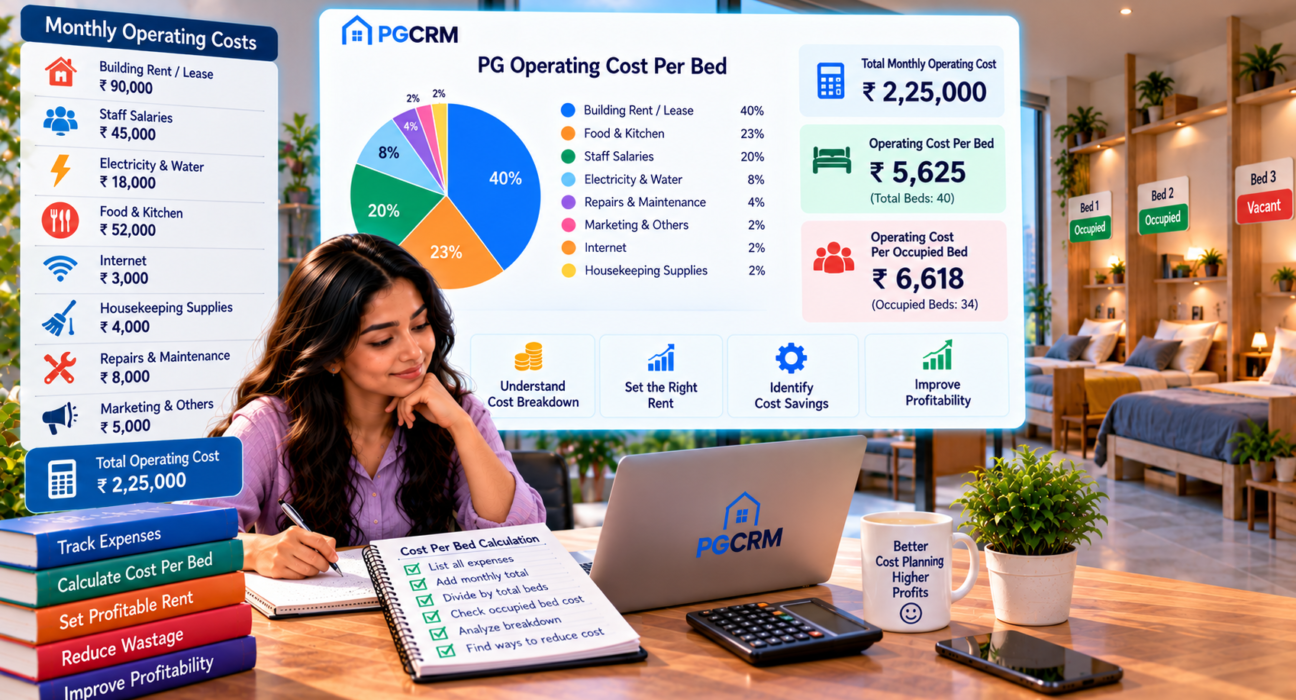
The figures below are illustrative, not real data. Imagine a 40-bed PG with 34 occupied beds.
| Cost category | Monthly amount |
|---|---|
| Building lease | ₹90,000 |
| Staff salaries | ₹45,000 |
| Electricity and water | ₹18,000 |
| Food and kitchen | ₹52,000 |
| Internet | ₹3,000 |
| Housekeeping supplies | ₹4,000 |
| Repairs and maintenance (monthly average) | ₹8,000 |
| Marketing and other | ₹5,000 |
| Total operating cost | ₹2,25,000 |
Cost per bed = ₹2,25,000 ÷ 40 = ₹5,625
Cost per occupied bed = ₹2,25,000 ÷ 34 = ₹6,618 (approximately)
The owner needs to earn more than ₹5,625 per bed just to break even at full occupancy. At 34 occupied beds, each paying tenant must contribute about ₹6,618 for the property to cover costs. If the average rent is ₹6,500, this PG is losing money even though 85% of its beds are filled.
Step 4: Break the Cost Down by Category
A single total is useful, but the category split shows where to act. Calculate each category per bed.
| Category | Monthly cost | Cost per bed | Share of total |
|---|---|---|---|
| Lease | ₹90,000 | ₹2,250 | 40% |
| Food and kitchen | ₹52,000 | ₹1,300 | ~23% |
| Staff | ₹45,000 | ₹1,125 | 20% |
| Electricity and water | ₹18,000 | ₹450 | 8% |
| Repairs | ₹8,000 | ₹200 | ~4% |
| Other | ₹12,000 | ₹300 | ~5% |
The lease is 40% of the cost here, so the best savings may come from negotiation, sharing arrangements, or higher occupancy, not from trimming small items.
Step 5: Compare Cost Per Bed With Rent Per Bed
Once you have your cost, compare it with your income.
Profit per bed = Average rent collected per bed − Operating cost per bed
Use rent actually collected, divided by total beds. Pending or unpaid rent does not pay your bills.
Using the example above, suppose the PG collected ₹204,000 in rent:
- Rent per total bed = ₹204,000 ÷ 40 = ₹5,100
- Profit per bed = ₹5,100 − ₹5,625 = −₹525
The property is running at a monthly loss of ₹21,000. Two things would help: higher occupancy and better collection. Both are covered below.
Step 6: Find Your Break-Even Occupancy
Break-even occupancy is the number of filled beds needed to cover your operating costs.
Break-even beds = Total monthly operating cost ÷ Average rent per occupied bed
If the average rent per occupied bed is ₹6,000:
- Break-even beds = ₹225,000 ÷ ₹6,000 = 37.5, so about 38 beds
- Break-even occupancy = 38 ÷ 40 = 95%
That is a tight margin. It tells the owner that occupancy alone may not solve the problem. Pricing or costs likely need attention too. Remember that variable costs such as food change with occupancy, so treat this as an estimate.
How to Reduce Your PG Operating Cost Per Bed
You can lower the cost per bed in two ways: cut costs or spread them across more beds.
Raise occupancy.
Fixed costs like lease and salaries do not drop when beds are empty. Filling vacant beds lowers cost per occupied bed without cutting any expense. Shorten the gap between a tenant leaving and the next one joining.
Control electricity and water
- Check for appliances left on in empty rooms.
- Track usage month to month and investigate spikes.
- Fix leaks and faulty fittings early.
Manage food costs carefully
- Track how much food is prepared versus eaten.
- Plan menus around seasonal, affordable ingredients.
- Compare supplier prices regularly.
Right-size your staff
Compare staff cost per occupied bed across your properties. A large gap may show over-staffing or under-utilised roles.
Prevent big repairs with small fixes
Regular maintenance is usually cheaper than emergency repairs. Log complaints and close them quickly so small issues do not become expensive ones.
Improve rent collection.
Cost per bed stays the same whether tenants pay on time or not. But late rent hurts cash flow and can make you delay payments to suppliers or staff. Send reminders before the due date and follow up promptly.
Common Mistakes When Calculating PG Operating Cost Per Bed
- Dividing by occupied beds only. This hides the cost of vacancy.
- Forgetting irregular expenses. Repairs and replacements are real costs, even if they are not monthly.
- Including deposits. Refundable deposits are not income or expense.
- Ignoring owner-paid costs. Utilities and small repairs you pay personally still count.
- Using one month only. Use a three-to-six-month average to smooth out spikes.
- Not assigning shared costs. If one cost covers two buildings, split it consistently, for example by bed count.
How PG Management Software Helps
Calculating operating cost per bed is simple maths. The hard part is having accurate records in one place. Expenses noted in notebooks, WhatsApp messages, and scattered spreadsheets are easy to lose or misclassify.
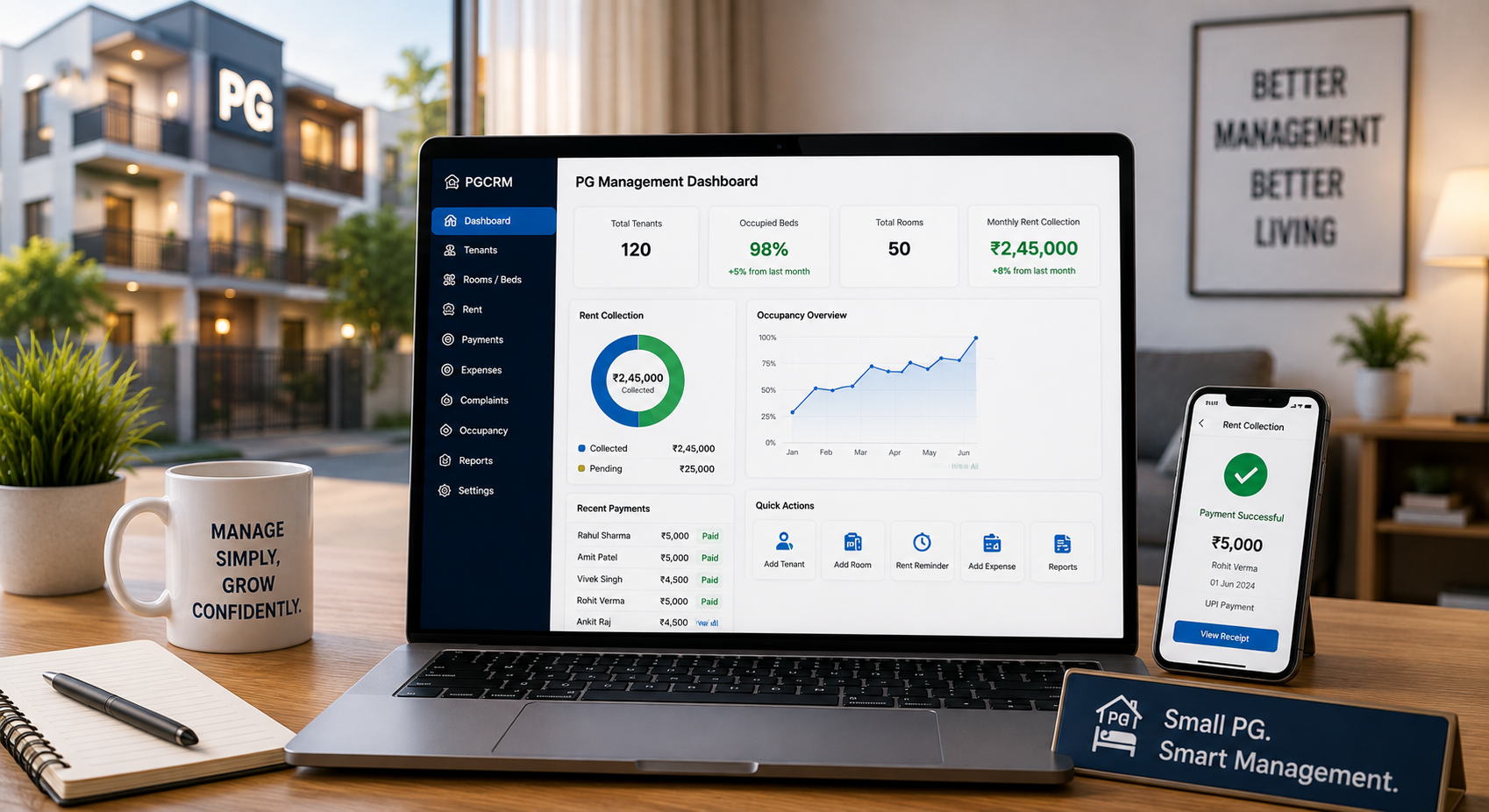
PG management software such as PGCRM can help by keeping your buildings, rooms, beds, tenants, and rent in one system. According to the PGCRM website, it supports expense tracking by category and building, along with occupancy reports and income and expense reports. That gives you the total expense figures and bed counts you need, ready for each property. For owners with several buildings, a single view across properties makes it easier to compare cost per bed side by side.
| Task | Registers and spreadsheets | PG management software |
|---|---|---|
| Recording expenses by category | Manual, easily inconsistent | Recorded by category and building |
| Counting total and occupied beds | Counted by hand | Available in occupancy reports |
| Month-end totals | Time-consuming | Faster, from recorded data |
| Comparing multiple buildings | Difficult | One view across buildings |
Software does not lower your costs on its own. It shows you where the money goes so you can act on it.
Frequently Asked Questions
How do I calculate operating cost per bed in a PG?
Add all recurring monthly costs, including lease, staff, electricity, food, maintenance, and other expenses, then divide by the total number of beds. Use total beds, not occupied beds, to capture the cost of vacancy. Spread irregular costs such as repairs across twelve months for an accurate monthly figure.
What expenses should be included in PG operating cost?
Include building lease or rent, staff salaries, electricity, water, internet, food, housekeeping supplies, repairs, marketing, and society or property charges. Exclude refundable security deposits, one-time setup costs, and personal expenses. Add irregular costs, such as painting or appliance replacement, as a monthly average.
Should I divide by total beds or occupied beds?
Use both, for different purposes. Total beds gives the true cost of your capacity and is best for comparing properties. Occupied beds gives cost per paying tenant, which shows the rent each tenant must contribute for you to break even. Together they reveal the effect of vacancy.
What is a good operating cost per bed for a PG?
There is no universal figure. It varies with city, location, lease terms, food service, and staffing. Instead of chasing an outside benchmark, track your own cost per bed monthly and compare it across your properties. The key test is whether rent collected per bed comfortably exceeds it.
How can I reduce my PG operating cost per bed?
Fill vacant beds quickly, since fixed costs are then shared among more tenants. Track electricity and water use, control food wastage, review staffing levels, and fix small maintenance issues before they grow. If you rent the building, renegotiating the lease can have the largest effect.
How often should I calculate operating cost per bed?
Calculate it every month, and review a three-to-six-month average each quarter. Monthly figures help you spot sudden spikes in cost. The longer average smooths out irregular expenses and seasonal changes, giving you a more reliable basis for pricing decisions.
Can PG software help me track operating costs?
Yes. Software that records expenses by category and building, and tracks beds and occupancy, gives you the numbers needed for this calculation. PGCRM, for example, offers expense tracking, occupancy reports, and income and expense reports, which can reduce the manual work of gathering figures each month.
Conclusion
Your PG operating cost per bed tells you the true price of keeping a bed available each month. Add every recurring cost, divide by total beds, and compare the result with the rent you actually collect. That comparison shows your real margin, your break-even point, and where to cut costs or raise occupancy.
Reliable numbers depend on organised records. To keep expenses, beds, tenants, and rent in one place, explore PGCRM to simplify your PG and hostel management.