Best Telecalling Software in India: Top 10 Tools for Sales Teams
Most Indian sales teams do not lose deals because their callers are lazy. They lose deals because a lead came in at 11 a.m., nobody was assigned to it, the follow-up was noted in a personal diary, and by the time someone called back the customer had already spoken to three competitors.
That gap is what telecalling software closes. Instead of leads sitting in Excel sheets and WhatsApp groups, the system captures every enquiry, assigns it to a caller, dials it, records the outcome and reminds the team when the next call is due. Teams that want telecalling software features such as auto-dialling, lead distribution and call reporting in one place usually move off spreadsheets within a month.
This guide compares ten tools used by Indian sales teams and gives you a practical way to shortlist.
What Is Telecalling Software?
Telecalling software is a system that helps sales teams manage outbound and inbound calls along with the leads behind them. It combines a dialer, lead records, call outcomes, follow-up reminders and reporting in one place, so managers can see how many calls were made, what happened on each one, and which leads need attention next.
It is different from a plain phone system. A phone system connects the call. Telecalling software connects the call and keeps the customer’s history, the caller’s notes and the next action attached to it. That is why most Indian tools in this category are sold as a telecaller CRM.
Best Telecalling Software in India: Quick Comparison
| Tool | Best suited for | Standout strength |
|---|---|---|
| TeleCallingCRM | Small and mid-size Indian sales teams | Flat team pricing with AI call analysis included |
| TeleCRM | WhatsApp-heavy sales teams | Lead capture plus WhatsApp automation |
| NeoDove | Growing telecalling teams | Dialer with plan-based user bundles |
| Runo | Mobile-first field and inside sales | SIM-based calling with AI call summaries |
| Callyzer | Teams that mainly need call monitoring | SIM-based call tracking and reports |
| Kylas | SMEs scaling beyond basic calling | Full sales CRM with unlimited-user pricing |
| LeadSquared | High-volume enquiry businesses | Lead routing across large distributed teams |
| Zoho CRM | Businesses already using Zoho | CRM with click-to-dial via telephony partners |
| CallHippo | Teams calling multiple geographies | Cloud phone system with call routing |
| MyOperator | Inbound-heavy businesses | Cloud calling, IVR and WhatsApp together |
Top 10 Telecalling Software Tools in India
1. TeleCallingCRM
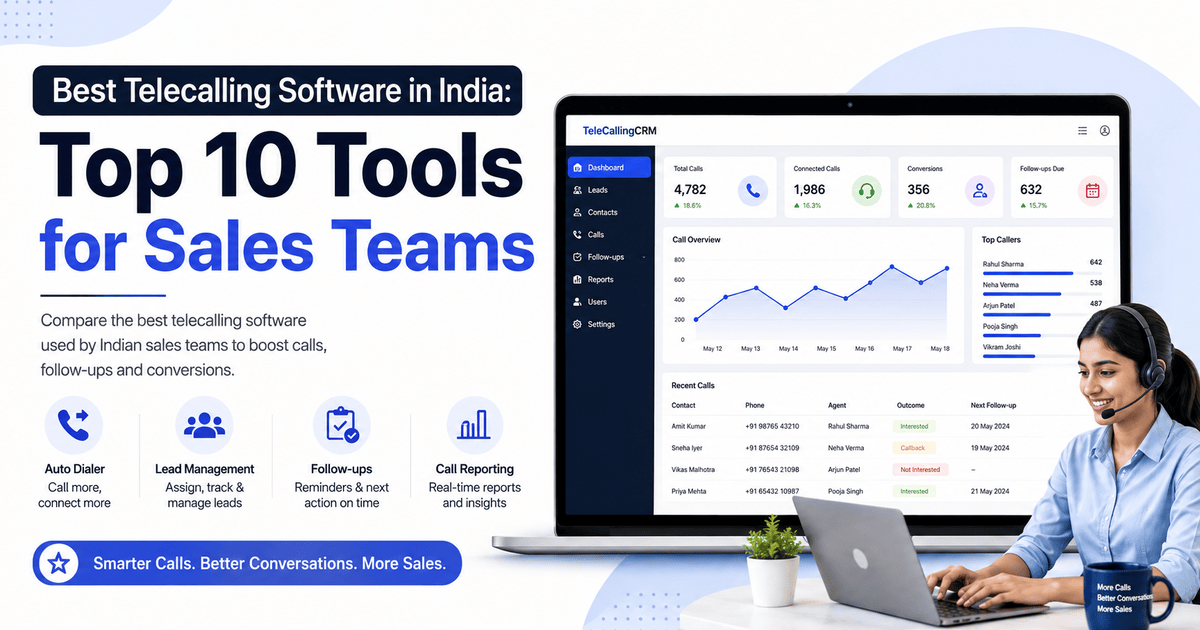
TeleCallingCRM is built specifically for Indian outbound sales teams. It combines a smart auto dialer, SIM-based one-click dialling, lead import with auto-assignment rules, follow-up reminders, a live monitoring dashboard and reporting in one product. Call recordings are stored encrypted, and DNC list enforcement is built in. AI call analysis — transcription in English, Hindi and Hinglish, plus summaries, sentiment and a quality score — is included rather than sold as an add-on.
Best for: small and mid-size Indian teams that want dialling, follow-ups and reporting in one tool at a fixed monthly cost.
Pricing model: flat monthly plans by team size rather than per user (Basic ₹999, Pro ₹1,599, Enterprise ₹2,999 per month), with a 3-day free trial.
2. TeleCRM
TeleCRM focuses on Indian teams that sell over phone and WhatsApp together. It offers a one-click dialer, call tracking and recording, automated lead capture from websites, Facebook and other sources, and WhatsApp templates, chatbots and broadcasts.
Best for: teams whose customers reply faster on WhatsApp than they answer calls.
Pricing model: a pro plan on quarterly and annual terms; rates shared on request.
3. NeoDove
NeoDove positions itself as a telecalling dialer and CRM combined. Plans cover dialling, lead management, customer engagement, team management, reporting and integrations, with contact limits, pipelines and workflows varying by plan.
Best for: teams that want a bundled annual plan covering a fixed number of users.
Pricing model: annual plans that include up to 10 or up to 20 users, with WhatsApp API, IVR and VoIP charged separately.
4. Runo
Runo is a mobile-first, SIM-based call management CRM. Calls go through the caller’s own SIM rather than an internet line, which suits areas with unreliable data connectivity. It includes auto-dialling, lead allocation, follow-up reminders, live team dashboards, AI call summaries and sentiment analysis.
Best for: field sales and inside sales teams that work primarily from mobile phones.
Pricing model: shared on request, with a 10-day free trial.
5. Callyzer
Callyzer is a SIM-based call monitoring tool rather than a full sales CRM. It tracks incoming, outgoing, missed and connected calls in real time, syncs recordings, sends daily email reports and supports lead assignment and CRM integration via API.
Best for: managers whose first problem is visibility — knowing how many calls actually happened — not pipeline management.
Pricing model: shared on request, with a free trial.
6. Kylas
Kylas is a sales CRM for growing Indian businesses. It covers pipeline management, lead routing, unified tracking of calls, email, WhatsApp and SMS, mobile apps, dashboards and a large integration marketplace. Calling runs through telephony integrations rather than being the core product.
Best for: SMEs that have outgrown a calling-only tool and need proper deal and pipeline management.
Pricing model: plans priced by team size with unlimited users, starting at ₹12,999 per month as listed on its site.
7. LeadSquared
LeadSquared is an enquiry-to-conversion platform used heavily in education, financial services, healthcare and automotive. Its strength is handling large lead volumes across distributed teams — intelligent routing, multi-channel engagement, field team tools and call sentiment insights.
Best for: organisations running large counselling, admissions or loan sales operations.
Pricing model: quoted based on modules and team size.
8. Zoho CRM
Zoho CRM is a general-purpose sales CRM with telephony through partner providers. It supports click-to-dial, automatic call logging against the right record and call transcription, so calls sit alongside deals, emails and tasks.
Best for: businesses already using Zoho products that want calling attached to an existing CRM.
Pricing model: per-user plans, with telephony billed separately by the connected provider.
9. CallHippo
CallHippo is a cloud business phone system rather than a CRM. It provides virtual numbers, HD calling, call routing by skill, language or availability, recording with transcription, an omnichannel inbox and CRM integrations.
Best for: teams calling customers in several countries, or support-and-sales teams that need routing rules.
Pricing model: tiered plans with a 10-day free trial; enterprise quotes on request.
10. MyOperator
MyOperator combines cloud calling with the WhatsApp Business API in one platform. It offers IVR, virtual numbers, call recording, multi-agent WhatsApp chat, broadcasts, bot building, unified analytics and integrations with tools like Zoho and Freshdesk.
Best for: businesses where inbound calls and WhatsApp enquiries matter as much as outbound dialling.
Pricing model: shared on request, with a free trial available.
How to Choose Telecalling Software for Your Team
Work through these questions in order. They matter more than feature lists.
- Outbound or inbound? Outbound teams need dialers, lead distribution and follow-up discipline. Inbound-heavy businesses need IVR, routing and missed-call handling.
- SIM-based or cloud calling? SIM dialling works on ordinary mobile networks and is cheaper to start. Cloud calling gives virtual numbers and routing but needs stable internet.
- How will leads reach the system? If enquiries come from Facebook Ads, Google Ads, 99acres, MagicBricks, JustDial or your website, check those sources connect directly.
- Per-user or flat pricing? Per-user pricing punishes you for adding callers. Flat team pricing usually wins past five or six users — our side-by-side comparison pages show how the gap adds up over a year.
- What will the manager look at daily? Ask to see the live dashboard and the daily report during the demo, not just the dialer.
- Will callers use it on mobile? If your team calls from phones, a weak mobile app kills adoption however good the web version is.
A useful test: import 100 real leads during the trial and run one full working day on the tool. Adoption problems show up in a day, never in a feature list.
Common Mistakes Teams Make
- Buying for features nobody uses. Most teams need dialling, follow-ups and reports done well. Advanced automation can wait.
- Ignoring per-user cost at scale. A ₹899 per user plan looks small until you have twelve callers.
- Not planning data migration. Clean your old Excel sheets before import, or duplicates and dead numbers follow you into the new system.
- Skipping caller training. If callers do not log outcomes, your reports are worthless.
- Treating call recordings casually. They contain personal data and need controlled access and retention rules.
Telecalling and TRAI Compliance in India
Commercial calling in India is regulated. Under amendments to the Telecom Commercial Communications Customer Preference Regulations (TCCCPR), 2018 notified by TRAI in February 2025, promotional calls must use the 140 number series and transactional or service calls the 1600 series, ordinary 10-digit numbers cannot be used for telemarketing, the consumer complaint window was extended to seven days, and a sender cannot approach a customer for consent for 90 days after that customer opts out.
In practice, your telecalling software should support DNC list enforcement, consent records and recording retention controls. Verify these before you buy, especially in insurance, lending or real estate.
Where TeleCallingCRM Fits
TeleCallingCRM is built for Indian teams that call a lot and want costs to stay predictable as the team grows. Plans are priced per team rather than per user, so adding a caller does not change the bill — useful in industries like real estate, education, insurance and loan DSA, where telecalling headcount moves up and down through the year.
A hypothetical example: a real estate team of eight runs portal leads from 99acres and MagicBricks. Leads import automatically, get distributed by assignment rules, callers dial from the mobile app and log outcomes in one tap, and the manager reviews connection rates and pending follow-ups each evening. The same pattern fits an admissions team or a loan DSA desk.
If you are still comparing categories rather than tools, our guide on how to choose the best telecalling CRM goes deeper into evaluation criteria.
Frequently Asked Questions
What is the best telecalling software in India for small teams?
For small teams, the best option is usually one with flat pricing, a simple mobile dialer and built-in follow-up reminders. Tools such as TeleCallingCRM, TeleCRM, NeoDove and Runo are all built for Indian small and mid-size sales teams rather than large enterprises.
What is the difference between telecalling software and a CRM?
A CRM stores customer and deal information. Telecalling software adds the calling layer — dialer, call outcomes, recordings, follow-up scheduling and caller productivity reports. Most Indian telecalling tools now combine both, which is why they are often called telecaller CRM or CRM for telecallers.
How much does telecalling software cost in India?
It depends on the pricing model. Flat team plans start from around ₹999 per month, while per-user CRM plans usually run from a few hundred to over a thousand rupees per user per month. Compare the annual cost for your actual team size, including add-ons like WhatsApp API or IVR.
Is SIM-based calling better than cloud calling?
It depends on your situation. SIM-based calling uses the caller’s mobile network, works in low-internet areas and is cheaper to start. Cloud calling gives virtual numbers, IVR and advanced routing, but needs reliable internet. Outbound teams often prefer SIM-based; inbound-heavy businesses prefer cloud.
Can telecalling software record calls legally in India?
Call recording is common in Indian sales operations, but recordings hold personal data and need consent, restricted access and defined retention periods. Choose software that supports encrypted storage, deletion requests and DNC enforcement, and check your obligations under TRAI’s commercial communication rules.
Which industries use telecalling software the most?
Real estate, education, insurance, lending and loan DSA, healthcare, recruitment and B2B sales are the heaviest users, because all of them depend on fast first calls and disciplined follow-ups.
Do I need telecalling software if my team is only three people?
Often yes, but for a different reason. With three callers the problem is not monitoring, it is memory — missed callbacks and lost numbers.
Conclusion
There is no single best telecalling software in India. The right choice depends on whether you call more than you receive, whether your team works on mobile or desktop, where your leads come from and how fast your headcount changes.
Shortlist two or three tools, run a real trial day with real leads, and check the annual cost for the team size you expect six months from now — not the one you have today. If predictable flat pricing matters to that decision, you can review the telecalling CRM plans and compare them against the per-user options in this list.