How to Measure Telecaller Productivity and Performance
A sales manager looks at two telecallers. One makes 150 calls a day. The other makes 80. On paper, the first telecaller looks more productive. But the second one closes three times as many deals.
This is the trap most businesses fall into when they measure telecaller productivity by call count alone. Real productivity is not about how many numbers an agent dials. It is about how effectively those calls move leads towards a sale.
This becomes much easier to track when your team uses telecalling software that logs every call, connection and outcome automatically, instead of relying on manual registers or spreadsheets that agents fill in themselves.
What Does Telecaller Productivity Actually Mean?
Telecaller productivity is the measure of how effectively a telecaller converts working time and available leads into meaningful business outcomes — connected calls, qualified leads, follow-ups completed and deals closed. It is not simply the volume of calls made in a day.
A productive telecaller does three things well:
- Reaches the right leads at the right time
- Has meaningful conversations, not just dials
- Moves leads forward in the sales process
Businesses that only track call volume often reward the wrong behaviour. An agent can inflate their numbers by dialling wrong numbers, disconnected leads, or making very short calls that go nowhere.
Why Measuring This Correctly Matters
Sales managers across real estate, insurance, education, healthcare, recruitment and financial services depend on telecalling teams to generate revenue. If productivity is measured badly, three things go wrong:
- Good agents look average. An agent handling complex, high-value leads may make fewer calls but close more business.
- Bad habits get rewarded. Agents chase easy metrics like call count instead of quality conversations.
- Coaching goes in the wrong direction. Managers coach agents on the wrong problem because the data doesn’t show the real issue.
Getting the metrics right protects both the business and the telecaller.
Core Metrics to Measure Telecaller Productivity
Below are the metrics that genuinely reflect performance, grouped by what they measure.
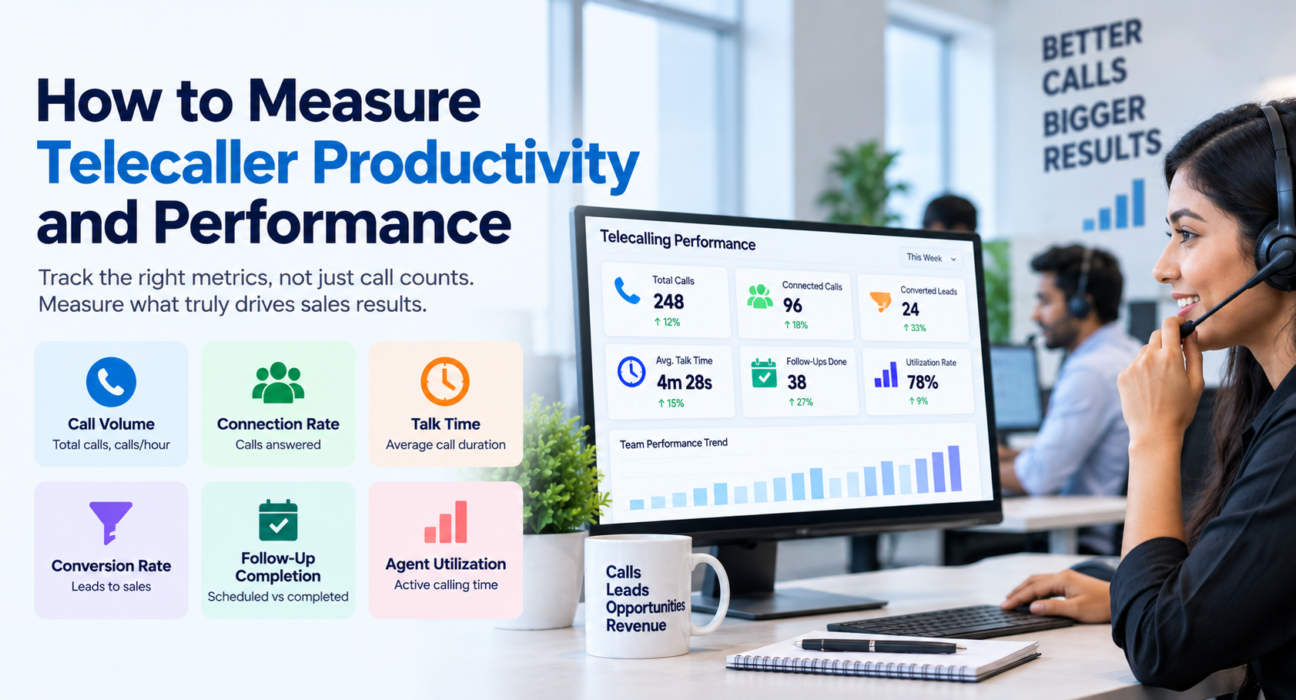
1. Call Volume Metrics
These tell you how much work is happening, but not how good it is.
| Metric | What It Shows |
|---|---|
| Total calls made | Overall activity level |
| Calls per hour | Dialing pace and idle time |
| Outbound vs inbound calls | Balance of proactive vs reactive work |
Call volume is a starting point, not a conclusion. Two agents with identical call counts can have very different results.
2. Connection Metrics
This is where real productivity starts to show up.
- Connection rate: Percentage of dialled calls that actually connect to a person.
- Answer rate: Percentage of connected calls where the lead engages, versus a quick hang-up.
Formula:
Connection Rate = (Connected Calls ÷ Total Calls Dialled) × 100
A low connection rate usually points to bad data (wrong numbers, old leads) rather than a lazy agent. This is one reason lead quality and CRM data hygiene matter as much as agent effort.
3. Talk Time and Utilization
- Average talk time per call: Very short calls often mean the agent isn’t engaging properly. Very long calls on simple queries can mean poor script discipline.
- Utilization rate: Time spent actively calling versus total logged-in time.
Formula:
Utilization Rate = (Total Talk Time ÷ Total Logged-in Time) × 100
An agent logged in for 8 hours but only talking for 90 minutes has a utilization problem, even if their call count looks fine on a report.
4. Conversion Metrics
These connect calling activity to actual business results.
- Lead-to-conversion rate: Percentage of leads that convert to the next stage (qualified, demo booked, sale closed).
- Call-to-conversion rate: Percentage of calls that directly result in progress on a lead.
Formula:
Conversion Rate = (Converted Leads ÷ Total Leads Handled) × 100
This is usually the single most important number for sales managers, because it reflects revenue impact, not just effort.
5. Follow-Up Discipline
Most sales are lost not on the first call but on the follow-up that never happened.
- Follow-up completion rate: Scheduled follow-ups actually completed on time.
- Overdue follow-ups: Callbacks that were missed or delayed.
A telecaller with a high conversion rate but poor follow-up discipline is often sitting on leads that will go cold soon. Tracking this consistently needs a lead follow-up software that reminds agents automatically, rather than depending on personal memory or sticky notes.
6. Quality Metrics
Numbers alone don’t capture how a call actually went.
- Call quality score: Based on script adherence, tone, and handling of objections.
- Customer sentiment: Whether the lead’s response was positive, neutral or negative.
Manually reviewing every call for quality isn’t realistic for most teams. This is why many businesses now rely on AI-based call analysis that scores calls automatically and flags coaching opportunities, instead of a supervisor randomly sampling a handful of calls each week.
A Simple Way to Combine These Metrics
No single metric tells the full story. A practical approach is to track a small dashboard per agent, rather than one “productivity score.”
| Category | Metric | Why It Matters |
|---|---|---|
| Activity | Calls per day | Shows effort and pace |
| Connection | Connection rate | Shows lead quality and timing |
| Engagement | Average talk time | Shows conversation depth |
| Utilization | Talk time vs logged-in time | Shows idle time |
| Outcome | Conversion rate | Shows business impact |
| Discipline | Follow-up completion rate | Shows consistency |
| Quality | Call score / sentiment | Shows conversation effectiveness |
When these are viewed together, a manager gets a realistic picture instead of chasing one inflated number.
Real-World Examples
Example 1 — Real Estate:
A real estate telecaller makes 60 calls a day, lower than the team average of 100. But their connection rate is 70% (against a team average of 40%) because they call during the evening, when property buyers are actually free. Their conversion rate is also the highest on the team. Call volume alone would have made this agent look average.
Example 2 — Insurance:
An insurance telecaller has a high call count and high connection rate, but a very short average talk time. Their conversion rate is below average. Quality scoring reveals the agent is rushing through calls without asking discovery questions. The fix here is coaching on conversation quality, not adding more leads.
Example 3 — Education:
An admissions telecaller has excellent conversion rates but a poor follow-up completion rate. Parents who need three or four conversations before enrolling are being missed on the second or third callback. Fixing the follow-up process, not the pitch, solves this.
These are illustrative scenarios, not case studies of any specific business.
Common Mistakes When Measuring Telecaller Productivity
- Judging performance by call count alone. This rewards volume over value.
- Ignoring lead quality differences. An agent working cold, purchased leads will naturally have lower conversion than one working warm, referred leads.
- Not tracking follow-ups separately from first calls. Most conversions happen on later touches, not the first call.
- Relying on manual call logs. Self-reported numbers are inconsistent and hard to audit.
- Comparing agents without accounting for lead assignment. If leads aren’t distributed fairly, productivity comparisons are misleading.
- Ignoring talk time and quality. High activity with low engagement often signals a training gap, not a hard worker.
How Businesses Can Implement Better Measurement
- Log calls automatically instead of asking agents to note down outcomes manually.
- Track connection and conversion rates, not just call volume, on the same dashboard.
- Separate follow-up performance from first-call performance.
- Review call quality periodically, using scoring or transcripts where possible.
- Account for lead quality and source before comparing agents against each other.
- Set realistic benchmarks by industry and lead type, rather than applying one number to every team.
This is exactly where a proper CRM for telecallers becomes useful, since it can capture call duration, connection outcomes, follow-up status and lead source automatically, without adding extra work for the agent.
How TeleCalling CRM Supports Productivity Measurement
TeleCalling CRM is built for outbound calling teams and includes features relevant to this kind of measurement:
- A live dashboard showing connection rate, answer rate, talk time and pipeline in real time
- Automatic call-duration capture from the phone’s call log, so numbers aren’t self-reported
- Follow-up scheduling with overdue alerts, so missed callbacks are visible
- AI call analysis that generates a summary, sentiment and a quality score for every call, without manual review
- A leaderboard that can be ranked by calls, talk time, conversions or revenue, not call count alone
- A live “war room” view showing which agents are on a call, idle, or away, along with attendance and utilization
These features are built into the platform and are not a substitute for good management judgement — the data still needs a manager who reads it in context.
FAQs
What is the best metric for telecaller productivity?
There is no single best metric. Connection rate, conversion rate and follow-up completion rate together give a realistic picture. Relying only on call count usually rewards the wrong behaviour.
How many calls should a telecaller make in a day?
This depends on the industry, lead type and call length. A real estate or insurance telecaller working detailed leads may realistically make 60–100 calls a day, while a shorter-cycle product may support 150 or more. Use it as a baseline, not a target in isolation.
What is a good connection rate for telecalling?
A connection rate of 35–50% is common for cold, purchased leads. Warm or referred leads typically see 60% or higher. Rates vary by industry and lead source, so compare against your own historical data rather than a fixed number.
How is telecaller conversion rate calculated?
Conversion rate is calculated as (Converted Leads ÷ Total Leads Handled) × 100. “Converted” can mean different things depending on the business — a qualified lead, a booked demo, or a closed sale — so define it clearly before tracking it.
Should call quality be measured manually or with software?
Manual review works for small teams but doesn’t scale. For larger teams, automated call scoring or AI-based analysis makes it possible to review every call instead of a small sample.
Why do some low-call-count agents perform better than high-call-count agents?
Usually because they connect with better-qualified leads, spend more time per conversation, or follow up more consistently. Call count alone doesn’t capture any of this.
What tools help track telecaller productivity accurately?
CRM systems built specifically for outbound calling, rather than generic CRMs or spreadsheets, are usually better suited since they log calls, connections and follow-ups automatically instead of depending on manual entry.
Conclusion
Measuring telecaller productivity properly means looking past call counts and towards outcomes — connections, conversions, follow-up discipline and call quality. Businesses that track only volume end up coaching the wrong agents and rewarding the wrong habits.
The most reliable way to get this right is to remove manual reporting from the picture. When call logging, follow-up tracking and quality scoring happen automatically through sales calling software, managers get accurate data to coach with, and telecallers get judged on real performance instead of guesswork.