Tele Calling CRM helps sales teams track every customer interaction, follow-up, and conversation without letting important details slip through the cracks.
Every sales call matters. But what happens after the call ends? Most tele calling teams struggle with this part. Agents forget to update notes. Managers have no idea what was promised to a customer. Follow-ups get missed. And deals fall through the cracks.
This is exactly the problem a tele calling CRM solves.
A good CRM for tele calling does not just store contact numbers. It records what happened in every interaction, who spoke to whom, what was discussed, and what needs to happen next. If you are managing a tele sales team or a call center, this kind of visibility changes everything.
What Is a Tele Calling CRM?
A tele calling CRM is a customer relationship management tool built specifically for phone based sales and support teams. It connects your calling process with your customer data so that every call, every follow-up, and every update gets logged automatically.
Unlike a general CRM, a tele calling CRM is designed around the way agents work. It shows the customer’s history before the call even begins. It records the conversation. It reminds the agent to call back at a specific time. And it gives managers a clear view of what the entire team is doing on any given day.
Why Tracking Every Interaction Is So Important
Think about a typical tele sales setup. You have 20 agents making 100 calls each per day. That is 2,000 customer interactions happening every single day. Without a system to track all of this, things break down fast.
Here is what usually goes wrong without proper tracking:
The same customer gets called multiple times by different agents because no one updated the status. A customer who said “call me next Tuesday” never gets that call because the agent forgot to set a reminder. A prospect who was almost ready to buy goes cold because there was a gap in follow-up. And when a manager asks why a deal was lost, nobody can give a clear answer.
With customer tracking in tele CRM, every one of these problems gets addressed. The system creates a clear record of each customer’s journey, and the entire team can see it.
How a Tele Calling CRM Tracks Customer Interactions
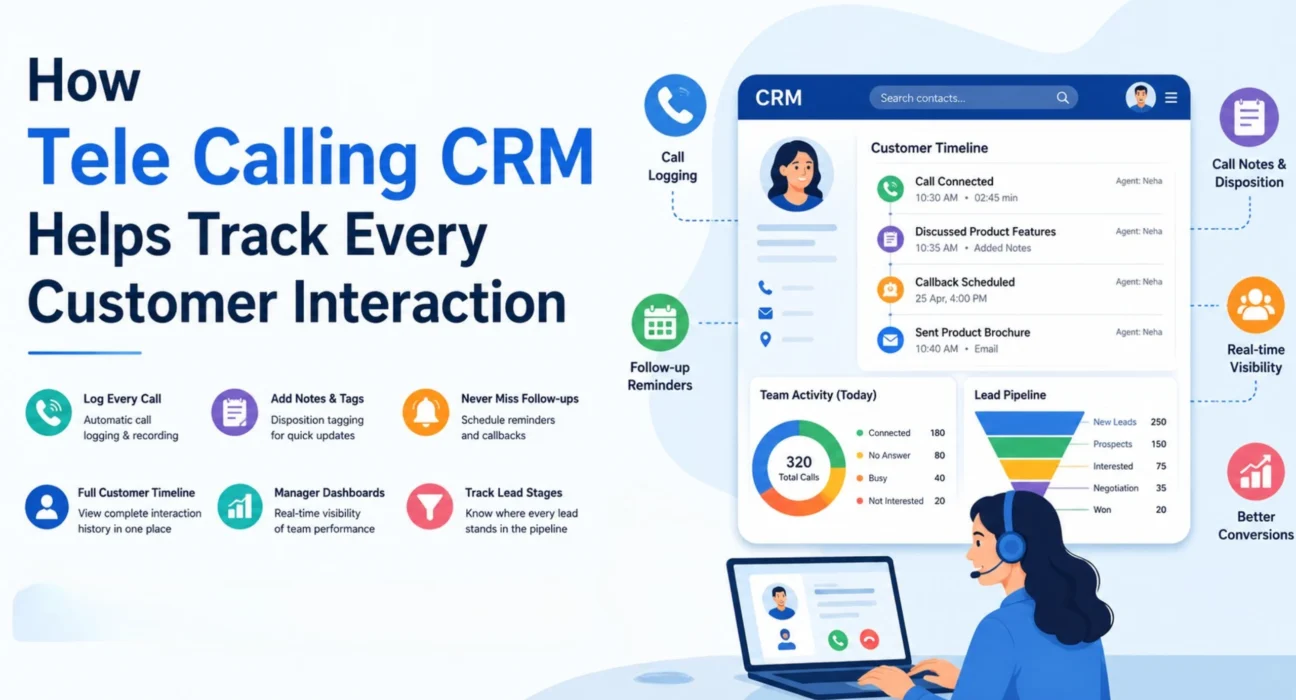
1. Automatic Call Logging
Every time an agent makes or receives a call, the CRM logs it. The date, the time, the duration, and the outcome are all recorded without the agent having to do anything manually. This alone removes a lot of human error from the process.
Some CRMs also allow call recordings to be saved directly against the contact record. So if there is ever a dispute or a manager wants to review a call for training, it is all right there.
2. Call Notes and Disposition Tagging
After a call, agents can add notes and mark the outcome. This is usually called call disposition. Was it a successful connect? Did the customer ask for a callback? Were they not interested? Did they request more information?
These tags help the team understand where every lead stands without having to read through paragraphs of notes. A quick glance at the disposition tells the story.
3. Follow-Up Reminders and Task Scheduling
One of the strongest features of a tele CRM is the ability to schedule the next action right after a call ends. If the customer says to call back on Friday afternoon, the agent sets that reminder in the CRM before the call even ends. When Friday arrives, the CRM puts that task on the agent’s screen automatically.
This is how no shows and forgotten follow-ups get eliminated. The system does the remembering so the agent does not have to.
4. Full Customer Timeline
Every interaction with a customer, whether it was a call three months ago or a WhatsApp message last week, gets stored in a single timeline. When an agent opens a contact in the CRM, they can see the entire history in order.
This is helpful not just for the agent who made the last call, but for anyone on the team who picks up from where the previous person left off. The customer does not have to repeat themselves. The agent already knows the background.
5. Real-Time Manager Dashboards
Good tele calling CRMs give managers a live view of what is happening across the team. How many calls have been made today? Which agents have the most pending follow-ups? How many leads are stuck without an update for more than three days?
These dashboards help managers spot problems early instead of finding out at the end of the month that something went wrong two weeks ago.
6. Lead Stage Tracking
Most tele sales processes have a pipeline. A lead starts as a fresh contact, then becomes a prospect after the first call, then moves to negotiation, and finally either converts or is marked as lost. The CRM tracks which stage every lead is in and shows how long they have been sitting there.
If a lead has been in the “interested” stage for two weeks without any movement, that is a signal that someone needs to step in. Without a CRM, this kind of visibility is almost impossible to maintain manually.
The Difference It Makes in Day-to-Day Operations
A tele calling team that uses a CRM to track every interaction operates very differently from one that relies on spreadsheets or just memory.
The agents feel more confident because they can see exactly what they said last time. The managers spend less time chasing updates because the data is already there. The customers feel better served because the agent they speak to already knows their story. And the business gets cleaner data to make decisions about where to focus the team’s effort.
For Indian tele sales teams especially, where volumes are high and the customer base is spread across cities and languages, having this kind of structure is not a luxury. It is a basic requirement.
Does a Tele Calling CRM Work for Small Teams Too?
Absolutely. The idea that CRMs are only for large call centers is a common myth. Even a team of five agents making 50 calls a day generates a lot of data. Without a system to organize it, that data either gets lost or becomes unmanageable.
A small team can actually benefit more from a tele CRM because each agent carries a heavier individual responsibility. If one person misses a follow-up, it shows up quickly. A CRM gives every team member the structure to stay on top of their work without needing a manager to constantly check in.
How to Get the Most Out of Customer Tracking in a Tele CRM
Having the tool is only the first step. The real value comes from how consistently the team uses it.
A few things that make a difference: Train agents to update call dispositions before moving to the next call. Make it a team norm that no lead stays without an update for more than 24 hours. Use the reports every week, not just at the end of the month. And when a deal is lost, actually look at the call history to understand what could have been done differently.
Over time, these habits turn the CRM from a simple tracking tool into a system that improves how the entire team sells.
Conclusion
A tele calling CRM is the backbone of any phone based sales operation that wants to grow without losing quality. It tracks every call, every follow-up, and every customer update so that nothing gets missed. For managers, it brings visibility. For agents, it brings structure. And for customers, it creates a smoother experience because the people they speak with are actually informed and prepared.
If your team is still relying on spreadsheets or informal tracking to manage tele calling, it is worth looking at what a dedicated CRM can do. Consistent customer tracking in tele CRM is what separates teams that hit their numbers from those that keep losing leads to poor follow-up. The difference in consistency and conversion rates is usually noticeable within the first month of proper use.