Introduction
Every PG owner eventually faces the same question: should tenants pay rent in cash, or should you switch entirely to UPI? The answer affects how much time you spend chasing payments, how accurate your records are, and how easily you can prove income if a dispute or tax query comes up. This article breaks down PG rent collection through cash and UPI, compares them across the factors that actually matter to PG owners, and explains how PG and hostel management software can make either method easier to track.
You’ll learn the real advantages and drawbacks of each method, how to choose based on your property size and tenant profile, and practical steps to reduce late payments regardless of which mode you use.
Why the Rent Collection Method Matters for PG Owners
PG rent collection isn’t just about receiving money. It affects three things directly:
- Cash flow predictability: how reliably rent arrives on the same date each month.
- Record-keeping accuracy: whether you can quickly answer “who paid”, “how much”, and when”.
- Tenant trust and convenience: whether the payment process feels easy or frustrating for residents.
Many PG owners run properties with a mix of long-term working professionals, students, and short-stay tenants. Each group may prefer a different payment mode, which is why understanding both cash and UPI in detail helps you design a collection process that actually works.
Cash Rent Collection: Strengths and Limitations
How Cash Collection Works in Practice
Cash collection is the traditional method most PGs started with. The owner or a designated staff member collects rent in person, usually on a fixed date each month, and issues a handwritten or printed receipt.
Direct answer: Cash rent collection means physically collecting currency notes from tenants, which requires manual tracking, in-person visits, and separate bookkeeping to avoid errors or disputes.
Advantages of Cash Collection
- No dependency on technology or internet connectivity, which helps in areas with unreliable network access.
- Immediate settlement, no waiting for bank processing or payment gateway delays.
- Familiar to tenants who are less comfortable with digital payments, such as some older tenants or those new to a city.
Drawbacks of Cash Collection
- Manual record-keeping increases the risk of human error, missed entries, or disputes over “I already paid” claims.
- No automatic timestamp or digital trail, making it harder to prove payment history if questions arise later.
- Requires physical presence, which is inconvenient when tenants are travelling or when owners manage multiple properties.
- Higher risk of cash handling issues, including misplaced cash, theft, or counting errors.
- Difficult to reconcile at scale. As the number of beds grows, manually cross-checking who has paid becomes time-consuming.
UPI Rent Collection: Strengths and Limitations
How UPI Collection Works in Practice
UPI (Unified Payments Interface) lets tenants transfer rent directly to the owner’s or PG’s bank account using apps like Google Pay, PhonePe, Paytm, or a bank’s own UPI app. Payments can be requested via a UPI ID, QR code, or payment link.
Direct answer: UPI rent collection allows tenants to pay rent digitally in seconds using their phone, with an automatic transaction record maintained by the bank and the payment app.
Advantages of UPI Collection
- Instant digital record of every transaction, including date, time, and amount.
- No physical cash handling, reducing the risk of loss or theft.
- Convenient for tenants, who can pay remotely without visiting the owner in person.
- Easier reconciliation, especially when payments are linked to tenant management records.
- Supports partial payments and reminders, which is useful when tenants pay in instalments.
Drawbacks of UPI Collection
- Requires tenants to have a working UPI app and bank account, which may not apply to every resident, particularly some students or first-time earners.
- Dependent on network connectivity and app uptime. Server downtime or poor connectivity can delay payments.
- Transaction limits may apply for certain UPI apps or bank accounts, which can affect high-value rent payments in some cases.
- Requires tenants to actively remember and initiate payment, similar to cash, unless reminders or auto-debit options are used.
Cash vs UPI: A Side-by-Side Comparison
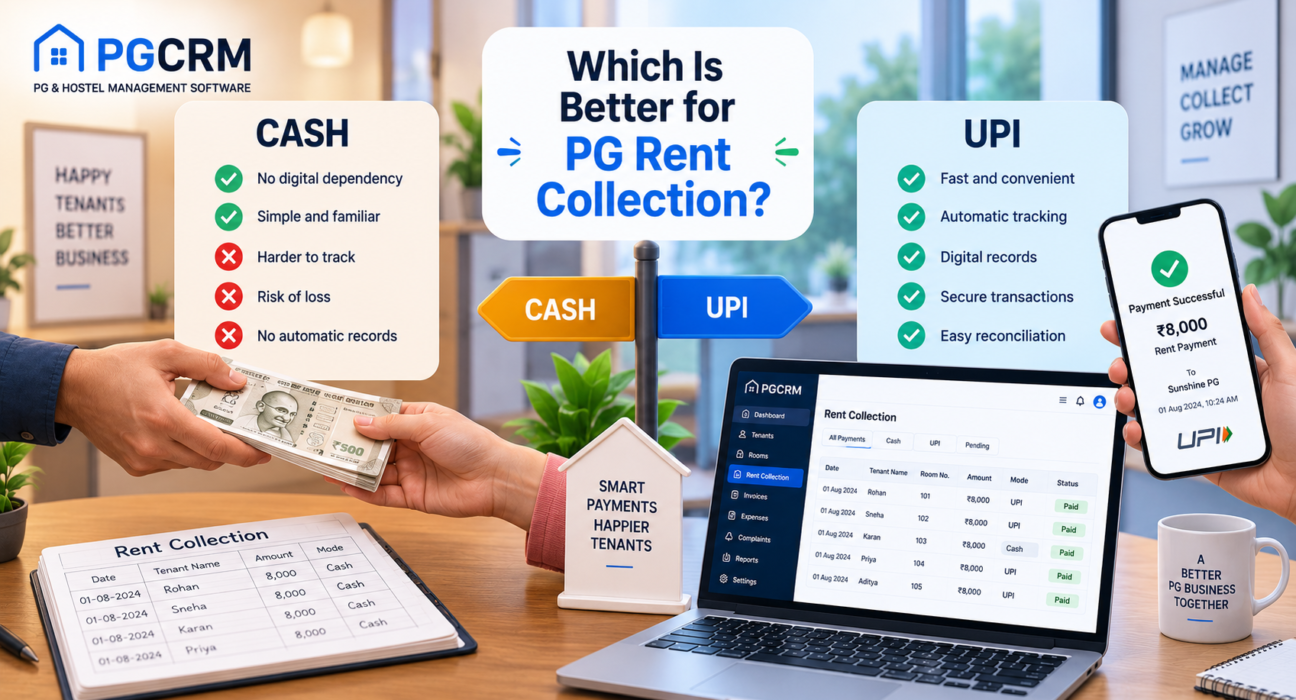
| Factor | Cash Collection | UPI Collection |
|---|---|---|
| Record-keeping | Manual, prone to errors | Automatic digital trail |
| Speed of payment | Immediate, in-person | Instant, remote |
| Tenant convenience | Requires physical presence | Pay from anywhere. |
| Traceability | Low, depends on receipts | High, transaction history available |
| Dependency | No internet needed | Needs internet and UPI app |
| Scalability across multiple properties | Difficult | Easier to manage centrally |
| Risk of loss/theft | Present | Minimal |
Which One Should PG Owners Choose?
There is no single correct answer for every property. The right choice depends on your tenant profile, property size, and how much time you can dedicate to manual tracking.
Choose cash primarily if:
- Most of your tenants are unfamiliar with digital payments.
- Your PG is small enough that manual tracking is manageable.
- You operate in an area with inconsistent internet access.
Choose UPI primarily if:
- You manage multiple rooms, floors, or properties and need centralised visibility.
- Your tenants are working professionals or students comfortable with digital payments.
- You want reduced cash-handling risk and faster reconciliation.
In practice, many PG owners use a hybrid approach, accepting both cash and UPI, based on tenant preference, while still maintaining a single, consistent record of who has paid.
Why a Hybrid Approach Often Works Best
Rather than forcing every tenant onto one payment method, many successful PG operators accept both cash and UPI but standardise how payments are recorded. This avoids alienating tenants who prefer cash while still gaining the traceability benefits of digital payments for the majority who use UPI.
The main challenge with a hybrid approach is keeping records consistent across both payment types. This is where a PG management system becomes useful — it allows owners to log cash payments and UPI payments in the same place, so there’s a single, reliable view of rent status regardless of how each tenant pays.
How PG Management Software Simplifies Rent Collection
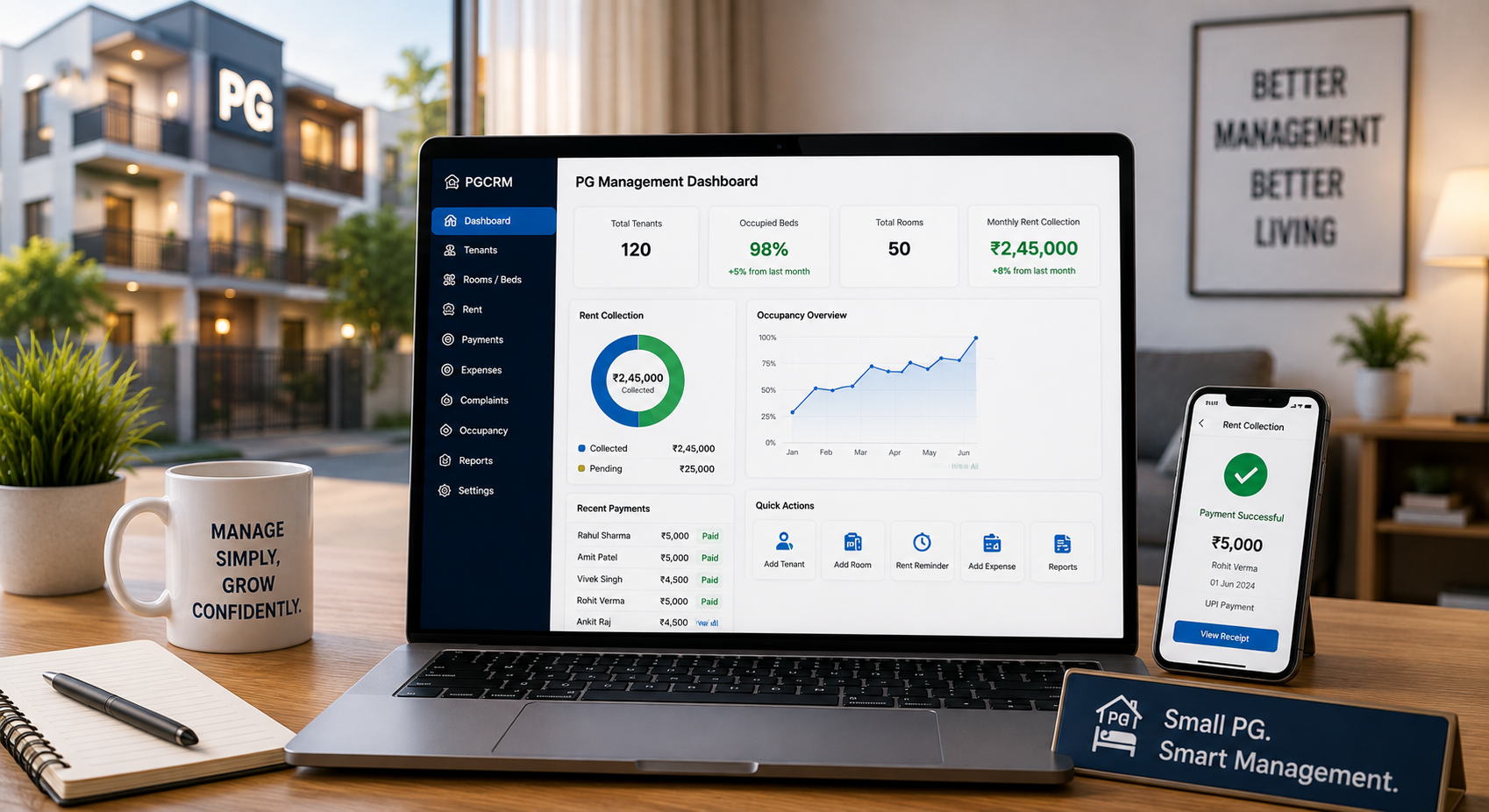
Regardless of whether you collect rent in cash, UPI, or both, tracking payments manually across spreadsheets, notebooks, or messaging apps becomes harder as your PG grows. Using PG management software such as PGCRM can help owners centralise tenant records, rent tracking, occupancy information, and daily operations in one place.
Specifically, this kind of platform can help with:
- Recording both cash and UPI payments in a single tenant ledger, so nothing gets missed regardless of payment mode.
- Sending rent reminders to reduce late payments and follow-up calls.
- Maintaining tenant records and KYC details alongside payment history for quick reference.
- Tracking occupancy and room/bed status, which ties directly into who owes rent and when.
- Generating reports that give a clear view of collected, pending, and overdue rent across the property.
This doesn’t replace the decision of choosing cash or UPI; it simply ensures that whichever method your tenants use, you have one accurate, centralised record instead of scattered notes.
Common Mistakes PG Owners Make with Rent Collection
- Not issuing or logging receipts for cash payments, leading to disputes later.
- Mixing personal and PG bank accounts for UPI collection, making reconciliation harder.
- Relying on memory or informal notes instead of a structured tenant ledger.
- Not setting a fixed rent due date, which causes inconsistent payment timing across tenants.
- Failing to follow up early on late payments, which increases the chance of prolonged non-payment.
Addressing these issues regardless of payment mode significantly reduces the operational stress of PG rent collection.
Frequently Asked Questions
Is UPI safer than cash for PG rent collection? UPI is generally considered safer in terms of traceability and reduced handling risk, since every transaction creates a digital record. Cash carries a higher risk of loss, theft, or disputes without proper receipts. However, UPI safety also depends on using a verified UPI ID and a secure banking app.
Can PG owners accept both cash and UPI from tenants? Yes, many PG owners accept both. The key is maintaining a consistent record of all payments in one place, regardless of the method used, so rent status remains accurate and easy to track across the property.
Does UPI rent collection help with tax records? UPI transactions automatically generate a timestamped digital trail through your bank statement, which can support income documentation. Cash payments require manual receipts to serve a similar purpose. For specific tax guidance, consult a qualified professional or refer to official Income Tax Department resources.
What is the biggest challenge with cash rent collection? The biggest challenge is manual tracking. Without a structured system, it becomes difficult to confirm who has paid, avoid disputes, and reconcile total collections, especially as the number of tenants grows.
How can PG owners reduce late rent payments? Setting a clear due date, sending timely reminders, and following up early on overdue payments are the most effective steps. Using a PG rent collection system that flags pending or overdue rent can also help owners act before payments are significantly delayed.
Is UPI reliable for large PGs with many tenants? UPI scales well for larger PGs because payments can be tracked digitally without needing in-person collection from every tenant. However, it works best when paired with a centralised system to record and reconcile payments across all rooms and floors.
Should new PG owners start with cash or UPI? New PG owners should assess their tenant profile first. If tenants are primarily students or working professionals comfortable with digital payments, starting with UPI can reduce early operational overhead. If not, a hybrid approach with structured record-keeping is a safer starting point.
Conclusion
Both cash and UPI have a place in PG rent collection, and the right choice depends on your tenants’ preferences, your property size, and how much manual effort you’re willing to manage. UPI offers stronger traceability and convenience, while cash remains necessary for tenants who aren’t comfortable with digital payments. What matters most is consistent, accurate record-keeping regardless of the method used. Explore PGCRM to simplify your PG and hostel management, from tracking rent payments to managing tenant records and occupancy in one centralised system.