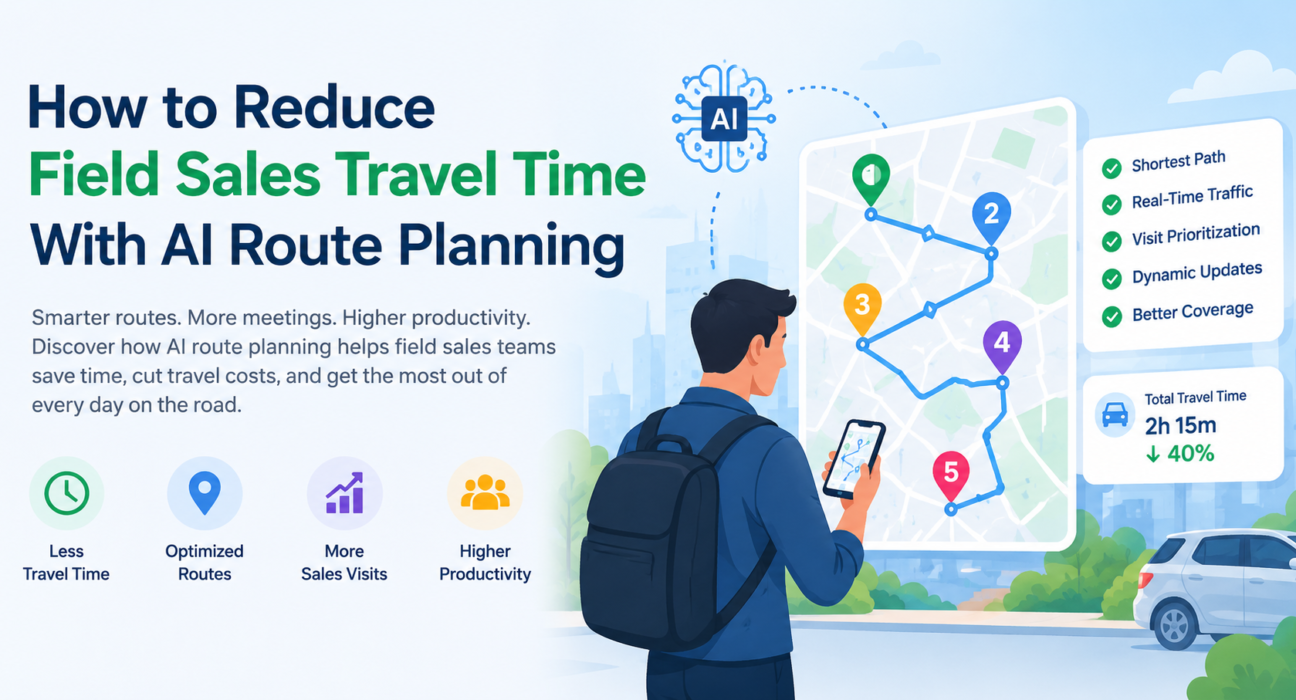
How to Reduce Field Sales Travel Time With AI Route Planning
A field sales rep who spends two extra hours a day driving between stops isn’t lazy — they’re following a route nobody optimized. Multiply that across a team of twenty reps, and you’re losing hundreds of selling hours every month to inefficient travel. Learning how to reduce field sales travel time with AI route planning is one of the fastest ways to fix this, since it calculates the shortest, smartest path between visits automatically instead of leaving it to guesswork or gut feel.
This article breaks down why field sales teams lose so much time on the road, how AI route planning solves the problem, and what to look for when choosing a route optimization tool for your team.
Why Field Sales Reps Lose So Much Time to Travel
Selling time is the most valuable resource a field sales team has, and it shrinks fast once you account for driving, parking, waiting, and rescheduling. Industry research consistently shows that field reps spend well under half their working day on actual selling activity, with the rest consumed by administrative work, data entry, and travel between accounts.
Several factors quietly eat into a rep’s day:
- Unplanned or reactive routes. Reps often decide their next stop on the fly, which leads to backtracking and zigzagging across a territory instead of a logical path.
- Manual scheduling. Building a visit plan by hand in a spreadsheet or notebook doesn’t account for real-time traffic, distance, or visit priority.
- Last-minute cancellations. Without a system to reshuffle the day, a single cancelled meeting can throw off the rest of the schedule.
- Territory sprawl. As customer bases grow, so does the geographic spread reps need to cover, making manual planning increasingly unreliable.
Field operations research backs this up: even a modest 10% improvement in route planning can free up 30–45 minutes per rep, per day — time that adds up quickly across a full team and a full month.
What Is AI Route Planning?
AI route planning is the use of artificial intelligence and algorithms to automatically calculate the most efficient sequence of stops for a field sales rep, factoring in variables like location, traffic, visit priority, and time windows.
Unlike static maps or manual planning, AI route planning continuously processes real-world data — live traffic conditions, customer location, appointment urgency, and even historical visit patterns — to recommend a route that minimizes drive time and maximizes the number of productive visits per day.
How AI Route Planning Differs From Traditional Route Planning
| Factor | Traditional Route Planning | AI Route Planning |
|---|---|---|
| Route creation | Manual, based on rep experience or memory | Automated, based on live data |
| Traffic awareness | Static or none | Real-time traffic integration |
| Adaptability | Fixed once planned | Adjusts dynamically to changes |
| Scalability | Difficult across large teams | Scales easily across territories |
| Visit prioritization | Subjective | Based on rules, SLAs, or customer value |
| Reporting | Manual logs | Automated, real-time tracking |
How to Reduce Field Sales Travel Time With AI Route Planning: 5 Ways It Works
1. It Calculates the Shortest Practical Path Automatically
Instead of a rep deciding stop order based on memory or convenience, AI route planning tools use mapping algorithms to sequence visits in the most time-efficient order — accounting for distance, road conditions, and time of day.
2. It Adapts to Real-Time Changes
If a customer cancels or a meeting runs long, AI-powered systems can recalculate the remaining route instantly, so reps don’t waste time figuring out their next best move manually.
3. It Prioritizes High-Value or Time-Sensitive Visits
Routes can be built around business rules — for example, visiting SLA-bound accounts first or grouping high-priority customers earlier in the day — so travel time is spent on the stops that matter most.
4. It Reduces Planning Time for Managers and Reps
Manually building daily beat plans for an entire team takes hours every week. AI route planning automates this process, freeing up managers to focus on coaching and performance rather than logistics.
5. It Improves Territory Coverage
By analyzing customer locations and visit frequency requirements, AI can help distribute visits more evenly across a territory, reducing the chance of reps clustering in convenient areas while under-serving farther accounts.
Step-by-Step: How to Implement AI Route Planning for Your Field Sales Team
- Map your existing territories and customer locations. Before optimizing anything, you need an accurate picture of where your accounts are and how often each needs a visit.
- Define visit priorities and rules. Decide which accounts need to be visited first — based on SLA commitments, deal size, or visit frequency — so the AI can factor this into route sequencing.
- Choose a route planning or beat planning tool. Look for software that supports GPS-based route optimization, real-time traffic data, and integration with your existing field operations workflow.
- Roll out to a pilot group first. Test the tool with a small group of reps to validate route accuracy and gather feedback before a full rollout.
- Track results against a baseline. Compare travel time, number of visits per day, and selling hours before and after implementation.
- Refine rules based on real-world performance. Adjust visit priorities and route constraints as you learn what works for your specific territories.
- Scale across the full team. Once the process is validated, extend the rollout to all field reps and territories.
Common Challenges When Reducing Field Sales Travel Time
Resistance to Changing Established Routines
Reps who’ve followed the same routes for years may be skeptical of a system-generated route, even if it’s more efficient. Clear communication about the time savings — and involving reps in the pilot phase — helps build buy-in.
Inaccurate or Outdated Customer Data
Route optimization is only as good as the location and visit-frequency data feeding it. Outdated addresses or incorrect customer details can undermine even the best routing algorithm.
Balancing Automation With Local Knowledge
AI can calculate the fastest route on paper, but reps often know practical realities — like which roads flood during monsoon season or which building has no parking. The best implementations combine AI recommendations with rep input rather than removing flexibility entirely.
Best Practices for AI Route Planning in Field Sales
- Combine route planning with visit verification. Knowing a rep took the optimal route matters less if you can’t confirm they actually completed the visit — GPS-based check-ins close that gap.
- Set realistic visit windows. Build in buffer time for unexpected delays rather than scheduling back-to-back visits with zero slack.
- Review route performance weekly. Look at completed visits versus planned visits to catch recurring bottlenecks early.
- Keep the rep experience simple. A route plan that’s difficult to follow on a mobile device defeats the purpose — the tool should be usable in the field, not just in the office.
- Align route planning with broader field force management. Route optimization works best when it’s connected to attendance, task management, and reporting, rather than operating as a standalone tool.
How Field Force Management Software Helps
Reducing travel time isn’t just a mapping problem — it touches scheduling, attendance, task assignment, and reporting. Businesses looking to simplify these processes can use field force management software such as FieldExecutives to bring AI route planning, GPS-based field employee tracking, and beat planning into a single system.
FieldExecutives supports field sales and distribution teams with structured daily beat plans for visit sequencing, geofencing and GPS tracking for accurate visit verification, and real-time reporting so managers can see how travel time and visit completion trend over time. Rather than treating route planning as an isolated tool, it connects directly to attendance, task management, and field visit records — giving both reps and managers a single, accurate view of the day.
For teams managing large or spread-out territories, this kind of integration matters more than the route calculation alone. A route is only useful if it’s tied to real visit outcomes, verified attendance, and reporting that shows whether the plan actually worked.
Measuring the Impact of AI Route Planning
Once implemented, track these metrics to understand whether route optimization is actually reducing travel time:
- Average travel time per rep, per day — compared before and after rollout
- Number of completed visits per rep, per day
- Percentage of planned visits actually completed
- Selling hours versus non-selling hours
- Fuel and vehicle costs, if applicable
Reviewing these numbers monthly helps confirm the tool is delivering measurable time savings rather than just theoretical efficiency.
Conclusion
Travel time will always be part of field sales — visiting customers in person is the job. The real issue isn’t that reps are on the road, it’s that most of that time is unplanned, reactive, and left to guesswork instead of data.
AI route planning solves this by sequencing visits based on real-time traffic, priority, and location, instead of memory or convenience. The result is fewer hours lost to backtracking, more completed visits per day, and more time available for actual selling. Combined with accurate customer data and clear visit priorities, it turns route planning from a daily headache into a repeatable, measurable process.
For businesses managing distributed field teams, this works best as part of a connected system — one where route planning, attendance, and visit verification all feed into the same reporting layer. That’s where platforms like FieldExecutives fit in, helping teams turn optimized routes into visible, trackable results rather than a one-off efficiency gain. See the full feature set on the FieldExecutives pricing page or explore how it fits different teams on the industries page.
If you’re still working out how to reduce field sales travel time with AI route planning for your own team, start small: fix your customer data, define visit priorities, and pilot the tool with a handful of reps before rolling it out company-wide.