Introduction
Most PG owners know their rent figure by heart. Fewer can tell you, without opening a notebook, what the business actually keeps after electricity, staff, repairs and the months when a few beds sit empty. That gap is where a PG business budget helps.
A budget isn’t a finance exercise for accountants. It’s a one-page plan that tells you what to expect, what you can afford and how many beds you need filled just to break even. This guide walks through it step by step, with a worked example you can copy. If you already use PG and hostel management software, you can keep your income and expense records in the same place and compare them against your plan.
What Is a PG Business Budget?
A PG business budget is a monthly plan that estimates how much money your PG will bring in, how much it will spend, and how much you’ll be left with. It covers rent income, fixed costs like building rent and salaries, variable costs like electricity and repairs, and a reserve for surprises.
Think of it as a forecast you check every month. You aren’t aiming to be perfect, only to know early when reality drifts from the plan.
Step 1: Estimate Your Income Realistically
Start with income, but be careful. This is where most budgets go wrong.
Count beds, not rooms
Your income depends on occupied beds. Multiply total beds by rent per bed to get your maximum possible income. That number is a ceiling, not a forecast.
Assume less than full occupancy.
Almost no PG stays 100% full all year. Beds go empty between tenants, and some months are slower than others. Look at your last year of records and use your actual average occupancy. If you’re new, pick a cautious number and adjust once you have real data.
Separate rent from other income
List each income source on its own line:
- Monthly rent
- Meal charges, if you serve food
- AC or other add-on charges
- Late fees or fines, if you charge them
Don’t count on late fees as planned income. They’re a bonus, not a plan.
Don’t treat deposits as income
Security deposits belong to the tenant until they leave. Treat them as money you owe, not money you’ve earned. Spending them on running costs is a common way to run into trouble when tenants move out and expect refunds.
Step 2: List Every Expense
Next, write down everything you spend, even the small items. Splitting costs into two groups makes the budget easier to read.
| Type | What it means | Examples |
|---|---|---|
| Fixed costs | Roughly the same every month, whether beds are full or empty | Building rent or loan EMI, staff salaries, internet, property tax (if you pay it monthly) |
| Variable costs | Change with usage and occupancy | Electricity, water, groceries, cleaning supplies, repairs |
| Occasional costs | Don’t happen monthly but will happen | Painting, furniture replacement, appliance repairs, licence renewals |
If you own the building, you don’t pay rent, but you may have a loan EMI or an opportunity cost. Include whichever applies so your numbers are honest.
If you want deeper detail on the big variable costs, our guides on controlling electricity, food and maintenance expenses cover them individually.
Step 3: Build a Sample Monthly Budget
Here’s a worked example using assumed figures. Replace every number with your own.
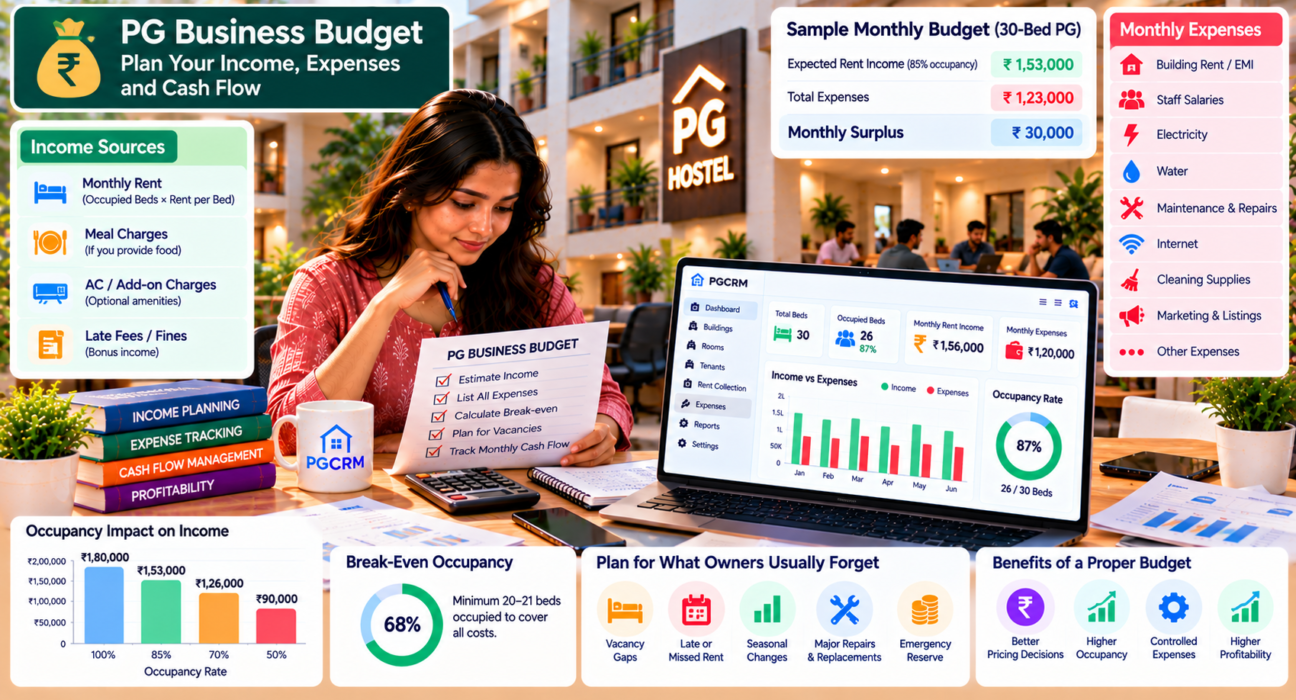
Assumptions: a leased 30-bed PG, rent of ₹6,000 per bed, no meals, and average occupancy of 85%.
| Income | Amount |
|---|---|
| Maximum rent (30 beds × ₹6,000) | ₹1,80,000 |
| Expected rent at 85% occupancy | ₹1,53,000 |
| Expense | Amount |
|---|---|
| Building rent | ₹60,000 |
| Staff (caretaker, cleaner) | ₹25,000 |
| Electricity | ₹18,000 |
| Maintenance and repairs | ₹6,000 |
| Water | ₹3,000 |
| Internet | ₹2,000 |
| Cleaning supplies and small items | ₹2,000 |
| Marketing and listings | ₹2,000 |
| Reserve fund contribution | ₹5,000 |
| Total expenses | ₹1,23,000 |
Monthly surplus: ₹1,53,000 − ₹1,23,000 = ₹30,000
That looks healthy. Now stress-test it.
What if occupancy drops to 70%?
At 70%, you’d have 21 occupied beds, and rent income of ₹1,26,000. Your expenses barely change, since most of them are fixed. You’d be left with about ₹3,000. One bad month and you’re close to zero.
This is the most important lesson in any PG business budget: empty beds hurt more than they seem, because most costs don’t shrink when tenants leave.
Step 4: Find Your Break-Even Occupancy
Break-even tells you the minimum occupancy you need to cover your costs. It’s one of the most useful numbers an owner can know.
Break-even occupancy = total monthly expenses ÷ (total beds × rent per bed)
Using the example above:
₹1,23,000 ÷ ₹1,80,000 = about 68%
So this PG needs roughly 20 to 21 of its 30 beds filled just to cover its costs. Anything above that is surplus. Anything below is a loss.
Once you know your number, decisions get simpler. If occupancy is hovering near break-even, you have a reason to focus on filling beds, trimming costs or adjusting rent, rather than adding new amenities.
Step 5: Plan for What Owners Usually Forget
A budget that only lists the obvious costs will look good on paper and fail in real life. Add these:
- Vacancy gaps. Beds sit empty between tenants. Build this into your occupancy assumption.
- Late or missed rent. Some money will arrive late. Keep enough cash to cover costs during delays.
- Seasonal changes. Demand often rises and falls through the year, depending on your tenants. Students and working professionals follow different patterns, so look at your own history.
- Big repairs. ACs, pumps, geysers and plumbing don’t fail on schedule. Set aside a monthly amount.
- Furniture and mattress replacement. Beds and mattresses wear out. Put a small amount aside each month.
- Licences, taxes and compliance. Requirements differ by city and state. Ask a local accountant or the relevant authority what applies to you, and include the costs.
- Your own pay. If you work in the PG full-time, decide what you pay yourself. Otherwise you’ll never know if the business is really profitable.
Build a reserve fund
A reserve is money set aside for unexpected costs and slow months. A common approach is to put a fixed amount aside every month, even a small one. How much to hold depends on your fixed costs and risk. Many owners aim to cover a few months of fixed costs over time, but the right number is your call.
Step 6: Compare Your Budget Against Actuals Every Month
A budget you never check is only a guess. The real value comes from comparing what you planned with what happened.
A simple monthly review
- Write down actual income and actual expenses for the month.
- Compare each line with the budget. Note what’s higher and what’s lower.
- Find the reason. Was it a one-off event, such as a big repair, or a pattern?
- Adjust next month’s budget if the pattern will continue.
- Update your reserve if you used it.
Manual vs. software-based tracking
| Notebook or spreadsheet | PG management software | |
|---|---|---|
| Recording expenses | Manual entry, easy to miss items | Recorded as they happen |
| Seeing who has paid rent | Check notes or messages | Paid and pending list in one place |
| Comparing buildings | Separate sheets | Expenses tagged by building |
| Monthly summary | Build it yourself | Reports ready to review |
| Sharing with a partner or manager | Photos or files | One shared record |
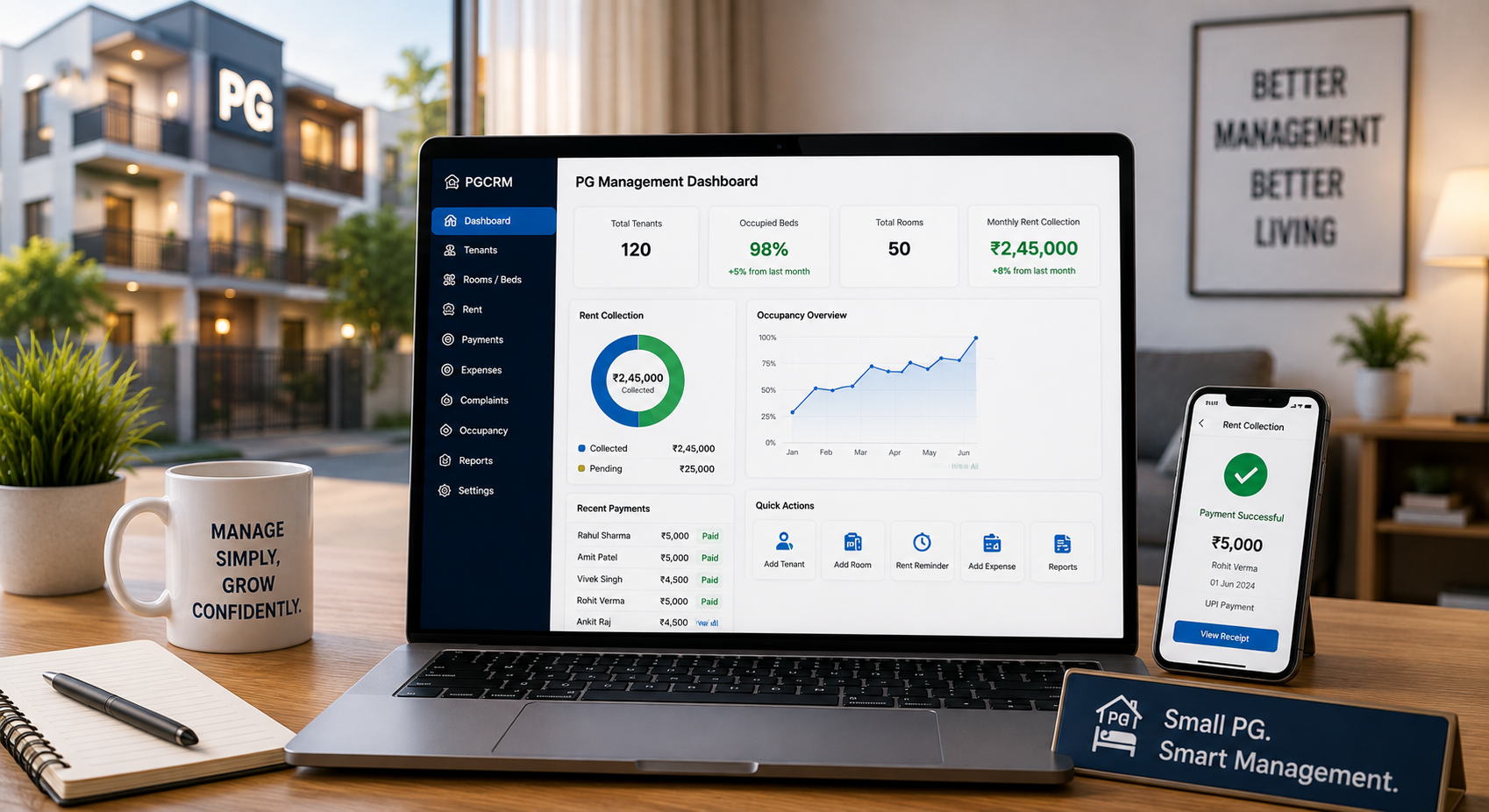
PG management software such as PGCRM won’t write your budget for you. But it can record rent collection and pending rent, log expenses by category and building, and show income, expense and occupancy reports. That gives you reliable actuals to compare with your plan, which is the part most owners find hardest to keep up.
Common PG Business Budget Mistakes
- Budgeting for 100% occupancy. It rarely happens, and it hides real risk.
- Counting deposits as income. They’re refundable, so they don’t belong in your profit.
- Forgetting occasional costs. Painting, repairs and replacements add up.
- Mixing personal and business money. You can’t see true profit when the two blend together.
- Setting a budget once and never reviewing it. Costs change, and your plan should too.
- Ignoring break-even. Without it, you don’t know how close you are to a loss.
- No reserve fund. One slow month or big repair can create a cash crunch.
FAQ
How do I make a budget for a PG business?
List your expected income from rent and any add-ons, using a realistic occupancy rate. Then list all fixed, variable and occasional expenses. Subtract expenses from income to find your surplus, add a reserve contribution, and compare the plan against actual numbers every month.
What expenses should be included in a PG budget?
Include building rent or loan EMI, staff salaries, electricity, water, internet, groceries if you serve meals, cleaning supplies, maintenance, marketing and a reserve fund. Also add occasional costs such as painting, furniture replacement and licence renewals, so surprises don’t strain your cash flow.
How do I calculate break-even occupancy for a PG?
Divide your total monthly expenses by your maximum monthly rent (total beds multiplied by rent per bed). The result is the occupancy percentage you need to cover costs. For example, ₹1,23,000 in expenses against ₹1,80,000 in maximum rent gives a break-even of about 68%.
What occupancy rate should I assume in my PG budget?
Use your own history if you have it. Look at average occupancy over the past year, including slow months, and budget a little below that. If you’re starting, pick a cautious figure and revise it after a few months of real data.
How much reserve fund should a PG keep?
There’s no fixed rule. It depends on your fixed costs, how stable your occupancy is and how old your building is. Many owners build up a cushion that can cover a few months of fixed costs, adding a set amount every month until they reach it.
How often should I review my PG budget?
Review it monthly. Compare actual income and expenses with your plan, look at occupancy and pending rent, and note any unusual costs. If something changes sharply, such as a big repair or a drop in occupancy, check again sooner and adjust.
Conclusion
A solid PG business budget comes down to a few habits. Estimate income cautiously, list every expense, know your break-even occupancy, set aside a reserve and compare the plan against real numbers each month. It takes a little time, but it shows you problems while they’re still small.
Reliable records make the monthly check much easier. If you’d like rent, expenses and occupancy in one place, explore PGCRM to simplify your PG and hostel management.