Best Contact Management CRM for Customer Contacts and Sales Activities
Most sales teams do not lose leads because of a weak pitch. They lose them because one number sits in an Excel sheet, a note sits in WhatsApp, and the follow-up date sits in someone’s memory. When that person is on leave, nobody knows what was promised.
A contact management CRM fixes this by keeping every contact, call, note and next step in one place. For teams that sell over the phone, a contact management CRM built for calling teams goes one step further and links each contact to calls, reminders and pipeline stages. This guide explains what to look for, how to compare options, and which mistakes to avoid.
What Is a Contact Management CRM?
A contact management CRM is software that stores customer and lead details, records every interaction, and tracks sales activities such as calls, follow-ups and deal stages. It gives the whole team one shared, searchable record for each contact instead of scattered spreadsheets, phone contacts and chat threads.
In simple terms, it answers three questions for every contact:
- Who is this person?
- What have we already discussed?
- What should happen next, and who owns it?
Contact Management Software vs CRM vs Telecalling CRM
These terms are often mixed up. The table below shows how they differ.
| Type | Main purpose | Typically includes | Best suited for |
|---|---|---|---|
| Basic contact management software | Store names, numbers, emails and notes | Searchable address book, tags | Individuals, very small teams |
| General CRM | Manage contacts, deals and customer relationships | Pipeline, tasks, email tracking, reports | Teams with mixed sales and marketing needs |
| Telecalling CRM | Manage contacts around phone-based selling | Dialer, call logs, follow-ups, lead assignment, agent reports | Outbound sales and calling teams |
If your team spends most of its day on calls, a CRM that treats calling as the core workflow usually saves more time than a general tool where calling is an add-on.
What Is the Best CRM for Managing Customer Contacts?
There is no single best CRM for every business. The best contact management CRM is the one your team will actually use every day, and that matches how you sell. A team that sells through calls needs different strengths from a team that sells mainly through email or demos.
Start by asking how your contacts reach you, how many people handle them, and how much follow-up your sales cycle needs.
Key Features to Look for in a Contact Management CRM
1. A single, complete contact record
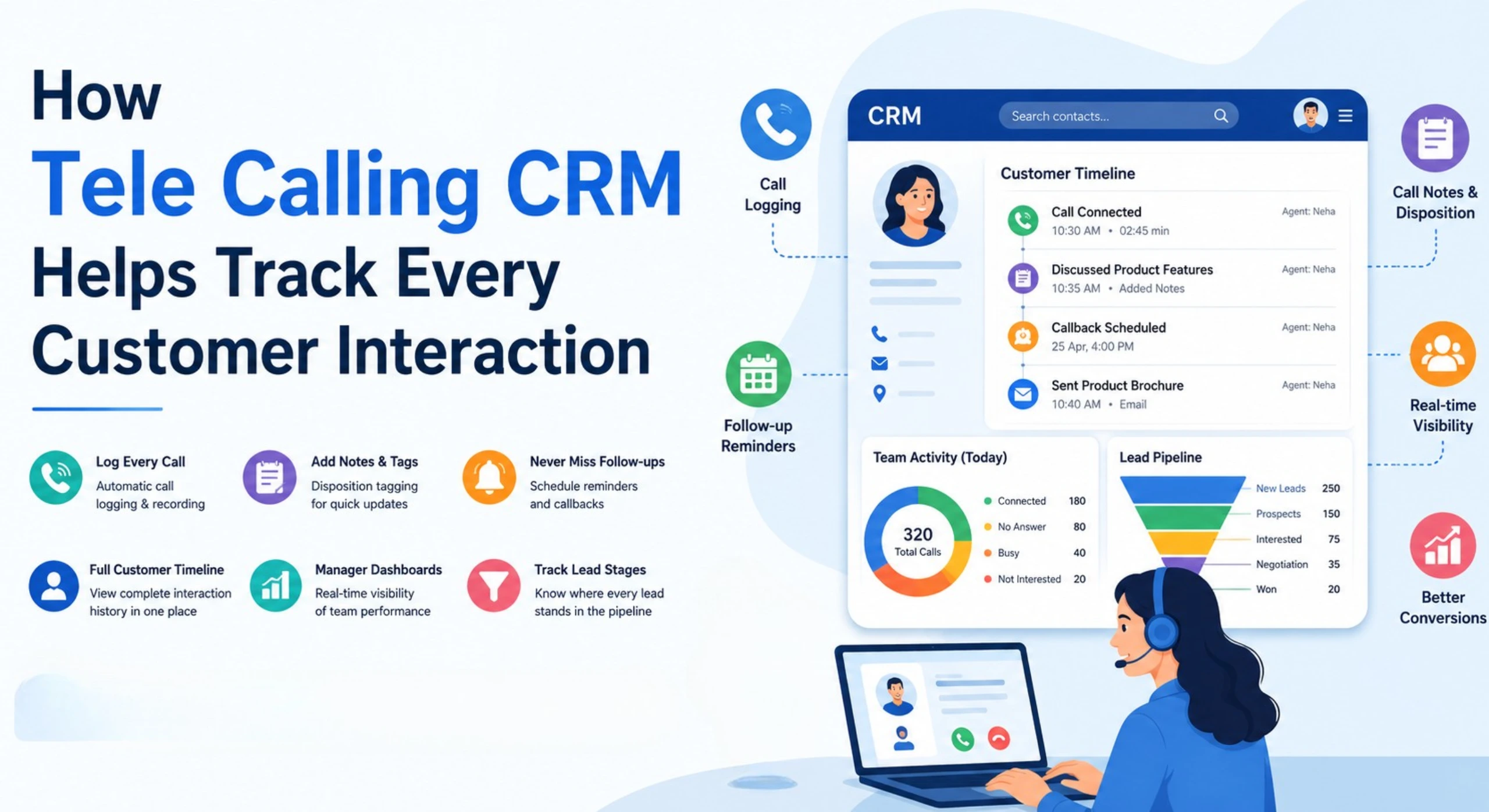
Each contact should show call history, notes, lead source, current stage, assigned owner and upcoming follow-ups on one screen. If agents must open three tools to understand one lead, the CRM is not doing its job.
2. Easy lead import and capture
Most teams begin with Excel or CSV files, so import should be simple. Look for automatic duplicate removal, plus the ability to receive leads from your ad platforms, property portals, website forms or Google Sheets.
3. Lead assignment rules
When leads arrive, someone has to decide who calls them. Good CRMs assign leads by rules such as round-robin, language or fixed owner, so no lead waits in a shared pool.
4. Follow-up reminders
Follow-ups are where most deals are won or lost. Look for one-tap scheduling, reminders before the call is due, and alerts for overdue follow-ups.
5. Call management
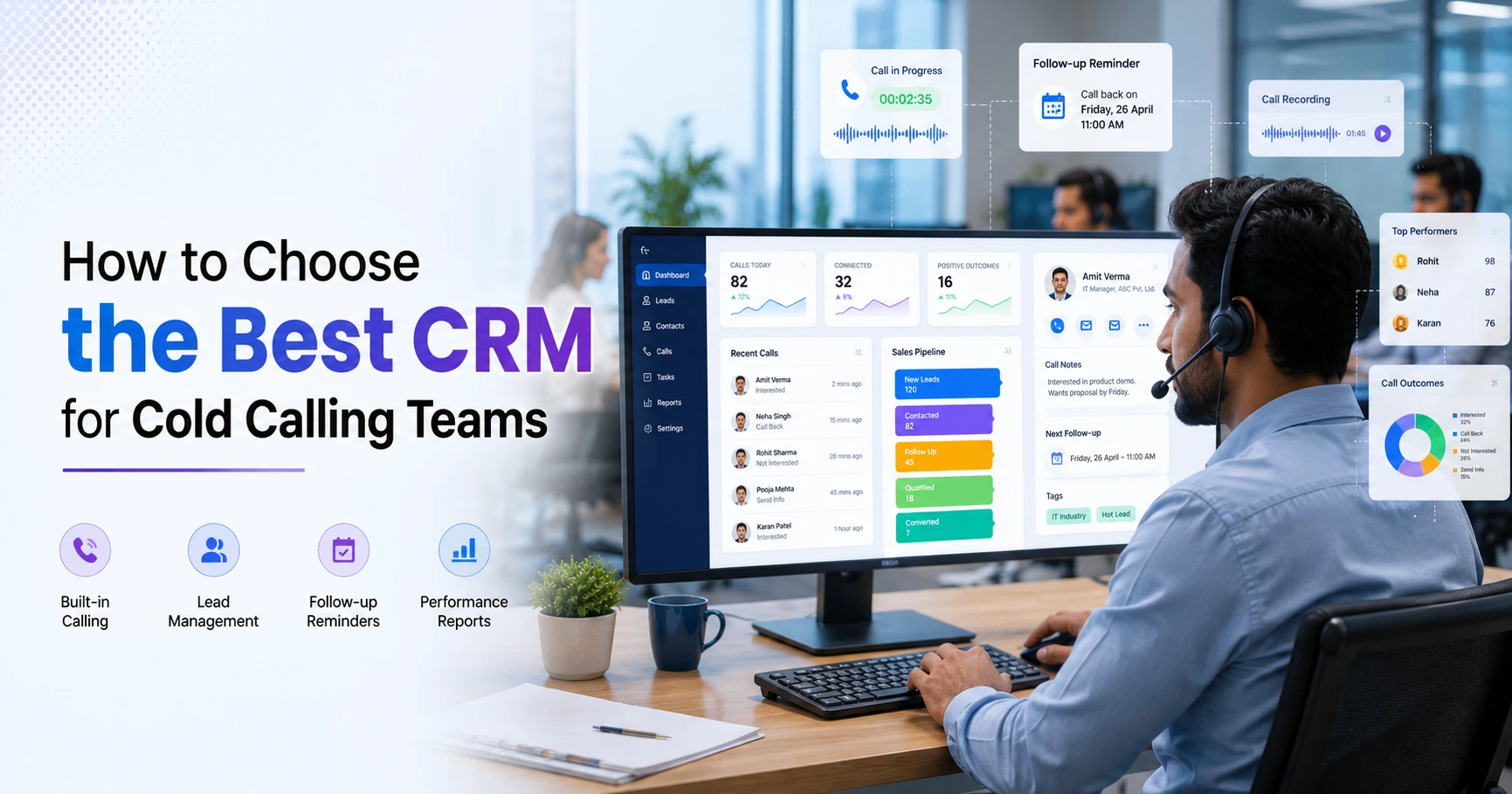
For phone-led teams, this means call logging with duration and outcome, call recordings, notes after each call, and ideally a dialer that moves agents to the next lead automatically.
6. Sales pipeline
A pipeline shows where each contact stands, such as new, qualified, proposal or won. Custom stages matter because every business sells differently.
7. Reports managers can use
Useful reports show calls made, talk time, connection rate, follow-ups completed and conversions by agent and by lead source. Avoid tools that give you charts but no clear action.
8. Mobile access
Field teams, remote agents and managers on the move need to update contacts from their phones. Check whether the mobile app covers the actual daily workflow, not just viewing data.
9. Access control and data privacy
Not every agent should see or export every record. Role-based access, encrypted call recordings and data retention settings protect both your customers and your business.
Real-World Examples (Hypothetical)
These are illustrative scenarios, not customer case studies.
Real estate: A site-visit team receives enquiries from several portals and ad campaigns. With a CRM, each enquiry lands in one place, gets assigned to an agent, and is tagged with its source. Managers can later see which source produces serious buyers rather than just more calls.
Education: A coaching institute handles hundreds of admission enquiries during peak season. Counsellors need to know which parent asked about fees, who requested a callback and who has gone silent. A shared contact record with scheduled follow-ups prevents students from slipping through.
Insurance: An agency calls prospects and also handles renewals. A CRM that stores policy-related notes and renewal follow-up dates lets any agent pick up a conversation without asking the customer to repeat everything.
How to Choose a Contact Management CRM: 6 Steps
- List your contact sources. Note where leads come from today: ads, portals, websites, referrals, Excel files.
- Map your sales process. Write down the stages from first contact to closing. Your CRM should match this, not force a new process.
- Count your users and their roles. Agents, team leaders, managers and admins need different access.
- Shortlist two or three tools. Compare them on the features above, not on the longest feature list.
- Run a real trial. Import a small batch of real leads and let two or three agents use it for a few days.
- Check the total cost. Look at per-user fees, add-ons and setup charges, not just the headline price. Our guide on how to choose the best telecalling CRM for your business goes deeper into this for calling teams.
Common Mistakes to Avoid
- Choosing by feature count. Many features that nobody uses only make the tool harder to learn.
- Skipping team training. A CRM works only when agents update it after every call.
- Importing messy data. Duplicate and outdated contacts create confusion from day one. Clean your files before importing.
- Ignoring follow-up discipline. The tool can remind agents, but managers must still review overdue follow-ups.
- Overlooking data privacy. India’s Digital Personal Data Protection Act is now operational through rules notified in November 2025. Hogan Lovells’ summary notes that when consent is withdrawn, personal data generally has to be deleted unless a legal obligation requires keeping it. Check how any CRM you consider handles deletion and retention, and take legal advice for your own situation.
How TeleCallingCRM Can Help
TeleCallingCRM is designed for sales teams that work mainly through phone calls. It is not a general-purpose marketing suite, so it suits businesses where calling and follow-up drive revenue. According to its website, it includes:
- Lead management: bulk CSV or Excel import with duplicate removal, assignment rules, lead scoring, tags, custom fields, and call history and notes on every lead.
- Lead sources: integrations with sources such as Facebook and Instagram Lead Ads, Google Ads, 99acres, MagicBricks, JustDial, WordPress and Google Sheets. Details are in the integration documentation.
- Follow-ups and reminders: one-tap scheduling, reminders, and overdue alerts.
- Smart auto dialer and call tracking: automatic dialing through assigned leads, call duration capture, and one-tap outcome logging.
- Sales pipeline: custom stages, deal values and weighted forecasting.
- Team visibility: a live war room, leaderboards and a report builder.
- Mobile app and messaging: Android and iOS apps, plus WhatsApp, SMS and email from the lead’s timeline.
Industry-specific pages are also available, such as real estate, education and insurance. A comparison page is available if you are evaluating alternatives.
One honest limitation: if your main need is email marketing automation or a complex customer support desk, check whether a calling-first tool covers that before deciding. The website mentions a 3-day free trial, which is a practical way to test fit with your own data.
Frequently Asked Questions
What is the best CRM for managing customer contacts?
The best CRM is the one that fits your sales process and gets used daily. Look for a single contact record, lead import, assignment rules, follow-up reminders, pipeline tracking and reports. For phone-based teams, call logging and a dialer matter more than marketing features.
What is the difference between contact management software and a CRM?
Contact management software mainly stores contact details and notes. A CRM adds sales activity tracking, such as pipelines, follow-ups, tasks, reports and team collaboration. If more than one person handles your contacts, a CRM is usually the better choice.
Do small businesses need a CRM, or is Excel enough?
Excel can work for a single person with a few dozen contacts. Problems begin when several people update the same sheet, follow-ups get missed, or you need to know who called whom. At that point, a CRM saves more time than it costs.
What features should a CRM for telecallers have?
A CRM for telecallers should include lead import, duplicate checks, lead assignment, call logging, call recording, follow-up reminders, a mobile app and agent-level reports. An auto dialer and Do Not Call list handling are also useful for outbound teams.
How do I move contacts from Excel into a CRM?
First clean the file by removing duplicates and fixing column names. Then export it as CSV and use the CRM’s import tool. Test with a small batch, check that fields map correctly, and only then import the full list.
Can a CRM help with sales follow-ups?
Yes. A CRM lets agents schedule a callback right after a call and reminds them before it is due. Managers can also see overdue follow-ups across the team, which makes it easier to step in before a lead goes cold.
Does TeleCallingCRM offer a free trial?
According to the TeleCallingCRM website, every plan comes with a 3-day free trial and no credit card is required. Plans and prices can change, so please confirm the latest details on the pricing page before you decide.
Conclusion
Choosing a contact management CRM is less about finding the longest feature list and more about finding a tool your team will actually update after every conversation. Start with your contact sources, map your sales stages, and test with real leads before committing.
If your team sells mainly by phone, you can compare plans for a CRM for telecallers and see whether the features and team-based pricing suit the way you work.