Introduction
Rent collected is not profit. Most PG owners know this, yet many still judge their business by how much came into the account this month. The number that actually shows whether your PG makes money is its net operating income.
PG net operating income (NOI) tells you what the property earns from day-to-day operations after paying the costs of running it. It’s the figure banks, buyers and sharp owners look at first. In this guide, you’ll learn the formula, what to include and leave out, and how to work through a real-looking example. You’ll also see how to use NOI to make better decisions. A spreadsheet can handle the math, and PG and hostel management software helps you keep the underlying records clean.
What Is PG Net Operating Income?
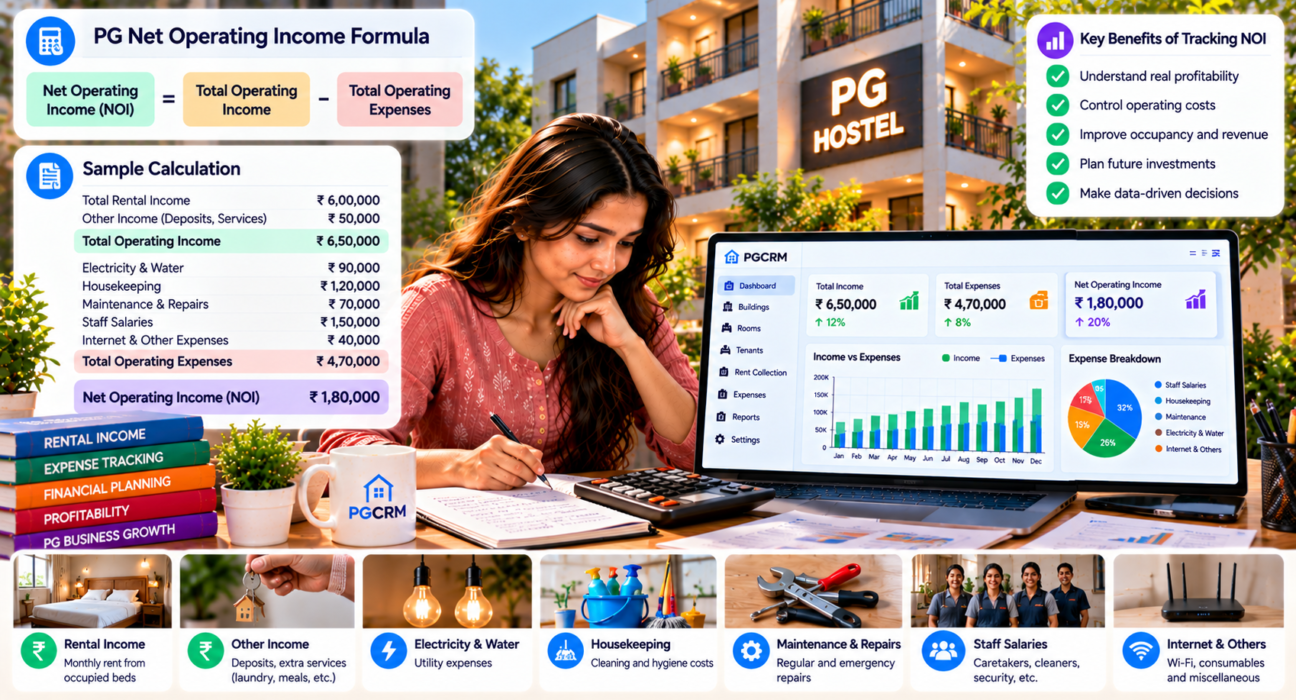
PG net operating income is the money your PG earns from running the business after paying all operating expenses, but before loan payments, depreciation and income tax. The formula is NOI = effective gross income − operating expenses. It shows how profitable the property itself is, separate from how you financed it.
That last part matters. Two owners can run identical PGs. One bought the building with a loan, the other with savings. Their NOI is the same, because NOI measures the operation, not the financing.
The PG Net Operating Income Formula
Here’s the full chain, step by step.
- Potential gross income = total beds × rent per bed × months
- Effective gross income = potential gross income − vacancy loss − unpaid rent + other income
- Net operating income = effective gross income − operating expenses
Don’t worry if these terms feel stiff. Each one has a plain meaning, and the next sections walk through them.
Step 1: Start With Potential Gross Income
This is what you’d earn if every bed were filled all year and everyone paid on time. It’s a theoretical ceiling.
Potential gross income = number of beds × average rent per bed × 12
A 40-bed PG at ₹7,000 average rent has a potential income of 40 × ₹7,000 = ₹2,80,000 a month, or ₹33,60,000 a year.
If you have different room types, calculate each type separately and add them up. A single room at ₹10,000 and a triple-sharing bed at ₹6,000 shouldn’t be averaged carelessly.
Step 2: Subtract Vacancy and Collection Losses
No PG runs at 100% all year. You need to account for two kinds of leakage.
Vacancy Loss
This is rent lost on beds that sat empty. If your bed utilization was 85%, then 15% of your potential income never materialized. In our example, that’s ₹42,000 a month.
Unpaid or Written-Off Rent
Some rent is never collected. A tenant leaves with dues, or a deposit doesn’t cover everything owed. Count only the amount you’ve given up on, not rent that’s merely late.
Keep this honest. Owners often ignore unpaid rent because it feels temporary, and then it quietly becomes permanent.
Step 3: Add Other Income
Add any regular income that comes from operating the PG, beyond room rent:
- Mess or food charges billed separately
- Late payment fines
- Laundry or parking charges, if you offer them
Do not add refundable security deposits. A deposit isn’t income. It’s money you owe back to the tenant, unless you legitimately deduct for damages or dues at the time of settlement. Only the deducted portion counts as income when it happens.
Add the above to what’s left of your rent, and you have your effective gross income (EGI).
Step 4: List Your Operating Expenses
Operating expenses are the costs of keeping the PG running and rentable. For most PGs, they include:
- Building rent (if you lease the property)
- Property tax and society charges (if you own it)
- Staff salaries: cook, caretaker, cleaner, security
- Electricity and water
- Food and groceries, if you provide meals
- Internet and cable
- Cleaning and housekeeping supplies
- Repairs and regular maintenance
- Insurance, licences and software subscriptions
- A fair salary for yourself, if you manage the PG daily
That last item surprises people. If you work in the PG every day and pay yourself nothing, your NOI looks better than it really is. Put a reasonable manager’s salary in the expenses, even if it’s notional. Otherwise you can’t tell whether the business pays for itself or only works because your time is free.
What to Leave Out of NOI
NOI has clear exclusions. These don’t belong in your operating expenses:
| Leave out | Why |
|---|---|
| Loan principal and interest | It’s a financing cost, not an operating one |
| Depreciation | A non-cash accounting item |
| Income tax | It depends on your personal or business tax position |
| Big one-time upgrades (new building floor, major renovation) | These are capital spending, not routine costs |
| Refundable deposits | They’re not income or expense |
| Personal expenses | They don’t belong to the property |
Where the line falls on some items, such as a big repair versus an upgrade, can depend on how your accountant treats them. For tax questions, talk to a chartered accountant rather than guessing.
A Worked Example of PG Net Operating Income
These numbers are made up to show the method. Use your own.
A PG leases a building with 40 beds. Average rent is ₹7,000 per bed, and occupancy was 85% for the month.
| Line item | Monthly amount |
|---|---|
| Potential gross income (40 × ₹7,000) | ₹2,80,000 |
| Less: vacancy loss (15%) | − ₹42,000 |
| Less: unpaid rent written off | − ₹5,000 |
| Add: other income (fines, extras) | + ₹4,000 |
| Effective gross income | ₹2,37,000 |
| Building rent | ₹80,000 |
| Staff salaries | ₹40,000 |
| Electricity and water | ₹22,000 |
| Food and groceries | ₹45,000 |
| Internet, cleaning, small repairs | ₹15,000 |
| Planned maintenance | ₹8,000 |
| Insurance, licences, software | ₹5,000 |
| Total operating expenses | ₹2,15,000 |
| Net operating income | ₹22,000 |
Over a year, that’s about ₹2,64,000. The NOI margin is NOI ÷ EGI, or about 9.3%.
Look at what the example tells you. Rent collected would have looked like ₹2,37,000, which sounds healthy. After costs, the real operating profit is a fraction of that. A few percentage points of extra vacancy, or a jump in food costs, could wipe it out. That’s the kind of sensitivity you only see once you calculate NOI.
Using NOI to Make Better Decisions
Once you have the number, here’s what to do with it.
Compare Months and Buildings
NOI lets you compare your PGs fairly. A bigger building isn’t automatically a better one. A smaller PG with lower costs might have a healthier margin.
Calculate the Cap Rate
If you own the building, you can measure its return:
Capitalization rate = annual NOI ÷ property value × 100
Suppose annual NOI is ₹12,00,000 and the property is worth ₹1.5 crore. The cap rate is 8%. This is an illustrative example, and property values depend on the market. The point is that you can compare your PG’s return against other uses of that money.
Check Whether You Can Afford Your Loan
Lenders often look at how comfortably NOI covers loan payments.
Debt service coverage ratio (DSCR) = annual NOI ÷ annual loan payments
If annual NOI is ₹12,00,000 and yearly loan payments are ₹9,00,000, DSCR is about 1.33. Above 1 means NOI covers the payments. The higher, the safer.
Test Your Pricing and Costs
NOI shows what happens when you change something. If you raise rent by ₹500 per bed, what happens to NOI? If food costs rise by 10%? If occupancy drops by five points? Run these what-ifs before making decisions, not after.
Common Mistakes When Calculating PG Net Operating Income
- Using collected rent as profit. Collections are only the first line.
- Including loan EMIs as an operating expense. They belong outside NOI.
- Ignoring vacancy. Calculating from full occupancy gives a fantasy number.
- Treating deposits as income. They’re refundable.
- Forgetting your own salary. It hides weak profitability.
- Skipping small expenses. A few thousand in missed costs each month adds up.
- Using messy records. If rent and expenses live in different notebooks, your NOI is a guess.
How PG Management Software Helps With NOI
NOI is simple arithmetic. The hard part is trusting the inputs. If cash payments go unrecorded or expenses are scattered across receipts and chat messages, your result won’t mean much.
PGCRM, for example, lets you collect rent by cash or UPI with each payment tied to a tenant, so your income records stay consistent. You can record expenses by category and building, which makes the operating-expense side easier to total. It also handles deposits, fines and refunds separately, and provides occupancy, income and expense reports. You can see the details on the PGCRM features page.
To be clear, you still do the NOI calculation yourself or with your accountant. The software’s job is to make sure the numbers you feed into it are accurate and easy to find.
Frequently Asked Questions
What is net operating income in a PG business?
It’s what the PG earns from operations after paying operating expenses, before loan payments, depreciation and income tax. You calculate it by subtracting operating expenses from effective gross income. NOI shows how profitable the property is on its own, regardless of how you financed it.
What is the formula for PG net operating income?
NOI = effective gross income − operating expenses. Effective gross income is potential rent minus vacancy loss and unpaid rent, plus other income such as fines. Operating expenses include building rent, salaries, utilities, food, repairs and similar running costs, but not loan payments or income tax.
Is NOI the same as profit?
Not exactly. NOI is profit from operations before financing costs, depreciation and income tax. Your final take-home profit is lower once you subtract loan interest, tax and other items. NOI is useful because it isolates how well the PG operates, which makes comparing properties and months fairer.
Should EMI payments be included in PG net operating income?
No. Loan principal and interest are financing costs, so they sit outside NOI. Keep them separate and compare them against NOI afterwards, using a measure like debt service coverage ratio. This shows whether the PG earns enough to cover its loan comfortably.
Do security deposits count as income for NOI?
No. Refundable deposits are money you hold and may have to return, so they aren’t income. Only the portion you rightfully keep, such as deductions for damages or unpaid dues, becomes income when you settle with the tenant. Confirm the right treatment with your accountant.
How often should I calculate NOI for my PG?
Calculate it monthly for a quick health check, and review the annual figure for bigger decisions like pricing, loans or expansion. Monthly figures can swing with seasons, so also compare the same month year over year. Regular tracking helps you catch rising costs or falling occupancy early.
Conclusion
PG net operating income cuts through the noise. Start with potential rent, subtract vacancy and unpaid rent, add other income, then take away the real cost of running the place. What’s left tells you whether the PG itself is healthy, before loans and taxes enter the picture.
Once you’ve got the habit, NOI becomes a decision tool: for pricing, for budgeting, for checking whether a loan is safe. It only works if your records are accurate. PG management software such as PGCRM keeps rent, deposits, expenses and occupancy in one place, so the inputs are ready when you need them. Explore PGCRM to simplify your PG and hostel management.