Introduction
Someone searching for accommodation, or someone about to start an accommodation business, often uses “PG” and “hostel” interchangeably. But the PG vs hostel distinction actually matters for pricing, tenant expectations, and how the property gets run day to day. This article breaks down what separates a PG from a hostel, how each works for tenants, and what the difference means operationally for owners. Whether you’re comparing options as a tenant or deciding which model to run as an owner, understanding this distinction helps you make a more informed choice. Owners managing either model often rely on PGCRM, a PG and hostel management software, to keep tenant records and rent tracking organised.
What Is a PG?
A PG, short for ‘paying guest’ accommodation, is typically a residential property where an owner rents out rooms to tenants, usually students or working professionals, often along with meals and basic amenities. PGs commonly operate out of converted homes or dedicated buildings and tend to feel more personal and home-like than institutional housing.
Key Characteristics of a PG
- Smaller scale – many PGs house anywhere from a handful to a few dozen tenants.
- Meals often included – a large share of PGs offering home-style meals as part of the package.
- Flexible room sharing – single, double, and triple sharing options are common within the same property.
- More personal management – owners or a small caretaker team often manage day-to-day operations directly.
- Longer average stays – tenants often stay for months at a time, especially students and working professionals near their college or workplace.
What Is a Hostel?
A hostel is generally a larger, more structured accommodation facility, often affiliated with an institution (like a college or company) or run as an independent commercial property with standardised rooms and shared facilities. Hostels tend to house more tenants and follow more formal, rule-based operations than most PGs.
Key Characteristics of a Hostel
- Larger scale – hostels often house dozens to hundreds of residents.
- Standardised rooms – dormitory style or shared rooms with fixed bed counts are common.
- Structured rules – fixed timings, visitor policies, and formal codes of conduct are typical.
- Shared common facilities – mess halls, common bathrooms, and recreational spaces are usually shared across a larger group.
- Institutional or commercial ownership – many hostels are run by educational institutions, companies, or larger hospitality operators rather than individual owners.
PG vs Hostel: Core Differences
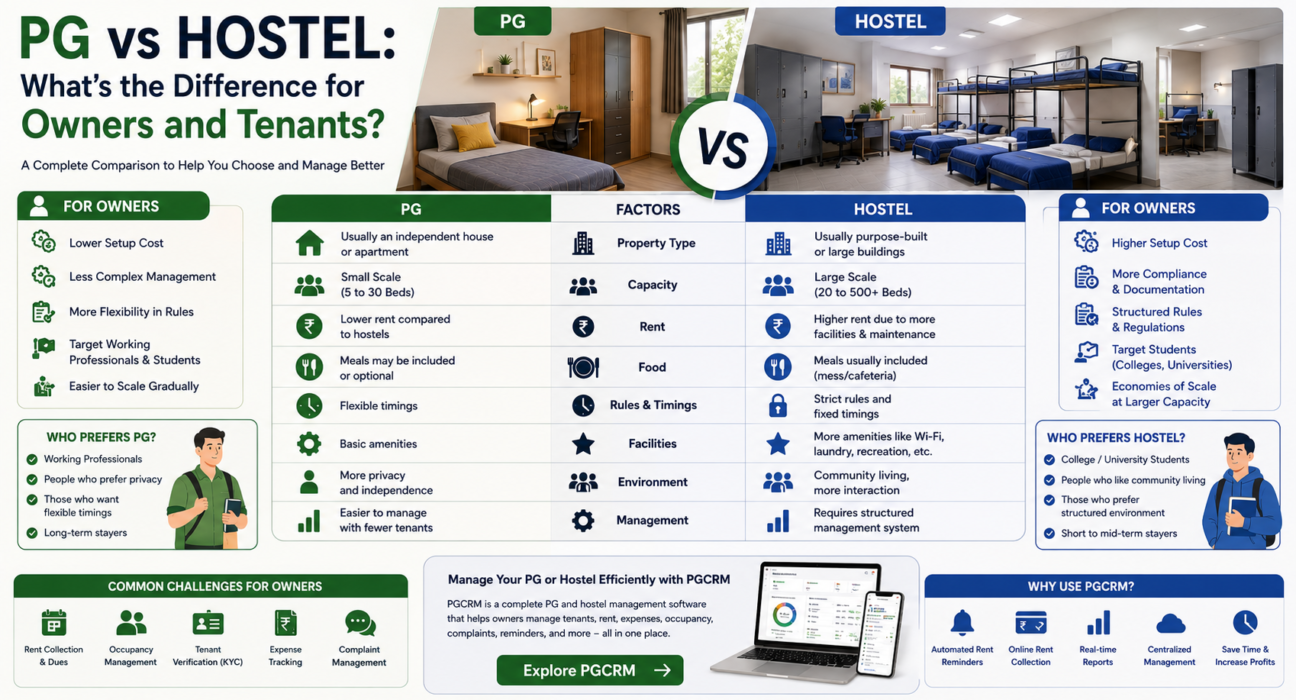
| Aspect | PG | Hostel |
|---|---|---|
| Scale | Smaller, a few to a few dozen tenants | Larger, often dozens to hundreds |
| Room setup | Single, double, or triple sharing | Often dormitory-style or fixed sharing |
| Meals | Frequently included | Sometimes included via a mess facility |
| Rules and structure | More flexible, owner-dependent | More formal, rule-based |
| Typical tenants | Working professionals, students | Primarily students, sometimes institution-affiliated |
| Management style | Personal, owner or small team | Institutional or larger operational team |
| Average stay length | Longer, often months | Varies, sometimes tied to academic terms |
PG vs Hostel: What It Means for Tenants
Privacy and Personal Space
PGs generally offer more privacy, with smaller room-sharing arrangements and a more home-like environment. Hostels, especially dormitory-style ones, prioritise capacity over personal space, which suits tenants who don’t mind shared living but want lower costs.
Cost Considerations
Hostels are often more budget-friendly per bed, since the model spreads facility costs across more residents. PGs can cost more per tenant but typically offer more personalised amenities, better food quality, and a quieter living environment in exchange.
Rules and Flexibility
PGs tend to have more flexible house rules, since the owner directly sets policies based on the property and tenant mix. Hostels usually enforce stricter, standardised rules, particularly around curfews and visitor access, since they house larger groups and often answer to an institution.
Community and Social Environment
Hostels naturally create a more social, communal atmosphere due to shared spaces and larger tenant groups. PGs offer a quieter, more private living experience, which appeals more to working professionals who want a residence rather than a highly social environment.
PG vs Hostel: What It Means for Owners
Operational Complexity
Running a hostel generally involves more operational complexity due to higher tenant counts, shared facility management, and often coordination with an affiliated institution. A PG, by comparison, is usually more manageable for an individual owner or small team, since bed counts and shared spaces are smaller.
Staffing Requirements
Hostels typically need more staff, including mess staff, wardens, and dedicated maintenance teams, given the scale of operations. PGs can often run with a smaller team, sometimes just a cook and a caretaker, especially at lower bed counts.
Revenue and Occupancy Patterns
PGs often see more stable, longer-term occupancy since tenants, particularly working professionals, tend to stay for extended periods. Hostels can experience more seasonal fluctuation, especially those tied to academic calendars, with occupancy dropping during breaks and holidays.
Regulatory and Licensing Considerations
Both PGs and hostels generally need a trade license and other local approvals to operate legally, though specific requirements vary by city and state. Hostels affiliated with an institution may follow additional institutional guidelines alongside standard municipal requirements, while independent PGs typically deal directly with local authorities.
Managing Tenant Records and Rent Across Both Models
Regardless of whether a property runs as a PG or a hostel, owners face similar operational needs: tracking rent, recording tenant details, managing occupancy, and staying on top of dues.
Using PG and hostel management software such as PGCRM helps owners:
- Maintain centralised tenant and room or bed records
- Track rent payments and outstanding dues in one place
- Manage occupancy across single properties or multiple locations
- Keep KYC and tenant documentation organised
For a hostel with higher tenant counts, this kind of centralised tracking becomes especially valuable, since manual record-keeping gets harder to sustain as the number of residents grows.
How to Decide Between Running a PG or a Hostel
- Consider your target tenant base – working professionals often prefer the privacy and food quality of a PG, while students on a budget may lean toward hostel-style shared living.
- Assess your capital and space – hostels typically require more space and a larger upfront investment to accommodate higher bed counts.
- Think about your management capacity – a PG suits an owner who wants to manage operations personally, while a hostel usually needs a dedicated team.
- Evaluate the local market – proximity to colleges favours hostel-style demand, while proximity to business hubs often favours the PG model.
Frequently Asked Questions
What is the main difference between a PG and a hostel?
The main difference is scale and structure. PGs are smaller, more personal accommodations often run by individual owners, with flexible room sharing and included meals. Hostels are larger, more standardised facilities with dormitory-style rooms, stricter rules, and often institutional or commercial management.
Is a PG cheaper than a hostel?
Not always. Hostels are often cheaper per bed since costs are spread across more residents in shared dormitory setups. PGs can cost more per tenant, but they typically offer better privacy, food quality, and a more home-like environment in return for the higher price.
Which is better for working professionals, a PG or a hostel?
PGs generally suit working professionals better, since they offer more privacy, flexible house rules, and a quieter living environment compared to the communal, often rule-heavy setup of most hostels. Hostels are more commonly associated with student housing near colleges.
Do PGs and hostels need the same licenses to operate?
Both typically need a trade license and other local municipal approvals, though specific requirements vary by city and state. Hostels affiliated with an educational institution may also need to follow additional institutional guidelines alongside standard local regulations.
Can the same management software work for both a PG and a hostel?
Yes. Both models involve similar core tasks: tracking rent, managing tenant records, and monitoring occupancy. PG and hostel management software such as PGCRM handles both, since the underlying operational needs are similar even though the scale and structure differ.
Is it more profitable to run a PG or a hostel?
Profitability depends on location, occupancy, and operating costs rather than the model itself. PGs often benefit from longer, more stable tenant stays, while hostels can generate revenue from higher bed counts but face more seasonal occupancy swings tied to academic calendars.
Conclusion
The PG vs hostel distinction comes down to scale, structure, and the kind of living experience tenants want. PGs suit smaller, more personal setups with flexible rules and included meals, while hostels serve larger groups through standardised, more institutional operations. For owners, choosing between the two depends on target tenants, available capital, and how hands-on you want daily management to be.
Whichever model you run, PGCRM helps simplify the shared operational load, from rent tracking to tenant records. Explore PGCRM to simplify your PG and hostel management, regardless of which model fits your property.