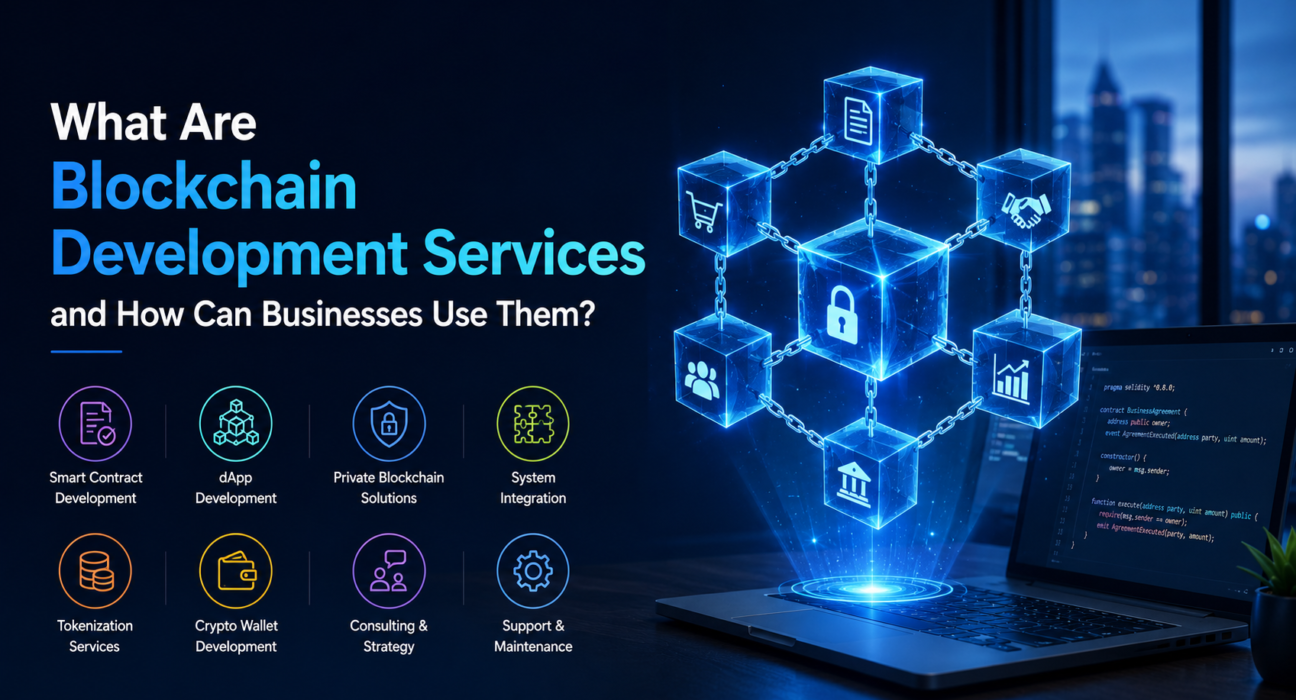
If you’ve been hearing “blockchain” in boardroom conversations but aren’t quite sure what it means for your business, you’re not alone. Blockchain development services help companies design, build, and maintain blockchain-based systems – from secure payment platforms to supply chain trackers to smart contracts that automate agreements without a middleman.
For a growing number of businesses, blockchain isn’t just a buzzword anymore. It’s a practical tool for solving real problems: reducing fraud, cutting out unnecessary intermediaries, improving transparency, and building trust between parties who don’t fully trust each other. But because blockchain technology is still relatively new and technically complex, most businesses can’t build these systems in-house. That’s where blockchain development services come in.
This article breaks down what blockchain development services actually include, how they work, what they cost, and how to evaluate a development partner – so you can decide whether blockchain is the right move for your business and how to get started.
What Are Blockchain Development Services?
Blockchain development services refer to the design, development, deployment, and maintenance of blockchain-based applications and infrastructure for businesses. This typically includes building decentralized applications (dApps), smart contracts, private or permissioned blockchains, cryptocurrency wallets, tokenization platforms, and blockchain integrations with existing business systems.
In simple terms, a blockchain development company takes your business idea – whether it’s a secure record-keeping system, a payment solution, or a tokenized asset platform – and builds the underlying technology to make it work reliably, securely, and at scale.
These services are typically offered by specialized software development companies, IT service providers, or dedicated blockchain agencies with expertise in distributed systems, cryptography, and specific blockchain platforms like Ethereum, Solana, Hyperledger, or Polygon.
What Do Blockchain Development Services Typically Include?
Blockchain development is not a single service – it’s a category that covers several distinct areas. Here’s a breakdown of what’s commonly offered:
1. Smart Contract Development
Smart contracts are self-executing pieces of code that automatically enforce the terms of an agreement once certain conditions are met. Businesses use them for things like automated payments, escrow arrangements, licensing agreements, and supply chain triggers – without needing a third party to oversee execution.
2. Decentralized Application (dApp) Development
dApps are applications that run on a blockchain network instead of centralized servers. They’re used for everything from decentralized finance (DeFi) platforms to marketplaces and voting systems.
3. Private and Permissioned Blockchain Development
Not every business needs a fully public blockchain. Many enterprises use private or permissioned blockchains, where only approved participants can access or validate data. This is common in industries like banking, healthcare, and logistics.
4. Blockchain Integration with Existing Systems
Businesses rarely build blockchain systems in isolation. Development services often include integrating blockchain functionality with existing ERP, CRM, payment, or inventory systems.
5. Tokenization Services
This involves converting real-world assets – such as real estate, invoices, or loyalty points – into digital tokens on a blockchain, making them easier to trade, transfer, or fractionalize.
6. Cryptocurrency Wallet Development
Businesses building fintech or crypto-related products often need secure, custom wallet solutions for storing and transferring digital assets.
7. Blockchain Consulting and Strategy
Before writing any code, many development firms offer consulting to assess whether blockchain is actually the right solution for a given business problem – and to define the right approach if it is.
8. Maintenance, Security Audits, and Upgrades
Blockchain systems need ongoing monitoring, security audits (especially for smart contracts, which are common attack targets), and updates as protocols evolve.
How Do Businesses Actually Use Blockchain Development Services?
Understanding the services is one thing – seeing how businesses apply them in practice makes the value clearer. Here are common, practical use cases:
Supply Chain Transparency Manufacturers and retailers use blockchain to track products from origin to delivery, giving customers and partners verifiable proof of authenticity, origin, or ethical sourcing.
Secure Payments and Cross-Border Transactions Blockchain enables faster, lower-cost international payments by removing intermediary banks from the process, which is especially valuable for businesses operating across multiple countries.
Smart Contracts for Automated Agreements Businesses in real estate, insurance, and logistics use smart contracts to automatically execute payments or actions once predefined conditions are met – reducing paperwork and disputes.
Digital Identity Verification Financial institutions and healthcare providers use blockchain-based identity systems to give users more control over their personal data while reducing fraud and identity theft.
Loyalty and Rewards Programs Retail and hospitality businesses use tokenized loyalty points that customers can transfer, trade, or redeem across multiple platforms more flexibly than traditional point systems.
NFTs and Digital Ownership Beyond art and collectibles, businesses use NFTs for ticketing, certifications, warranties, and proof-of-ownership use cases.
Decentralized Finance (DeFi) Products Fintech companies build lending platforms, decentralized exchanges, and yield-generating products on blockchain infrastructure.
Benefits of Blockchain Development for Businesses
- Transparency – All participants can view the same verified data, reducing disputes.
- Security – Data is cryptographically secured and distributed, making it harder to tamper with.
- Reduced Intermediary Costs – Smart contracts and decentralized systems can eliminate the need for certain third parties.
- Faster Transactions – Especially valuable for cross-border payments and settlements.
- Improved Trust – Useful in industries where parties don’t inherently trust each other (supply chains, multi-party contracts, marketplaces).
- Immutable Record-Keeping – Once data is recorded, it can’t be altered retroactively, which is valuable for compliance and auditing.
Challenges to Consider Before Investing in Blockchain
Blockchain isn’t the right solution for every business problem. Before moving forward, consider:
- Not every problem needs blockchain. If your use case doesn’t require decentralization, transparency across multiple untrusted parties, or immutable records, a traditional database may be simpler and cheaper.
- Development costs and timelines can be higher than conventional software projects, especially for custom smart contracts or private blockchain networks.
- Regulatory uncertainty varies by industry and region, particularly for cryptocurrency- or token-related products.
- Talent scarcity. Experienced blockchain developers are still relatively rare compared to traditional software developers, which affects cost and availability.
- Scalability concerns. Some public blockchains face limitations in transaction speed and cost during high demand, which may require specific technical solutions.
How Much Do Blockchain Development Services Cost?
Blockchain development costs vary significantly based on project complexity, the type of blockchain (public vs. private), the platform used, and the development team’s location and experience. A simple smart contract project will cost far less than building a custom private blockchain network integrated with existing enterprise systems.
Because pricing varies so widely, it’s best to request detailed quotes from multiple development providers based on your specific project scope, rather than relying on general estimates. Verifying current market rates with a few development companies before budgeting is recommended, since pricing can shift based on technology trends and developer demand.
How to Choose the Right Blockchain Development Company
When evaluating potential partners, look for:
- Relevant technical expertise – Experience with the specific blockchain platform your project requires (Ethereum, Solana, Hyperledger, Polygon, etc.).
- A strong security track record – Ask about their approach to smart contract audits and vulnerability testing.
- Portfolio and case studies – Evidence of similar projects they’ve delivered, ideally in your industry.
- Clear communication and project management – Blockchain projects often involve iterative development; a partner who explains trade-offs clearly is valuable.
- Post-launch support – Blockchain systems require ongoing maintenance, monitoring, and upgrades, so ask about long-term support options.
- Transparent pricing and scope – Avoid vague estimates; ask for a detailed breakdown of deliverables and costs.
This is where a platform like GoFirms can help. Businesses can use GoFirms to research and compare technology and software development companies, including those with blockchain expertise, making it easier to shortlist providers based on relevant experience before reaching out for proposals.
Blockchain Development: Build In-House or Hire an Agency?
| Factor | In-House Team | Blockchain Development Agency |
|---|---|---|
| Upfront cost | Higher (hiring, training) | Lower (project-based) |
| Speed to launch | Slower (hiring takes time) | Typically faster |
| Access to specialized expertise | Limited unless you hire specialists | Broad, cross-project experience |
| Long-term control | Full internal control | Shared, depends on contract |
| Best for | Companies building blockchain as a core, ongoing product | Businesses testing or launching a specific blockchain solution |
For most businesses exploring blockchain for the first time, working with an experienced development agency is the more practical starting point, since it reduces upfront risk while still providing access to specialized skills.
Frequently Asked Questions
What industries benefit most from blockchain development services? Finance, supply chain and logistics, healthcare, real estate, and retail are among the industries seeing the most practical blockchain adoption, largely due to their need for transparency, secure record-keeping, and reduced reliance on intermediaries.
Is blockchain development only for cryptocurrency projects? No. While cryptocurrency and DeFi are common use cases, many businesses use blockchain for supply chain tracking, digital identity, smart contracts, and secure data-sharing systems that have nothing to do with crypto trading.
How long does it take to build a blockchain application? Timelines vary widely depending on complexity – a simple smart contract might take a few weeks, while a custom enterprise blockchain platform can take several months. It’s best to request a project-specific timeline from your development partner.
Do small businesses need blockchain development services? Not always. Blockchain is most valuable when a business needs transparency, security, or trust across multiple parties. Many small businesses are better served by traditional software solutions unless they have a specific blockchain-relevant use case.
What’s the difference between public and private blockchains? Public blockchains are open to anyone and fully decentralized, while private (permissioned) blockchains restrict access to approved participants. Businesses often choose private blockchains for internal or B2B use cases requiring more control.
How do I find a reliable blockchain development company? Look for proven technical expertise, security practices, relevant case studies, and transparent pricing. Platforms like GoFirms allow businesses to research and compare technology companies, including those offering blockchain development services, to help narrow down the right fit.
Are smart contracts legally binding? This depends on jurisdiction and the specific use case. While smart contracts can automate execution of agreed terms, businesses should consult legal counsel to confirm enforceability requirements in their region before relying on them for binding agreements.
Conclusion
Blockchain development services give businesses the tools to build more transparent, secure, and efficient systems – whether that’s automating agreements through smart contracts, tracking products through a supply chain, or enabling faster cross-border payments. But blockchain isn’t a fit for every business problem, and success depends heavily on choosing the right development partner with proven technical expertise.
If you’re exploring blockchain for your business, start by clearly defining the problem you’re trying to solve, then research development companies with relevant experience in your industry and blockchain platform of choice. Platforms like GoFirms can support that process by helping businesses discover and compare technology companies with the right expertise, making it easier to find a partner suited to your specific project.