Mobile technology has changed the way businesses connect with customers, manage operations, and deliver services. From online shopping and food delivery to banking, healthcare, education, logistics, and entertainment, mobile applications have become an important part of modern business strategies.
For startups and established businesses, investing in Mobile App Development can create a direct digital channel to customers while improving engagement, accessibility, and operational efficiency.
India has also become a major destination for businesses looking for reliable and cost-effective Mobile App Development Services. With experienced developers, modern technologies, and a growing technology ecosystem, Indian app development companies help businesses build applications for both local and international markets.
What Is Mobile App Development?
Mobile App Development is the process of designing, developing, testing, deploying, and maintaining applications for mobile devices such as smartphones and tablets.
Depending on the business requirements, an application can be developed specifically for Android or iOS, or it can be built using cross-platform technologies that allow the same application to work across multiple operating systems.
A successful mobile application is more than just a collection of screens. It combines:
- User-friendly UI/UX design
- Secure backend systems
- APIs and database integration
- Mobile application development
- Performance optimization
- Security
- Testing and quality assurance
- App Store and Play Store deployment
- Continuous maintenance and support
This complete approach helps businesses create mobile products that are reliable, scalable, and easy for customers to use.
Why Mobile App Development Is Important for Businesses
Customers increasingly expect businesses to provide convenient digital experiences. A mobile application allows businesses to interact with customers directly through their smartphones.
Here are some of the major benefits of investing in Mobile App Development.
1. Direct Customer Engagement
Mobile applications provide businesses with a direct communication channel. Companies can use notifications, personalized content, offers, and updates to maintain customer engagement.
2. Better Customer Experience
A well-designed mobile application can make it easier for customers to browse products, make payments, book services, track orders, communicate with support teams, and manage their accounts.
3. Improved Business Efficiency
Mobile applications can also be designed for internal business operations. Employee applications can help teams manage tasks, field operations, inventory, sales activities, reporting, and customer information.
4. New Revenue Opportunities
Businesses can use mobile applications to introduce subscription models, in-app purchases, digital services, marketplace commissions, advertising, and other revenue streams.
5. Stronger Brand Presence
Having a dedicated application can improve brand visibility and give customers a consistent digital experience across different touchpoints.
Types of Mobile App Development
Businesses can choose different development approaches depending on their target audience, budget, performance requirements, and long-term goals.
Android App Development
Android is one of the most widely used mobile platforms globally. Android App Development helps businesses create applications for smartphones and tablets running on the Android operating system.
Professional Android applications can be developed with a focus on:
- Performance
- Security
- Device compatibility
- Scalable architecture
- Payment integration
- Push notifications
- API connectivity
- Third-party integrations
Businesses targeting a broad mobile audience can benefit from a professionally developed Android application.
iOS App Development
iOS App Development focuses on creating applications for Apple’s ecosystem, including iPhone and iPad devices.
iOS applications require attention to Apple’s development guidelines, security requirements, performance standards, and user experience principles.
A well-developed iOS application can provide customers with a smooth and premium mobile experience.
Cross-Platform App Development
Businesses that want to launch applications on both Android and iOS may consider Cross-Platform App Development.
Technologies such as Flutter and React Native allow developers to build applications that can run across multiple platforms while reducing the need to maintain completely separate codebases.
Cross-platform development can be useful for startups and businesses that want to reduce development time while reaching both Android and iOS users.
Flutter App Development
Flutter is a modern framework that can be used to develop applications for multiple platforms.
Flutter App Development can help businesses build applications with a shared codebase while maintaining a consistent user interface and experience.
It is commonly considered for:
- Startup applications
- E-commerce applications
- Business applications
- On-demand applications
- Customer portals
- Enterprise applications
The right technology should always be selected based on the application’s features, performance requirements, integrations, and long-term maintenance needs.
React Native App Development
React Native App Development is another popular approach for building applications across Android and iOS.
React Native can be particularly useful for businesses that want to create a cross-platform application while using a technology ecosystem based around JavaScript and React.
It can be used for applications that require:
- Custom user interfaces
- API integration
- Payment gateways
- Push notifications
- Location services
- Authentication
- Third-party integrations
Custom Mobile App Development
Every business has different requirements. A ready-made application may not always provide the functionality needed for a specific business process.
Custom Mobile App Development allows businesses to create applications based on their exact requirements.
For example, a company may need a custom application for:
- E-commerce
- Healthcare
- Education
- Financial services
- Real estate
- Logistics
- Food delivery
- Travel and hospitality
- Enterprise operations
- CRM and sales management
- Inventory management
- On-demand services
Custom development provides greater flexibility because the application architecture, features, integrations, and user experience can be designed around the business model.
UI/UX Design in Mobile App Development
A powerful backend cannot compensate for a confusing user interface.
UI/UX design plays an important role in Mobile App Development because users expect applications to be simple, fast, and intuitive.
A good mobile app design should focus on:
- Simple navigation
- Clear visual hierarchy
- Easy-to-understand interfaces
- Responsive layouts
- Consistent branding
- Accessibility
- Fast interactions
- Simple onboarding
The design process should begin by understanding the target audience and their requirements rather than simply focusing on visual appearance.
Backend and API Integration
A mobile application often requires a powerful backend to manage users, content, transactions, notifications, and other business information.
Backend integration can include:
- REST APIs
- Databases
- User authentication
- Payment gateways
- CRM systems
- ERP systems
- Cloud services
- Third-party APIs
- Push notification systems
- Analytics platforms
A secure and scalable backend allows a mobile application to handle growing users and increasing business requirements.
Mobile App Development for Different Industries
Mobile applications are now used across a wide range of industries.
Healthcare
Healthcare applications can support appointment booking, patient communication, digital health services, clinical workflows, and other healthcare-related operations.
Finance and Fintech
Financial applications can provide banking, payments, investment, financial management, and other digital financial services.
Retail and E-commerce
Retail businesses can use mobile applications for product discovery, shopping, payments, order tracking, customer accounts, and loyalty programs.
Education
Educational applications can provide online courses, learning materials, assessments, communication tools, and learning management features.
Logistics
Logistics applications can help businesses manage deliveries, fleet operations, field employees, shipment tracking, and supply chain activities.
Real Estate
Real estate applications can provide property listings, search functionality, lead management, property inquiries, and communication between customers and agents.
Food and Hospitality
Restaurants, hotels, and travel businesses can use mobile applications for reservations, ordering, customer engagement, loyalty programs, and service management.
Mobile App Development Process
A professional Mobile App Development Company generally follows a structured development process.
Step 1: Requirement Analysis
The first step is understanding the business idea, target users, required features, competitors, and expected outcomes.
Step 2: Planning
The development team defines the application architecture, technology stack, development milestones, integrations, and project scope.
Step 3: UI/UX Design
Designers create wireframes, user flows, prototypes, and final interfaces based on the target audience and business requirements.
Step 4: Development
Developers build the mobile application and connect it with the required backend systems, databases, APIs, and third-party services.
Step 5: Testing
The application is tested for functionality, performance, security, compatibility, usability, and potential bugs.
Step 6: Deployment
After testing and approval, the application can be prepared and submitted to platforms such as the Google Play Store and Apple App Store.
Step 7: Maintenance and Support
Mobile applications require ongoing updates because operating systems, devices, security requirements, and customer expectations continue to change.
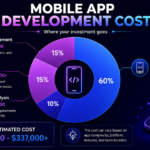
How Much Does Mobile App Development Cost in India?
The cost of Mobile App Development in India depends on several factors.
Some of the major factors include:
- Number of platforms
- Application complexity
- Number of features
- UI/UX requirements
- Backend development
- Third-party integrations
- Payment gateway integration
- Admin panel requirements
- Security requirements
- Development technology
- Testing requirements
- Post-launch maintenance
A simple consumer application may require a significantly smaller investment than a complex enterprise application with multiple integrations and advanced workflows.
For this reason, businesses should define their requirements and development scope before finalizing a budget.
How Long Does It Take to Develop a Mobile App?
The development timeline depends on the application’s complexity.
A basic MVP may be developed within a few weeks, while applications with advanced features, offline functionality, payment systems, enterprise integrations, and complex backend infrastructure may take several months.
A clear development plan should include:
- Discovery
- UI/UX design
- Development
- Testing
- Deployment
- Post-launch support
How to Choose the Right Mobile App Development Company in India
Choosing the right development partner is an important decision because the quality of development can affect the application’s performance, security, scalability, and long-term maintenance.
Before selecting a company, consider:
Technical Expertise
Check whether the development team has experience with Android, iOS, Flutter, React Native, backend technologies, APIs, and cloud platforms.
Industry Experience
A development partner with experience in your industry may better understand your users, workflows, regulations, and business challenges.
Portfolio
Review previous applications and projects to understand the company’s design quality, technical capabilities, and development experience.
Development Process
Ask about the company’s approach to requirement gathering, UI/UX design, development, testing, deployment, and maintenance.
Security
Security should be considered from the beginning, especially for applications that handle financial, personal, healthcare, or business data.
Post-Launch Support
Mobile applications require regular maintenance and updates. Choose a development partner that can support the application after launch.
Final Thoughts
Mobile App Development is no longer limited to large technology companies. Startups, small businesses, enterprises, and traditional businesses can use mobile applications to improve customer engagement, streamline operations, introduce new services, and create additional revenue opportunities.
The key is to build an application around a clear business objective rather than simply creating an app because competitors have one.
Whether you need Android App Development, iOS App Development, Flutter App Development, React Native App Development, or Custom Mobile App Development, choosing the right technology, development process, and technology partner can make a significant difference to the success of your application.