How Much Does Mobile App Development Cost in 2026?
If you have ever sat with a cup of filter coffee and wondered, “Boss, what will it actually cost me to build an app?” – you are not alone. This is probably the most common question every founder, shopkeeper, startup team, or even a large enterprise asks before they start their mobile app journey. And honestly, there is no one-line answer, because mobile app development cost depends on so many moving parts – just like the price of vegetables in Koyambedu market, it changes with season, demand, and quality.
In this article, we will break down everything in plain, simple language – no heavy jargon, no confusing tech-talk – so that by the end, you will have a clear, realistic picture of what to budget for your app in 2026.
Why Talking About App Development Pricing Matters More in 2026
The mobile app industry has grown leaps and bounds in the last few years. With AI features, voice search, regional language support, and UPI-based payment integrations becoming standard expectations rather than “nice-to-have” add-ons, the cost of building a mobile app has naturally gone up compared to 2020 or 2022. At the same time, competition among app development companies has increased, so pricing has also become more transparent and modular.
Whether you are asking about the app development budget for startups, cost to build an Android or iOS app, or custom mobile app pricing in India, this guide covers it all.
What Decides the Final Price of Your App?
Before we throw numbers at you, it is important to understand what actually drives the mobile application development cost. Think of it like building a house – the cost depends on the size, the materials used, the interior design, and who is doing the construction.
1. Type of App You Want to Build
- Basic app (simple utility, informational app, single-feature app) – lowest cost, quick turnaround.
- Medium complexity app (e-commerce, booking apps, on-demand services with payment gateway, chat, and notifications) – moderate cost.
- Complex or enterprise-grade app (apps with AI, machine learning, real-time tracking, multiple third-party integrations, high security compliance) – highest cost.
2. Platform Choice: Android, iOS, or Both
Building for a single platform is naturally cheaper than going for both Android and iOS simultaneously. Many businesses in India start with Android first, since Android holds a much bigger market share here, and then expand to iOS once the business gains traction – a smart, budget-friendly approach many Chennai and Bangalore startups follow.
3. Design Complexity (UI/UX)
A simple, template-based design will cost less than a fully custom, branded, animation-rich interface. If you want your app to look and feel premium – similar to how a well-decorated Marina Beach food stall attracts more customers than a plain one – you will need to invest more in design.
4. Backend and Third-Party Integrations
Payment gateways (Razorpay, PayU, UPI), maps, SMS/OTP verification, cloud hosting, push notifications, and AI chatbots all add to development time and, therefore, cost.
5. Team Location and Experience
This is a big one. A mobile app development company in India, especially in cities like Chennai, Hyderabad, Pune, or Coimbatore, will generally charge much less than agencies in the US, UK, or Australia – without compromising on quality. This is exactly why India continues to be a hotspot for affordable app development services globally.
6. Maintenance and Post-Launch Support
Many people forget this, but an app is not a “one-time cost, forget it” kind of investment. Bug fixes, OS updates, server costs, and feature upgrades are ongoing expenses – similar to servicing your bike or car regularly to keep it running smoothly.
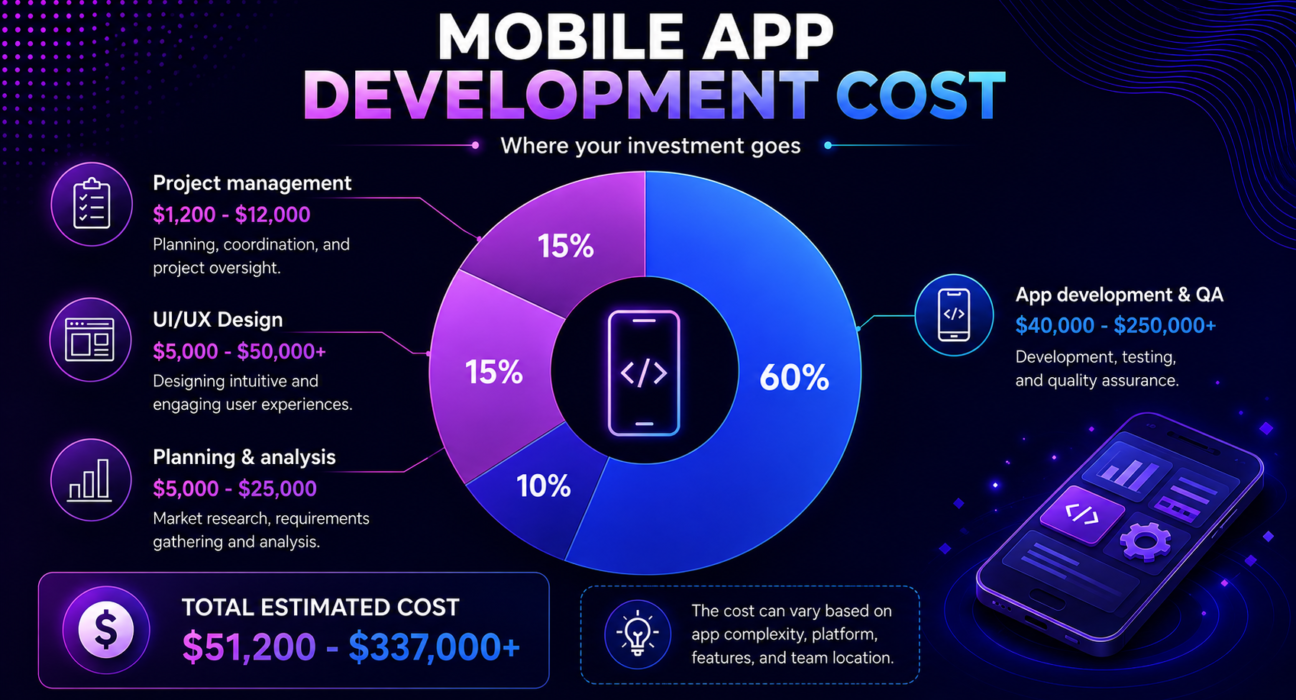
Mobile App Development Cost in 2026 – Realistic Price Ranges
Now, coming to the numbers everyone is waiting for. Please treat these as indicative ranges, since actual quotes will vary based on the company, your requirements, and the technology stack chosen.
Basic Apps (Simple Utility or Informational Apps)
Estimated cost: ₹1.5 lakh – ₹4 lakh These include apps with login, a few screens, static content, and basic navigation – like a small business directory app or a simple portfolio app.
Medium Complexity Apps (E-commerce, Booking, On-Demand Apps)
Estimated cost: ₹5 lakh – ₹15 lakh This category covers apps with user profiles, payment gateway integration, order tracking, admin panel, and push notifications – similar to a small to mid-sized online store or a local service booking app.
Complex or Enterprise Apps (AI-Driven, Multi-Platform, High Security)
Estimated cost: ₹18 lakh – ₹60 lakh and above These are apps built for large-scale businesses, fintech platforms, healthcare apps with compliance needs, or apps requiring AI-based personalization and heavy real-time data processing.
On an Hourly Basis
Many Indian development teams also work on an hourly billing model, which typically ranges between ₹800 to ₹3,000 per hour, depending on the seniority of developers and complexity of work – much more pocket-friendly compared to western hourly rates that can go 4-5 times higher for similar output.
Region-Wise Cost Comparison (India vs Global Markets)
If you are comparing app development cost in India versus USA or UK, here is a quick, simple picture:
- India: Most economical, with strong technical talent – a full-featured app can be built for a fraction of what it costs abroad.
- USA/Canada: Development costs can be 4x to 6x higher than India for similar app complexity.
- UK/Australia: Similarly high, often comparable to or slightly above US rates.
- Eastern Europe: Moderately priced, sitting somewhere between India and Western countries.
This cost advantage is a big reason why global clients often prefer outsourcing their custom app development work to Indian companies without any compromise on quality – much like how Chennai’s IT corridor along OMR has become a magnet for international clients over the years.
Hidden Costs People Often Forget to Budget For
Just like how a wedding budget always overshoots because of “small-small” extra expenses, app development also has some hidden costs that first-time founders often miss:
- App Store and Play Store listing fees (one-time and annual charges)
- Third-party API and licensing costs (maps, SMS gateways, payment processors)
- Cloud hosting and server charges (monthly or yearly, based on usage)
- App maintenance and updates (usually 15-20% of the original development cost, per year)
- Marketing and App Store Optimization (ASO) to actually get downloads after launch
Ignoring these can throw your entire budget planning off track, so it is wise to keep a buffer of at least 15-20% over your core development quote.
How to Reduce Your App Development Budget Without Cutting Corners
Everyone wants a good app at a reasonable price – and that is completely fair. Here are some practical, tried-and-tested ways to manage your app development cost effectively:
- Start with an MVP (Minimum Viable Product) – build only the core features first, launch, gather feedback, then expand. No point building a five-star hotel when a comfortable, functional home will do the job initially.
- Choose cross-platform development (like Flutter or React Native) instead of building separate native apps – this can cut costs significantly while still covering both Android and iOS.
- Work with an experienced Indian development partner who understands both technology and business goals – many are as capable as international agencies but charge far more reasonably.
- Avoid frequent scope changes mid-project, as this is one of the biggest reasons budgets balloon unexpectedly.
- Plan for maintenance from day one, so there are no last-minute surprises after launch.
Choosing the Right App Development Partner
While cost is important, it should never be the only deciding factor. A cheaper quote that leads to a poorly built app will cost you more in the long run – through lost customers, bad reviews, and rework expenses. It is always better to treat your app development partner selection the way you would choose a good doctor – based on trust, experience, and track record, not just the consultation fee.
Look for a company that is transparent about pricing, shows you previous work, explains the technology choices in simple terms, and offers proper post-launch support. A good development partner will also guide you honestly on what features you truly need at launch versus what can wait for a later phase – saving you money without cutting quality.
Conclusion
Building a mobile app in 2026 is more accessible than ever, but the mobile app development cost still depends heavily on what you want to build, who builds it, and how well you plan the whole journey. Whether your budget is a modest few lakhs or a much bigger enterprise-level investment, the key is to plan smart, prioritise the right features first, and choose a development partner who genuinely understands your business – not just your code requirements.
At the end of the day, your app is an investment in your business’s future, not just an expense. Spend wisely, plan realistically, and build something that truly serves your users well – because a well-built app, much like a well-brewed filter coffee, always leaves a lasting good impression.