Lead Follow Up Strategy: How to Build One Your Sales Team Will Actually Follow
Most sales teams do not lose leads because their product is weak. They lose them because nobody called back at the right time, or the second call never happened. A clear lead follow up strategy fixes this by deciding who contacts each lead, when, how often and on which channel.
Without that plan, follow-up depends on memory and mood. With it, every lead gets a fair chance, and managers can see what is pending. Teams that use follow-up scheduling and reminders in a CRM can run this process far more consistently than teams using notebooks or spreadsheets. This guide gives you a practical seven-step plan you can adapt to your own business.
What Is a Lead Follow Up Strategy?
A lead follow up strategy is a written plan for how your team contacts a lead after the first enquiry. It defines the response time, the number of attempts, the gap between them, the channels used and the person responsible. Its goal is to move each lead to a clear outcome: sale, lost or nurture.
It is different from a sales pitch. The strategy covers the process around the conversation, not the conversation itself.
Why a Lead Follow Up Strategy Matters
Interest in a product is highest at the moment of enquiry, and it fades with time. Slow or missing follow-up is also very common.
A widely cited 2011 Harvard Business Review article, The Short Life of Online Sales Leads, shows both problems. Its research on about 1.25 million online leads found that firms contacting a lead within an hour were nearly seven times as likely to qualify it as firms that waited one more hour. The same article reports that when companies were tested with online enquiries, only 37% replied within an hour and 23% never replied at all. The data is from US online leads, so use it as a guide, not a benchmark for your market.
The benefits of a clear plan are practical:
- Fewer leads are forgotten
- Response times become predictable
- New agents learn the process faster
- Managers can coach using real data
- Customers get a more professional experience
7 Steps to Build a Lead Follow Up Strategy
1. Define Your Lead Stages
Start by naming the stages a lead moves through, such as New, Contacted, Interested, Site Visit or Demo Done, Negotiation, Won and Lost. Then define what “followed up” means. A call that rang unanswered is an attempt, not a conversation, and your reports should show the difference.
2. Set a First-Response Standard
Decide how fast a new lead must be contacted. For example, within 15 to 30 minutes during working hours, and by 10 AM the next day for after-hours enquiries. Pick a target your team can meet every day, then tighten it later.
3. Prioritise Leads by Quality
Not every lead deserves the same effort. Score or tag leads as hot, warm or cold using simple signals: source, budget, urgency and responses so far. Hot leads get contacted first and reminded sooner. Cold leads move to a slower cadence.
4. Build a Contact Cadence
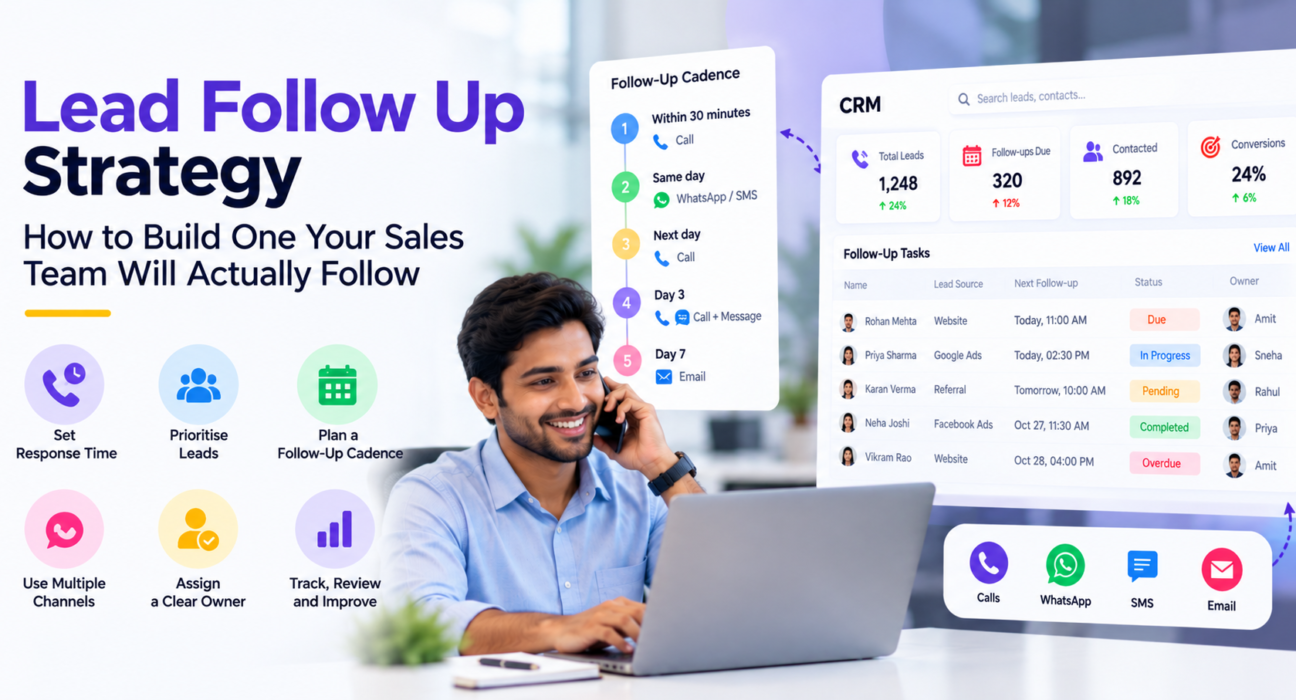
A cadence is the sequence of attempts after the first contact. Set the number of attempts, the gap between them, and what each touch should achieve. Vary the time of day, because a lead who misses your morning call may pick up in the evening. The table below shows a sample you can adapt.
5. Mix Channels Sensibly
Do not rely on calls alone. After an unanswered call, a short WhatsApp message or SMS with the customer’s consent gives them an easy way to reply. Email suits documents, quotations and detailed information. Respect DNC lists and legal calling hours on every channel.
6. Assign a Clear Owner
Every lead needs one named owner. Use assignment rules, such as round-robin, language match or a fixed agent, so leads do not wait for someone to pick them up. Assign only to agents who are available that day.
7. Track, Review and Improve
Review the follow-up data weekly. Look at response time, attempts per lead, contact rate and overdue follow-ups. Then change one thing at a time, such as the call timing or the message template, and watch the result.
A Sample Follow-Up Cadence
This is a hypothetical starting template, not a proven formula. Change the timing to suit your sales cycle.
| Touch | Timing | Channel | Purpose |
|---|---|---|---|
| 1 | Within 30 minutes | Call | Introduce yourself and understand the need |
| 2 | Same day, if unanswered | WhatsApp or SMS | Share a short message and ask for a good time to talk |
| 3 | Next day, at a different hour | Call | Retry when the lead may be free |
| 4 | Day 3 | Call and message | Share useful details such as pricing or brochure |
| 5 | Day 5 to 7 | Call | Check interest and answer doubts |
| 6 | Day 10 to 14 | Email or WhatsApp | Final check, and offer to reconnect later |
After the last touch, move the lead to a nurture list instead of calling endlessly.
Examples of Follow-Up Strategy by Industry
These are hypothetical examples, not customer case studies.
- Real estate: A lead enquires about a 2 BHK from a property portal. The executive calls within minutes, sends project details on WhatsApp, and schedules a site visit follow-up for the next day. See how this suits real estate teams.
- Education: A coaching institute receives enquiries after an ad campaign. Counsellors call hot leads the same day, then follow up with fee details and a reminder before the admission deadline. This is a common pattern for education businesses.
- Insurance: An agent speaks to a prospect who needs time to compare plans. The agent logs a follow-up date, sends a quote by email, and calls again before the quote expires. Insurance teams use this kind of scheduled follow-up often.
Metrics That Show Whether Your Strategy Works
You cannot improve what you do not measure. Track these basics:
- First response time: how long a new lead waits for the first contact
- Attempts per lead: how many times each lead is tried before closing
- Contact rate: the share of leads you actually speak to
- Overdue follow-ups: scheduled calls that were not made on time
- Stage conversion: how many leads move from one stage to the next
- Source performance: which lead sources turn into customers
How Lead Follow-Up Software Helps
A spreadsheet can work for ten leads a day. At fifty or a hundred, it breaks down. Lead follow-up software keeps every lead, call, note and next step in one place, and reminds agents when action is due.
When you compare tools, look for:
- Follow-up scheduling with reminders and overdue alerts
- Call logging with outcomes and notes
- Lead scoring or priority tags
- Assignment rules and ownership
- WhatsApp, SMS and email templates
- Reports on response time and contact rate
- A mobile app for field and remote teams
For a wider checklist, read our guide on how to choose the best telecalling CRM.
How TeleCallingCRM Can Help Your Lead Follow Up Strategy
TeleCallingCRM is a CRM built for Indian telecalling and outbound sales teams. Its verified features line up with the steps above:
- Follow-ups: One-tap scheduling, reminders before a call is due, overdue alerts, and Today, Overdue and Upcoming lists. Smart timing can create the next follow-up from the call outcome, and hot leads get reminders sooner.
- Lead priority: Leads can be scored Hot, Warm or Cold, and marked high, normal or low priority.
- Assignment: Assignment rules support round-robin, language match or a fixed agent, and only to agents who are punched in.
- Messaging: SMS, email and WhatsApp templates, with the full conversation on one timeline per lead.
- Automation: A no-code workflow builder can auto-assign leads, send messages and alert managers, including when a follow-up is due.
- Compliance controls: DNC numbers are skipped, and the dialer keeps calls within a set calling-hours window.
- Reporting: Connection rate, answer rate and a custom report builder for calls and follow-ups, plus a live War Room for real-time team activity.
- Campaigns: Campaign tags let you compare conversion, talk time and cost per lead.
Plans start at ₹999 per month for up to 5 users, with all features in every plan and a 3-day free trial. Details are on the pricing page. A CRM supports your process but cannot replace it, so settle the first six steps before you configure any tool.
Common Mistakes to Avoid
- Giving up too early. One or two attempts is rarely enough. Set a minimum number of tries.
- Calling at the same time every day. Vary the hour to reach people at different points in their day.
- Treating all leads equally. Without priority, hot leads wait behind cold ones.
- No clear owner. Shared responsibility usually means no responsibility.
- Skipping notes. The next call starts from zero if the last one was not recorded.
- Over-contacting. Too many calls and messages annoy leads and harm your reputation.
- Never reviewing the data. A strategy that is never measured cannot improve.
FAQs
What is a lead follow up strategy?
A lead follow up strategy is a plan that defines how and when a sales team contacts a lead after an enquiry. It covers response time, number of attempts, gaps between them, channels and ownership. The aim is that no lead is forgotten and every one reaches a clear outcome.
How quickly should you follow up with a new lead?
As fast as your team can do consistently. Research on online leads shows that conversion chances fall quickly after the first hour. Many teams aim for 15 to 30 minutes in working hours, and early next morning for after-hours leads. Start with a realistic target and improve it.
How many times should you follow up with a lead?
There is no single right number. It depends on your product, price and sales cycle. A common approach is five to seven touches over two weeks, mixing calls and messages, then moving the lead to a nurture list. Track your own contact and conversion data to find the right number.
Which channel is best for lead follow-up?
Calls usually work best for first contact because they allow a real conversation. WhatsApp or SMS suits quick reminders and easy replies, while email suits quotations and documents. Use a mix, and always follow consent, DNC and calling-hour rules.
What should a CRM have for lead follow-up?
It should schedule follow-ups with reminders, flag overdue ones, log every call with notes and show full lead history. It should also assign leads to owners, support WhatsApp, SMS and email templates, and report on response time and contact rate. A mobile app helps field teams.
Can small businesses use a lead follow up strategy?
Yes. A small team can start with a simple version: one response-time target, a six-touch cadence, a named owner for each lead and a weekly review. The process matters more than company size. As volume grows, a CRM makes it easier to keep the discipline.
What is the difference between lead follow-up and lead nurturing?
Lead follow-up is active contact to move a lead towards a decision, usually through calls and messages in the first days or weeks. Lead nurturing is slower, longer-term engagement with leads who are not ready to buy, often through useful content and periodic check-ins. Most strategies use both.
Conclusion
A good lead follow up strategy is simple. Set a response standard, prioritise leads, follow a cadence, mix channels, give each lead an owner and review the numbers every week. The plan matters more than any tool, but the right tool makes it easier to stick to.
If you are ready to move from spreadsheets to structured lead management software, you can try TeleCallingCRM free for 3 days and test it on your own team’s follow-up process.