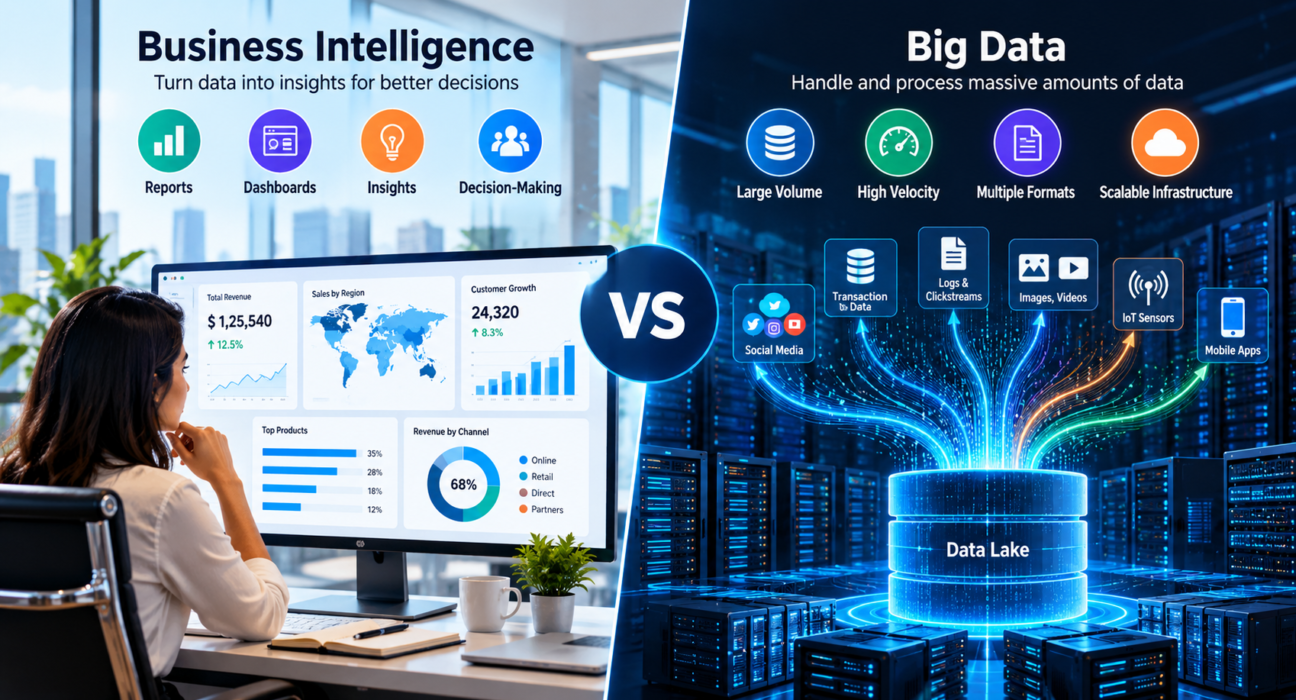
Business intelligence (BI) is the practice of turning business data into reports, dashboards, and insights that support better decisions. Big data, on the other hand, refers to datasets so large, fast, or varied that traditional tools can’t easily store or process them. Put simply, BI is about using data to make decisions, while big data is about handling data at massive scale.
If you’re weighing business intelligence vs big data for your company, the answer is rarely either/or. In fact, many organizations use BI to understand performance and rely on big data technologies to feed that analysis with richer sources. This guide explains what each term means, how they differ, and how they work together. It also helps you decide where to invest first.
Business Intelligence vs Big Data at a Glance
| Factor | Business Intelligence | Big Data |
|---|---|---|
| Core purpose | Support business decisions with reports and dashboards | Store, process, and analyze very large or complex datasets |
| Typical data | Mostly structured (sales, finance, CRM, inventory) | Structured, semi-structured, and unstructured (logs, sensor data, social media, clickstreams) |
| Main question | “What happened, and why?” | “What patterns exist in all this data?” |
| Typical users | Business managers, analysts, executives | Data engineers, data scientists, technical teams |
| Common tools | Power BI, Tableau, Looker, Qlik | Hadoop, Apache Spark, Kafka, cloud data lakes |
| Focus | Insight and decision-making | Volume, speed, variety, and processing |
What Is Business Intelligence?
Business intelligence is the set of strategies, processes, and tools that collect data from across a business, organize it, and present it in a form people can act on.
A typical BI setup includes:
- Data sources: accounting software, CRM, ERP, e-commerce platform, marketing tools
- Data integration and storage: often a data warehouse where information is cleaned and standardized
- Analysis and visualization: dashboards, scorecards, and scheduled reports
- Governance: rules on who can see and change what
BI mostly answers questions about the past and present. For example, it can show:
- Which product lines drove the most revenue last quarter
- Which regions are behind on sales targets
- How customer churn has changed over the last year
Because BI tools are designed for business users, a marketing manager can often explore a dashboard without writing code. That accessibility is one of its biggest strengths.
What Is Big Data?
Big data describes datasets that are too large, too fast, or too varied for conventional databases and spreadsheets to manage well. Most explanations rely on a few “V” characteristics:
- Volume: the sheer amount of data being generated and stored
- Velocity: how quickly data arrives and needs to be processed
- Variety: the mix of formats, from database tables to text, images, video, and machine logs
In addition, some frameworks add veracity (data quality and trustworthiness) and value (the usefulness of the data).
Big data isn’t a single product. Instead, it’s an ecosystem of technologies, such as distributed storage, stream processing, and cloud data platforms, that let organizations work with data at this scale. Common sources include website clickstreams, IoT sensors, mobile apps, payment systems, and social media.
The term describes the nature of the data and the technology needed to handle it, not a specific business outcome. As a result, big data becomes valuable only when someone analyzes it, whether through BI, machine learning, or data science.
Key Differences Between Business Intelligence and Big Data
1. Purpose
BI exists to support decisions. Big data, in contrast, describes data and the infrastructure required to manage it. Put another way, one is a use case and the other is a data challenge.
2. Type of Data
Traditional BI works best with structured, well-organized data, such as rows and columns in a database. Big data environments, however, routinely include unstructured content like emails, images, audio, and free-text feedback.
3. Scale and Speed
A BI dashboard refreshed daily from a data warehouse may be perfectly adequate for finance reporting. Big data setups, by contrast, are built for continuous, high-volume streams, such as processing millions of events as they happen.
4. Users and Skills
BI is aimed at business users and analysts. Big data, on the other hand, typically requires specialized skills in data engineering, distributed computing, and data science.
5. Type of Analysis
BI usually focuses on descriptive and diagnostic analysis, meaning what happened and why. Big data environments more often support predictive and advanced analytics, such as forecasting, recommendation engines, and anomaly detection. That said, modern BI tools increasingly include predictive features, so the line is blurring.
6. Cost and Complexity
BI can often start small, with a few data sources and a handful of dashboards. Big data initiatives, however, usually involve more infrastructure, more engineering effort, and more ongoing management. Because the exact cost depends heavily on your setup, treat any estimate as something to verify with providers.
Are Business Intelligence and Big Data the Same Thing?
No, they are related but different. BI is a discipline focused on decision support, whereas big data is a category of data and technology. For instance, a small company can practice BI with a simple sales dashboard and no big data at all. Conversely, a company can collect huge volumes of logs and still lack mature BI if it rarely turns them into business insight.
How Business Intelligence and Big Data Work Together
The two are strongest when combined. Big data technologies collect and process large, varied data, and then BI presents the results in a form decision-makers can use.
Consider a mid-sized online retailer:
- Big data layer: The company captures website clicks, app behavior, and order data in a cloud data platform.
- Processing: Engineers then clean and organize this data, combining it with inventory and marketing data.
- BI layer: Next, the cleaned data feeds dashboards showing conversion rates by channel, cart abandonment trends, and stock-out risks.
- Decision: As a result, the marketing manager shifts budget to the channel with the strongest return, and the operations team adjusts reorder levels.
Without the big data layer, the dashboards would miss behavioral detail. Likewise, without BI, the data would sit unused. Together, they connect raw data to real decisions.
Which Does Your Business Need?
Use this checklist to gauge where you stand.
BI is probably your priority if:
- Most of your data lives in a few business systems (CRM, accounting, e-commerce)
- Teams still build reports manually in spreadsheets
- Leaders can’t easily see key metrics in one place
- Clearer, faster reporting is your main need
Big data capabilities may be worth exploring if:
- High-volume data such as app events, sensor readings, or transaction streams is part of your business
- Existing databases are slowing down or can’t handle new data types
- Real-time processing or advanced analytics is on your roadmap
- You plan to build machine learning or personalization features
You likely need both if:
- You already have large, varied data and want business teams to benefit from it
- You’re building a modern data platform from scratch
For many startups and small businesses, the sensible first step is BI, which means getting reliable reporting on core data. Big data investments, meanwhile, make sense once data volume or complexity outgrows your current setup.
Common Tools and Technologies
The examples below are well-known categories, not recommendations.
Microsoft Power BI, Tableau, Looker, and Qlik are widely used for dashboards and reporting. On the big data side, Apache Hadoop, Apache Spark, and Apache Kafka are commonly used for large-scale storage and processing. In addition, major cloud providers offer managed data lake and analytics services.
Since product features and pricing change often, check each vendor’s current documentation before deciding.
Common Mistakes to Avoid
- Starting with tools instead of questions. First, define the business decisions you want to improve. Technology choices should follow.
- Assuming you need big data. If your data fits comfortably in a standard database, a big data platform may add complexity without benefit.
- Ignoring data quality. Dashboards built on inconsistent or incomplete data produce misleading conclusions, no matter how advanced the tools.
- Skipping governance. Decide early who owns the data, who can access it, and how privacy and compliance requirements are handled.
- Building without adoption in mind. A dashboard nobody uses has no value, so involve business users from the start.
How to Find the Right Partner for BI or Big Data Projects
Many companies don’t build these systems alone. Instead, they work with software development firms, data consultancies, or IT service providers that specialize in analytics, data engineering, or BI implementation. When evaluating providers, consider the following:
- Relevant experience. Check whether they have worked on projects similar in scope and industry.
- Technical fit. Confirm they have skills in the tools and cloud platforms you plan to use.
- Approach to data quality and security. Ask how they handle integration, governance, and access control.
- Communication and delivery process. Look for clear timelines, milestones, and reporting.
- Post-launch support. Data platforms need ongoing maintenance, so ask what happens after launch.
At the research stage, a directory like GoFirms can help you discover and compare technology and software service providers before you shortlist and speak with them directly. Either way, verify credentials and ask for references and relevant case studies.
Frequently Asked Questions
What is the main difference between business intelligence and big data?
Business intelligence focuses on analyzing business data to support decisions through reports and dashboards. Big data, on the other hand, refers to extremely large, fast-moving, or varied datasets that need specialized technology to store and process. In short, BI turns data into insight, while big data manages data at scale.
Is business intelligence part of big data?
Not exactly. BI and big data are separate concepts that often overlap. For example, BI can work with ordinary business data without any big data technology. However, when organizations use big data platforms, BI tools frequently sit on top to visualize and share results with business users.
Do small businesses need big data?
Usually not at first. Most small businesses gain more from BI, such as consolidating sales, finance, and marketing data into clear dashboards. Big data technology becomes relevant only when data volume, speed, or variety exceeds what standard databases and tools can handle comfortably.
Can you use business intelligence without big data?
Yes. Many companies run effective BI on data from a CRM, accounting system, or e-commerce platform, stored in a standard database or data warehouse. Big data infrastructure, therefore, is optional and needed only when data scale or complexity demands it.
What are examples of business intelligence and big data tools?
Common BI tools include Power BI, Tableau, Looker, and Qlik. Big data technologies, meanwhile, include Apache Hadoop, Apache Spark, and Apache Kafka, along with managed cloud data platforms. The right choice depends on your data, budget, team skills, and goals, so review current vendor details before committing.
Which is better for decision-making, BI or big data?
BI is more directly built for decision-making because it presents insights in a form business users can act on. Big data supplies richer raw material, but it needs analysis to become useful. For the strongest results, many organizations combine both.
How do I choose between BI and big data for my company?
Start with the decisions you want to improve and the data you already have. When unclear reporting is your challenge, begin with BI. When your challenge is managing massive or fast-growing data, explore big data capabilities. Still unsure? A data or software development partner can provide an assessment.
Conclusion
The business intelligence vs big data question comes down to purpose. BI turns business data into insight for decision-makers, while big data is about collecting and processing information that’s too large or complex for conventional systems. Ultimately, they aren’t rivals. Big data can feed BI with richer inputs, and BI makes that data useful to the people running the business.
To get started, define the decisions you need to improve, assess the data you have, and scale your tools as your needs grow. If you need outside expertise, you can research and compare software and technology service providers through GoFirms to build a shortlist that fits your project.