Field Collection Tracking: How to Track Collections and Settlement in Real Time
Your collection executive visits ten customers and returns with a list of amounts and a bundle of cash. Nobody in the office can confirm the visits happened, that the amounts match the receipts, or when the money will reach the bank.
That gap between collecting and settling is what field collection tracking closes. This guide covers what to track, how real-time settlement visibility works, which practices reduce leakage and delays, and what to look for in software.
What Is Field Collection Tracking?
Field collection tracking is the process of monitoring payments collected by field staff, from the visit to the customer through to deposit and reconciliation, using live location, digital proof and status updates instead of paper receipts and end-of-day phone calls.
It answers four questions at any moment:
- Who is collecting, and from which customer?
- Where did the visit happen, and was the executive actually there?
- How much was collected, in what mode (cash, cheque, UPI or transfer), and with what proof?
- Has it settled, meaning deposited, reconciled and matched to the customer’s outstanding balance?
Field collection management often covers more than payments. It can also include visit planning, follow-up scheduling and customer verification, which is why it is usually handled inside broader field force management software.
Why Manual Collection Tracking Breaks Down
Most teams begin with receipt books, WhatsApp updates and spreadsheets. This works for a handful of people and fails as volume grows.
Common problems include:
- Delayed visibility. Managers learn about collections at the end of the day, or the week, which is too late to follow up on a failed visit.
- Unverified visits. Without location or proof, a reported visit is only a claim.
- Cash-in-hand risk. Money held by executives overnight, or for several days, is exposed to loss, misuse and disputes.
- Reconciliation gaps. Receipts, deposit slips and ledger entries are matched by hand, so mismatches are found late.
- Customer disputes. A missing or illegible receipt turns a simple payment into an argument.
- Poor prioritisation. Overdue accounts get no focused follow-up because nobody has a live view of who paid and who did not.
What Should You Track in Real Time?
Tracking only the amount collected leaves out most of what matters. A useful system records the full chain of events.
| Stage | What to capture | Why it matters |
|---|---|---|
| Assignment | Customer, amount due, due date, assigned executive | Sets a clear target and owner |
| Route and visit | Live location, arrival time, visit outcome | Confirms the visit happened |
| Collection | Amount, payment mode, receipt, photo or signature | Creates proof of payment |
| Follow-up | Promise-to-pay date, reason for non-payment | Turns failed visits into scheduled actions |
| Deposit | Deposit amount, time and reference | Closes the gap between collection and company account |
| Settlement | Match against collections and customer balance | Confirms nothing is missing |
How to Track Field Collections in Real Time: Step by Step
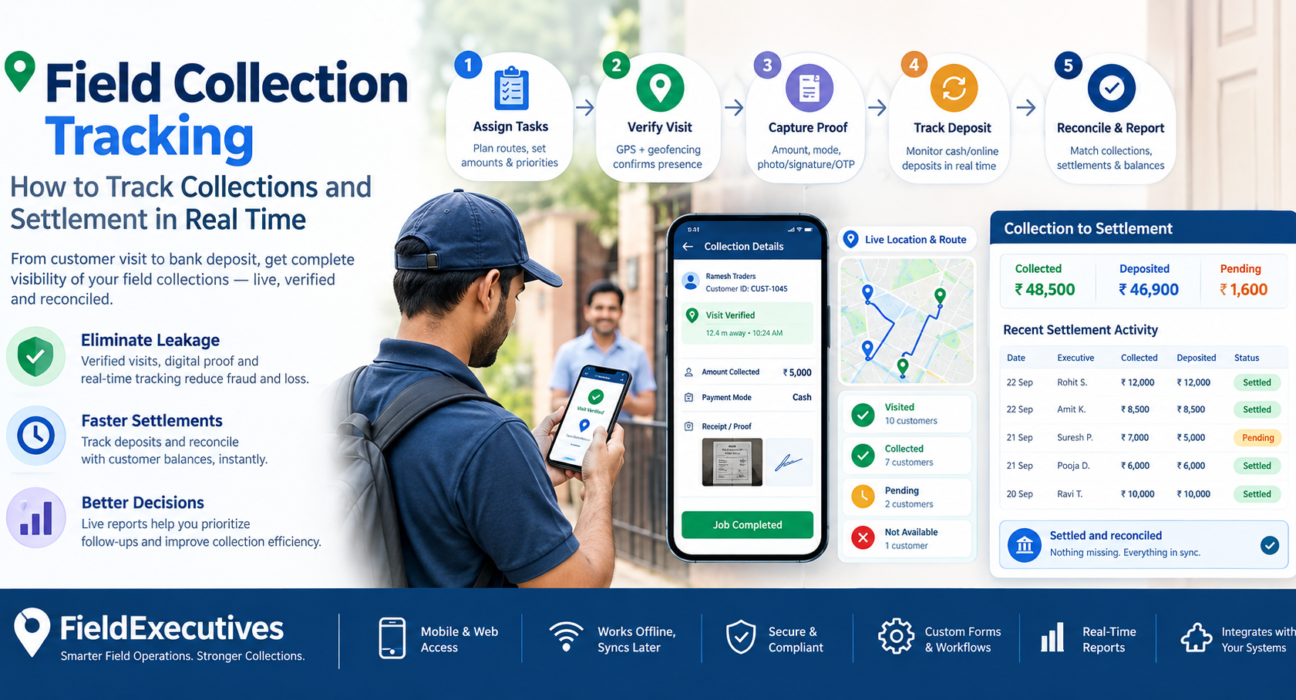
To track field collections in real time, assign each collection digitally, verify each visit by location, capture proof at the point of payment, and update status as soon as the executive submits it.
- Assign collection tasks digitally. Create a task for each customer with the amount due, due date and priority, and assign it to an executive. Group tasks into routes so the day is planned, not improvised.
- Verify the visit. Use GPS and geofencing so the system records whether the executive was at the customer’s location. This turns “I visited” into evidence.
- Capture proof at the point of collection. Record the amount, payment mode and supporting proof such as a photo, signature or OTP, and make sure the app works offline in low-network areas.
- Update status immediately. Every visit should end with an outcome: collected, partially collected, promised, or not available. Managers then see results as they happen.
- Track deposits against collections. Compare what each executive collected with what was deposited, and flag differences the same day.
- Reconcile and report. Match settled amounts to collections and customer balances, then review executive-wise, route-wise and customer-wise reports.
Understanding Collection Settlement
Collection and settlement are different events. Collection is when the customer pays the field executive. Settlement is when that money is deposited, matched to records and credited against the customer’s account.
The gap between the two is where most risk sits. Settlement tracking should show:
- Total collected versus total deposited, by executive and by day
- Pending deposits, with the age of each
- Mismatches between receipts and deposit amounts
- Payments made through different modes, tracked separately
Reviewing this daily is much easier than untangling a month of accumulated differences.
Best Practices for Field Collection Tracking
Set a deposit rule and enforce it
Define how quickly collected cash must be deposited, and make pending deposits visible to managers. A clear rule with visible exceptions changes behaviour faster than a policy document.
Require proof for every collection
No proof, no closed task. Requiring a receipt, photo or signature protects both the company and the executive when a customer disputes a payment.
Plan routes around outstanding accounts
Group nearby customers and prioritise high-value or overdue accounts. Route planning reduces travel time and increases the number of visits per day.
Record non-payment reasons
“Customer not available” and “will pay next week” are different situations. Structured reasons and promise-to-pay dates make follow-ups measurable.
Use structured forms
Custom forms keep data consistent across executives, which makes reports easier to trust and reconcile.
Review a small set of metrics daily
Useful measures include:
- Collection efficiency (collected versus due)
- Visits completed versus planned
- Pending deposits and their age
- Promise-to-pay conversion
- Executive-wise and route-wise performance
Keep the app usable offline
Field teams often work where connectivity is weak. Offline capture that syncs automatically prevents lost entries and delayed updates.
Manual Tracking vs. Software-Based Tracking
| Factor | Manual (paper, calls, spreadsheets) | Field collection software |
|---|---|---|
| Visibility | End of day or later | Live |
| Visit verification | Verbal report | Location-stamped |
| Proof of payment | Paper receipts | Digital proof |
| Reconciliation | Manual matching | Structured, faster |
| Reporting | Compiled by hand | Real-time dashboards |
| Audit trail | Limited | Recorded per action |
What to Look for in Collection Tracking Software
Before choosing a tool, check whether it can:
- Assign collection tasks and routes to specific executives
- Track live location and verify visits with geofencing
- Capture payment amount, mode and proof at the customer’s location
- Work offline and sync when connectivity returns
- Show collection-to-settlement status, not just amounts collected
- Support custom forms and workflows for your process
- Provide real-time reports for managers and owners
- Integrate with the systems you already use, such as CRM, ERP or accounting
How FieldExecutives Helps With Field Collection Tracking
Businesses looking to simplify these processes can use field force management software such as FieldExecutives, which brings collections into the same platform used to manage field teams.
Based on the platform’s published features, teams can use FieldExecutives to:
- Assign collection jobs with a guided job card showing where to go, whom to meet and what to collect
- Capture proof through photo, signature and OTP, with checklists that must be completed before a job closes
- Verify presence through GPS-stamped, geofenced activity and a live map of the team
- Work offline, with data syncing when the executive reconnects
- Follow collections through to settlement, alongside expense claims, in one workflow
- Build custom forms and workflows to match how your collection process runs
- Review real-time KPIs and reports for managers, directors and owners
It is designed for teams that collect in the field, including banking and NBFC, microfinance and recovery teams, distribution businesses and field service companies. It runs as a mobile app for executives, a web console for managers and an admin portal for owners.
Conclusion
Field collection tracking replaces guesswork with a clear chain of evidence: an assigned task, a verified visit, proof of payment, a deposit and a reconciled record. The fewer steps that depend on memory or manual reporting, the fewer disputes, delays and leaks you will deal with.
Start by defining a deposit rule, requiring proof for every collection and reviewing pending settlements daily. Then move from spreadsheets to software that gives you live visibility. FieldExecutives can help you track collections from the field visit through to settlement on one platform. Book a demo to see how it would work for your collection process.