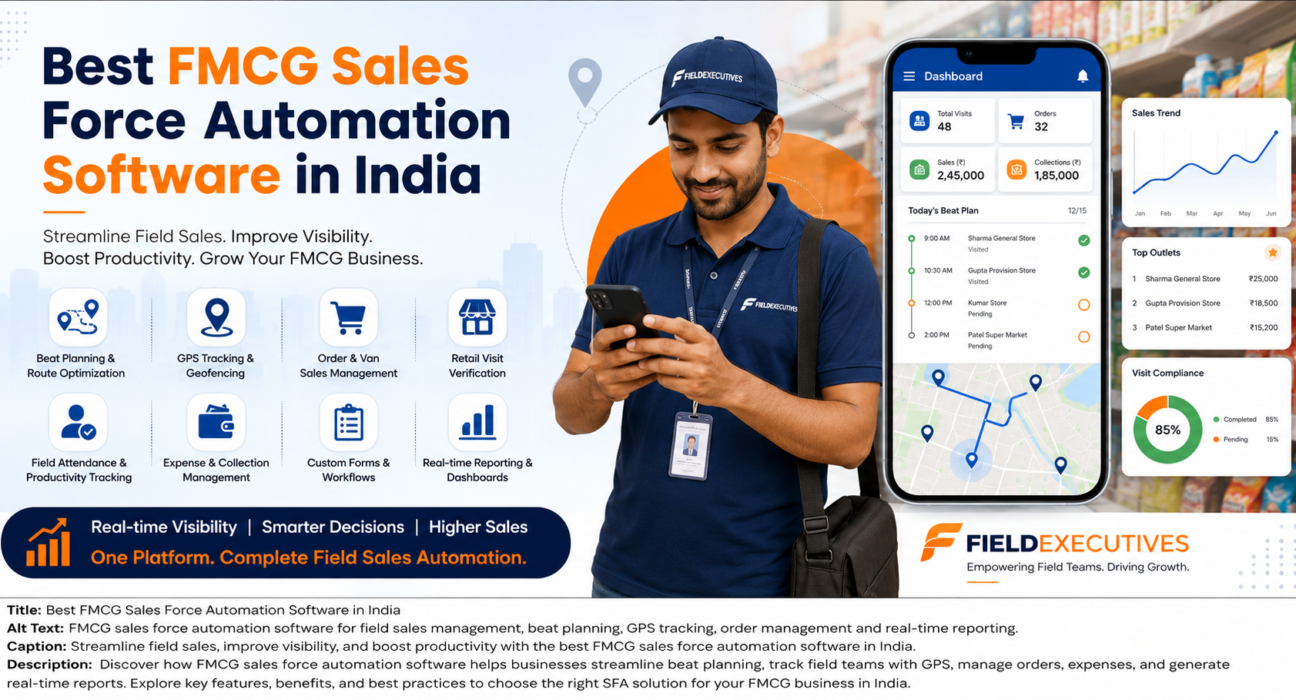
Best FMCG Sales Force Automation Software in India
If your field sales team still fills paper order books, calls in stock updates, and reconciles numbers a day late, you already know the cost. Orders get delayed, retailers run out of stock, and a missed beat only comes to light after a distributor complains. This is exactly the gap FMCG sales force automation software closes.
In this guide, we’ll break down what FMCG sales force automation (SFA) software actually does, the problems it solves for distribution-heavy businesses, the features worth prioritizing, and how to evaluate the right platform for your team in India.
What Is FMCG Sales Force Automation Software?
FMCG sales force automation software is a digital platform that helps consumer goods companies manage, track, and optimize their field sales operations — from beat planning and order booking to distributor visibility and reporting.
Sales reps use a mobile app to log visits, capture orders, update stock availability, and report on the go, instead of relying on manual registers, phone calls, and Excel sheets. Meanwhile, sales managers get real-time visibility into what’s happening across hundreds of outlets and territories from a single dashboard.
For FMCG businesses, where sales volumes run high and margins stay thin across large distribution networks, this visibility isn’t a convenience. It’s often the difference between hitting targets and missing them.
Why FMCG Companies in India Need Sales Force Automation
India’s FMCG distribution model runs in layers: company, distributor, stockist, and retailer, often spread across urban and deep rural markets. Managing this manually creates predictable friction points.
Common Challenges Without SFA Software
- No real-time visibility into which outlets were visited and which were skipped
- Delayed order processing, since orders are collected on paper and entered into systems later
- Inconsistent beat plans, which lead reps to visit convenient outlets repeatedly while others go unattended
- Stock-outs at retail, because field reps have no easy way to report inventory gaps
- Expense and claim disputes from manually submitted travel and daily allowance claims
- Limited accountability, as it’s hard to verify whether a reported visit actually happened
- Slow reporting cycles, so management decisions rely on last week’s data instead of today’s
As a result, these issues compound the moment a business tries to scale. A distributor network that works fine with 20 reps often breaks down at 200, simply because manual processes can’t keep pace with headcount.
What Sales Force Automation Solves
Sales force automation directly targets these gaps by digitizing the field sales workflow:
- Reps follow structured, system-generated beat plans instead of ad-hoc visit lists.
- Orders get captured on a mobile app and reflect in the system instantly.
- GPS tracking or geofencing confirms reps were physically present at the outlet, which verifies each visit.
- Managers view dashboards showing visit compliance, sales performance, and territory coverage in real time.
- Teams submit, approve, and track expense claims digitally, which reduces disputes.
Key Features to Look For in FMCG Sales Force Automation Software
Not all SFA tools work the same way. When you evaluate options, focus on features that map directly to FMCG field operations rather than generic CRM add-ons.
1. Beat Planning and Route Optimization
Look for software that lets you create structured beat plans — daily or weekly visit schedules mapped to specific outlets — and optimizes routes so reps spend less time traveling and more time selling.
2. Real-Time GPS Tracking and Geofencing
Field employee tracking with GPS and geofencing verifies that a rep actually visited the outlet they claim to have visited, within a defined radius. This reduces fake reporting and improves accountability without micromanaging the team.
3. Order and Van Sales Management
Reps should book orders directly from the field, check stock, and, for van sales models, process on-the-spot billing. As a result, the order-to-delivery cycle shortens significantly compared to manual entry.
4. Customer and Retail Visit Verification
Every outlet visit needs a log with time, location, and outcome. This gives sales managers a clear picture of retail coverage and outlet-level performance, not just aggregate numbers.
5. Attendance and Field Team Productivity Tracking
Field attendance tracking tied to GPS check-in and check-out helps you understand how reps spend their day and spot productivity gaps early.
6. Expense and Collection Management
Digital expense submission, approval workflows, and collection tracking for outstanding payments together remove a major source of manual reconciliation work for finance teams.
7. Custom Forms and Workflows
FMCG businesses often need to capture merchandising data, shelf audits, or competitor pricing. Custom forms let you build these data-capture workflows without needing a developer.
8. Real-Time Reporting and Dashboards
Reports on sales performance, visit compliance, SKU-level sales, and territory coverage should update in real time, not at the end of the week.
How to Choose the Right SFA Software for Your FMCG Business
Use this checklist when you shortlist vendors:
| Evaluation Criteria | What to Check |
|---|---|
| Ease of use for field reps | Does the app work well on low-end Android phones and low connectivity? |
| Offline functionality | Can reps log orders/visits offline and sync later? |
| Scalability | Can it handle your current team size and future growth? |
| Integration | Does it integrate with your existing ERP or distributor management system? |
| Customization | Can workflows and forms adapt to your specific sales process? |
| Reporting depth | Are dashboards actionable, or just raw data dumps? |
| Support and onboarding | Is implementation support available for rollout across distributors? |
| Pricing structure | Is pricing per-user, tiered, or based on modules used? |
However, price alone shouldn’t drive the decision. A cheaper tool that field reps find difficult to use, or that lacks offline support for rural markets, often ends up costing more in poor adoption and lost visibility.
Best Practices for Implementing Sales Force Automation
Rolling out SFA software successfully depends as much on process as on the tool itself.
- Start with a pilot territory. Test the software with one region or team before a full rollout.
- Involve field reps early. Adoption improves when reps understand how the app makes their day easier, not just how it tracks them.
- Keep beat plans realistic. Overloaded schedules reduce compliance and data quality.
- Review dashboards weekly, not just monthly, so issues surface early.
- Train distributor-side staff if the software touches secondary sales or stockist data.
- Set clear KPIs — visit compliance, order value per outlet, territory coverage — so you can measure the software’s impact.
How FieldExecutives Supports FMCG Field Sales Teams
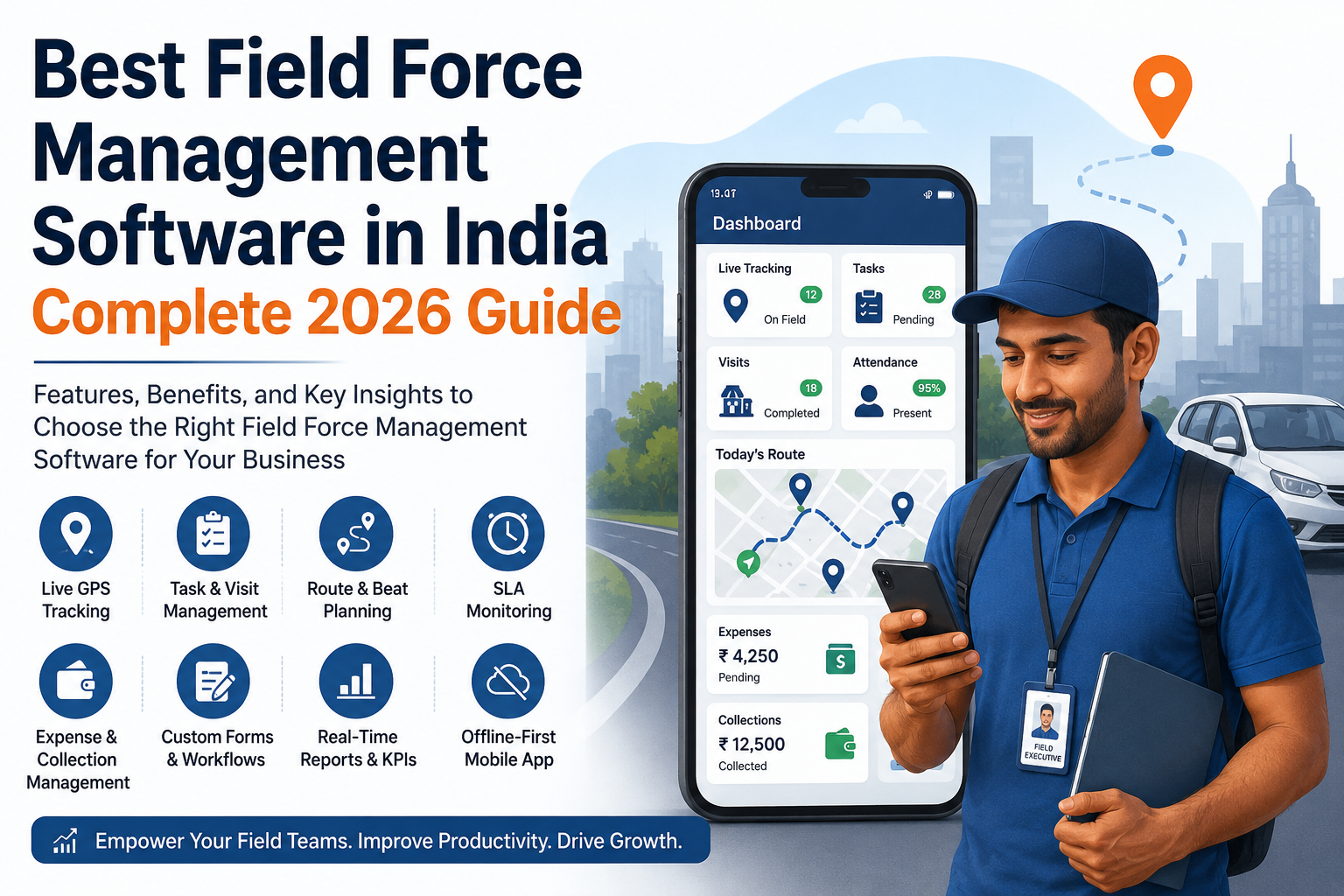
Businesses looking to simplify these processes can use field force management software such as FieldExecutives, which brings beat planning, GPS-based field employee tracking, order and visit management, expense tracking, and real-time reporting into a single platform built for field-heavy operations.
For FMCG companies specifically, sales managers gain visibility into outlet-level visit compliance, reps get structured routes instead of guesswork, and finance teams get cleaner expense and collection data, all without adding administrative overhead to the sales process.
[Internal Link Opportunity: FieldExecutives Field Sales Management solution page]
[Internal Link Opportunity: FieldExecutives GPS Tracking & Geofencing feature page]
[Internal Link Opportunity: FieldExecutives Beat Planning & Route Optimization feature page]
If your FMCG business is evaluating sales force automation software, comparing your current manual process against a structured, real-time system is a useful place to start.
[Internal Link Opportunity: FieldExecutives Pricing page]
Conclusion
Manual field sales processes simply can’t keep pace with the scale and complexity of FMCG distribution in India. Missed beats, delayed orders, and stock-outs aren’t just operational annoyances — they directly affect revenue and retailer relationships.
FMCG sales force automation software addresses these problems at the root by giving sales managers real-time visibility and giving field reps a simpler, structured way to do their jobs. The right platform combines beat planning, GPS-based tracking, order management, and reporting into one system, so decisions rely on what’s happening today rather than what happened last week.
If your team still relies on paper registers and phone calls to manage the field, it’s worth evaluating a dedicated SFA solution. Platforms like FieldExecutives bring this structure to field sales operations without adding complexity for your reps or your managers.