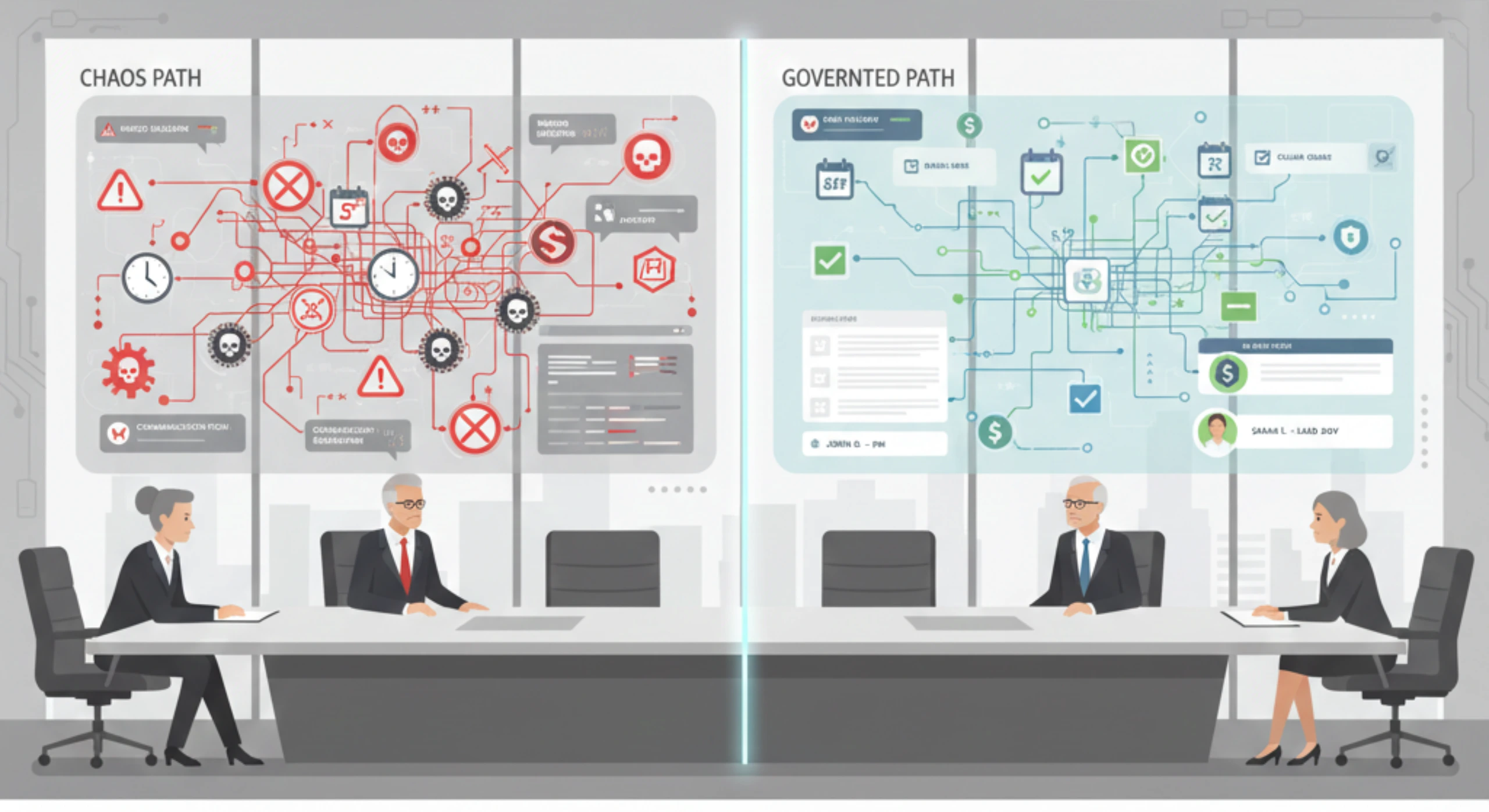
Every CIO has sat through that board meeting. The one where the CEO asks why the cloud migration is six months behind schedule, why costs have doubled, and why the sales team is still complaining about system downtime.
You had the right consultants. You approved the architecture. You signed off on the roadmap. And yet, here you are, explaining why a supposedly straightforward lift-and-shift has turned into a multi-year negotiation with reality.
This is not a technology problem. It is an execution problem.
Cloud migration for large enterprises is fundamentally different from what the case studies and vendor whitepapers suggest. It is not about choosing between AWS, Azure, or Google Cloud. It is about moving a living, breathing business with all its dependencies, politics, legacy debt, and daily operational pressures from one technology foundation to another without breaking anything critical.
And “anything critical” is a much longer list than most teams realize at the start.
Why Enterprise Cloud Migrations Fail (and It’s Rarely the Cloud)
Large enterprises do not fail at cloud migration because of poor technology choices. They fail because they underestimate the organizational complexity involved in executing such programs.
Let’s be specific about what actually goes wrong.
The Planning Trap
Most cloud migration programs begin with a detailed plan. Hundreds of applications mapped. Dependencies documented. Timelines created. Stakeholders aligned. Then reality hits.
The ERP system that was supposed to be “cloud-ready” requires a version upgrade that the vendor cannot support for another year. The data center contract that was ending in six months gets automatically renewed because someone missed a notice period. The compliance team discovers that certain data cannot leave specific geographies, invalidating half the cost assumptions.
The problem is not poor planning. The problem is that enterprises are too complex to plan perfectly upfront. By the time you have mapped every dependency, the business has changed, the technology landscape has shifted, and your plan is already outdated.
The Ownership Gap
In mid-to-large enterprises, especially those operating in India with global stakeholders, cloud migration quickly becomes everyone’s problem and no one’s responsibility.
IT owns the infrastructure. Application teams own the workloads. Business units own the budget. The CIO owns the outcome. The CFO owns the cost control. The CISO owns the security posture. The COO owns business continuity.
When something goes wrong and something always goes wrong the question becomes: whose problem is it to fix?
Without clear, single-threaded ownership at every layer of the program, cloud migrations stall. Not because of technical blockers, but because no one has the authority and accountability to make hard decisions quickly.
The Vendor Juggling Act
Enterprise cloud migrations involve multiple vendors. Cloud providers, legacy system integrators, specialized migration partners, network providers, security vendors, and often an army of consultants.
Each vendor optimizes for their own scope of work. The cloud provider wants you to consume more services. The integrator wants to extend the timeline. The consultant wants to expand the engagement. No one is optimizing for your actual business outcome.
Coordinating these vendors, holding them accountable to shared milestones, and ensuring they work as one coherent delivery unit is a full-time executive leadership challenge. Most enterprises understaff this coordination layer and pay for it later in delays and finger-pointing.
The Legacy System Reality
Every large enterprise has legacy systems that are older than some of their employees. These systems are often undocumented, built by people who have long left the organization, and deeply embedded into critical business processes.
The attitude toward legacy is usually one of two extremes. Either “we will rewrite everything in the cloud” or “we will lift-and-shift everything as-is.”
Both approaches fail.
Rewriting is expensive, risky, and slow. Lift-and-shift often moves technical debt to a more expensive environment without solving the underlying problems. The real work is in understanding which systems deserve investment, which need to be retired, and which can be migrated with minimal changes.
This requires business judgment, not just technical assessment.
What Actually Works: Execution Principles That Deliver
After watching dozens of enterprise cloud programs some successful, many not certain patterns become clear. The programs that succeed do not necessarily have better technology or bigger budgets. They have better execution discipline.
Start with Business Outcomes, Not Technology
The most common mistake is framing cloud migration as an IT project. It is not. It is a business transformation program that happens to involve technology.
Before designing your cloud architecture, answer these questions clearly:
What specific business capabilities are we trying to improve? Which processes are slowing us down today? Where are we spending money that is not creating value? What risks are we carrying that we need to reduce? How will we measure success in business terms, not just technical metrics?
If the answer is “we are moving to the cloud because everyone else is,” you are not ready. Cloud migration must solve real business problems, or it will be deprioritized the moment something more urgent comes along.
And in large enterprises, something more urgent always comes along.
Build a Delivery-First Governance Model
Governance in enterprise programs often means endless steering committee meetings where nothing gets decided. Effective governance is different. It is about creating the conditions for fast, informed decision-making.
This means:
A single executive owner who can make binding decisions across IT, business, and finance. A small, empowered core team with end-to-end accountability, not a matrix of stakeholders. Weekly decision forums with clear escalation paths, not monthly status updates. Transparent metrics on progress, blockers, and risks that everyone can see.
Governance is not about control. It is about removing obstacles so the delivery teams can move fast.
Migrate in Waves, Not All at Once
The instinct in large programs is to plan everything upfront and execute in one coordinated big-bang cutover. This almost never works.
The better approach is to identify a small, valuable workload that can be migrated quickly. Use it to test your process, validate your assumptions, and build organizational confidence. Then iterate.
Each migration wave should:
Deliver tangible business value, not just technical progress. Teach you something new about your environment. Build the muscle memory your teams need for larger, more complex migrations.
The first wave will be slow and painful. The tenth wave will feel routine. You cannot skip to wave ten. You have to earn the experience.
Treat Compliance and Security as Enablers, Not Gatekeepers
In Indian enterprises operating under global regulations, compliance and security are often seen as barriers to cloud adoption. Data localization requirements, industry-specific regulations, audit trails, and security certifications create genuine constraints.
The mistake is treating these as problems to be solved at the end. Build compliance and security into your cloud design from day one. Involve your legal, compliance, and security teams early. Make them part of the solution, not the approval chain.
When these teams understand the business case and see their requirements being addressed proactively, they become allies in the migration process, not obstacles.
Invest in People, Not Just Technology
The hardest part of cloud migration is not the technology. It is the people.
Your infrastructure teams need to learn cloud-native operations. Your developers need to understand DevOps and automation. Your architects need to design distributed systems. Your project managers need to manage uncertainty and rapid iteration.
This is not a training problem you can solve with a few certification courses. It is a culture shift that takes time, coaching, and real-world experience.
The enterprises that succeed in cloud migration invest heavily in their people. They create learning paths, rotate talent through cloud projects, and reward teams for building cloud capabilities, not just delivering features.
The Role of an Execution Partner in Enterprise Programs
There is a reason many enterprises choose to work with specialized partners for large-scale cloud migrations. It is not because they lack internal talent. It is because they need execution capacity, program discipline, and someone who has made all the mistakes before.
A good execution partner brings three things that are hard to build internally:
Deep delivery experience. They have managed complex migrations before. They know where the landmines are. They can tell you what is normal friction and what is a red flag.
Program maturity. They have the processes, frameworks, and tools to manage multi-vendor, multi-workload programs without losing control. They can keep dozens of moving parts synchronized.
Accountability without politics. An external partner can make hard calls and hold vendors accountable without navigating internal organizational dynamics. They can tell you when your timeline is unrealistic, when your architecture needs to change, and when you need to stop a workstream that is not working.
For example, firms like Ozrit position themselves not as technology vendors but as enterprise delivery partners. Their value is not in writing code or configuring cloud infrastructure. Their value is in taking ownership of complex programs and delivering them predictably.
This distinction matters. Many enterprises are sold cloud migration “solutions” by vendors who disappear when things get difficult. What you need is a partner who shows up every day, navigates the complexity with you, and takes accountability for outcomes.
Managing the Cost Reality of Cloud Migration
Every cloud business case starts with cost savings. And every CFO, halfway through a migration, wonders why costs are going up, not down.
The truth is that cloud migrations usually increase costs in the short term. You are running dual environments. You are investing in training. You are paying for migration tools and services. You are often over-provisioning cloud resources until you understand actual usage patterns.
The cost benefits come later, after you have migrated, optimized, and started leveraging cloud-native capabilities like auto-scaling, serverless computing, and managed services.
To manage this reality:
Be honest about the cost curve. Show the CFO and the board what to expect in years one, two, and three. Do not oversell short-term savings.
Track unit economics, not just absolute costs. Cost per transaction, cost per user, cost per application. This gives you a clearer picture of efficiency than raw cloud bills.
Build a FinOps capability early. Someone needs to monitor cloud spending, identify waste, and optimize continuously. This is not a one-time exercise.
Make cost accountability part of application ownership. If development teams do not see the cost of the resources they consume, they will not optimize. Make cloud cost visible and tie it to team budgets.
Cloud can be cheaper than on-premises infrastructure, but only if you manage it actively.
Risk Management in Large-Scale Migrations
Every enterprise cloud migration carries risk. The question is whether you manage that risk proactively or react to it when things break.
Technical Risk
What if the migration tool fails? What if performance degrades after migration? What if integrations break? What if data gets corrupted?
You manage technical risk through testing, validation, and rollback plans. Every workload should have a tested rollback procedure. Every migration should have a pilot phase. Every critical system should have parallel runs before cutover.
Business Continuity Risk
What if the migration disrupts customer-facing services? What if internal teams cannot do their jobs? What if revenue is impacted?
You manage business continuity risk through careful scheduling, phased cutovers, and communication. Migrations should happen during low-usage windows. Business users should be trained on any changes before go-live. Support teams should be ready for issues.
Organizational Risk
What if key people leave mid-program? What if priorities shift? What if funding gets cut?
You manage organizational risk through clear sponsorship, documented knowledge, and demonstrating value early. If the program is delivering tangible business benefits in the first six months, it is much harder to kill.
The Role of Leadership in Migration Success
Technology programs fail or succeed based on leadership, not technology.
As a CIO, CTO, or CDO driving a cloud migration, your job is not to choose the right cloud provider or approve the architecture. Your job is to:
Maintain executive sponsorship. The CEO and CFO need to understand why this matters, not just once, but continuously. Cloud migration will compete for attention and budget with every other priority. You need to keep it visible and valued.
Make hard decisions quickly. Should we retire this legacy system or migrate it? Should we stay on schedule or add three months to do it right? Should we replace this vendor or give them another chance? Delayed decisions are expensive decisions.
Hold people accountable. If workstreams are falling behind, someone needs to intervene. If vendors are underperforming, someone needs to address it. If teams are stuck, someone needs to unblock them. That someone is you.
Communicate constantly. Not status updates. Real communication. What is working, what is not, what we are learning, what we need to change. With the board, with business units, with IT teams, with vendors.
Leadership is not about having all the answers. It is about creating clarity, driving decisions, and holding the program together when it gets difficult.
What Success Actually Looks Like
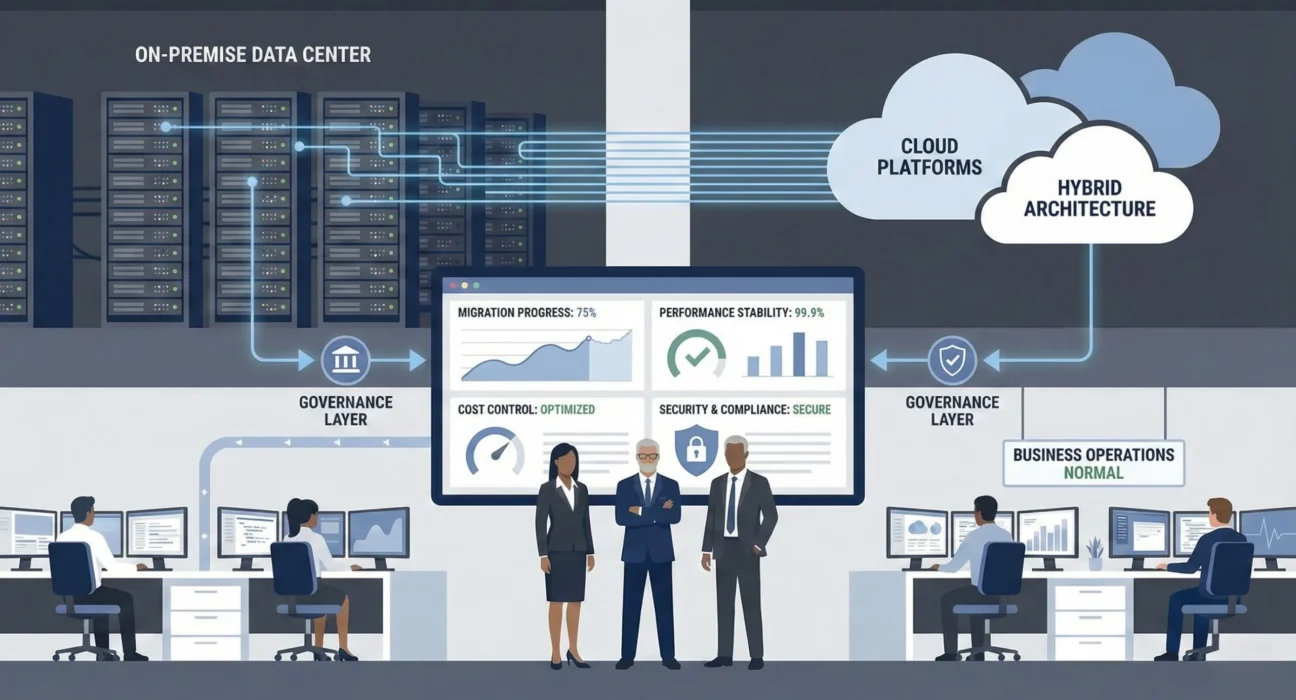
Zero business disruption does not mean zero issues. It means that when issues happen and they will, they are contained, resolved quickly, and do not impact critical business operations.
A successful enterprise cloud migration looks like this:
Business teams barely notice the change. Their applications work the same or better. Performance is maintained or improved. Support processes are clear. Training is provided where needed.
IT teams are confident in the new environment. They can operate, monitor, and troubleshoot cloud workloads effectively. Runbooks are documented. Escalation paths are clear. Automation is in place.
Leadership has visibility and control. Costs are predictable. Timelines are met. Risks are managed. Vendors are delivering. Metrics show progress.
This does not happen by accident. It happens because someone took ownership, built a disciplined execution approach, and drove the program with clarity and accountability.
Building Long-Term Cloud Maturity
Cloud migration is not a project with a finish line. It is the beginning of a new operating model.
After the initial migration, the real work begins. Optimizing costs. Improving security posture. Adopting cloud-native services. Building automation. Enabling faster innovation.
Enterprises that treat cloud migration as a one-time lift-and-shift end up with an expensive data center in someone else’s building. Enterprises that treat it as a platform for continuous improvement get the business agility and cost efficiency they were promised.
This requires ongoing investment in people, processes, and partnerships. It requires treating the cloud as a business capability, not an IT project.
Moving Forward with Confidence
If you are a CIO, CTO, or CDO evaluating a cloud migration, the question is not whether to migrate. The question is how to do it without creating chaos, burning budget, or losing credibility.
The answer is execution discipline. Clear ownership. Strong governance. Experienced partners who understand enterprise realities. And leadership that is willing to make hard calls and drive accountability.
The technology is ready. The question is whether your organization is ready to execute.
If you are looking for a partner who understands what it really takes to deliver large-scale enterprise programs, not just design them, but actually deliver them, consider working with firms that have deep execution experience across industries and geographies. Partners like Ozrit bring the program maturity, delivery discipline, and accountability that make the difference between cloud migrations that succeed and those that stall.
But regardless of who you choose to work with, the fundamentals remain the same. Own the outcome. Make decisions. Manage complexity. Communicate constantly. And never lose sight of the business value you are trying to create.
Cloud migration is hard. But it is not impossible. Hundreds of enterprises have done it successfully. The ones that succeed are not necessarily the smartest or the best-funded. They are the ones that execute with discipline, learn from mistakes quickly, and keep moving forward even when it gets difficult.
That is what separates transformation from disruption.