Every large technology initiative carries risk. Some of it is visible from the start. Budget constraints, tight deadlines, vendor dependencies. Other risks emerge slowly during execution. A critical integration doesn’t work as expected. A third-party API changes without warning. A key technical lead leaves halfway through the project.
For enterprise leaders, the question isn’t whether risk exists. It’s whether your organisation can identify, manage, and reduce it systematically before it disrupts delivery.
Most enterprises are good at managing financial and compliance risk. They have frameworks, audits, and established processes. But technology risk operates differently. It’s harder to quantify. It spreads across architecture, code, infrastructure, and people. And by the time it becomes visible in a steering committee report, it’s often too late to fix without significant cost or delay.
Why Technology Risk Becomes Complex at Enterprise Scale
In small projects, risk is contained. A single team, a defined scope, limited dependencies. When something goes wrong, the impact is localised and relatively easy to correct.
Enterprise programs are different. They involve multiple teams, external vendors, legacy systems, and strict regulatory requirements. A delay in one workstream cascades into others. A poor technical decision made early in the project becomes expensive to reverse six months later. A vendor misses a deadline, and suddenly your business case no longer holds.
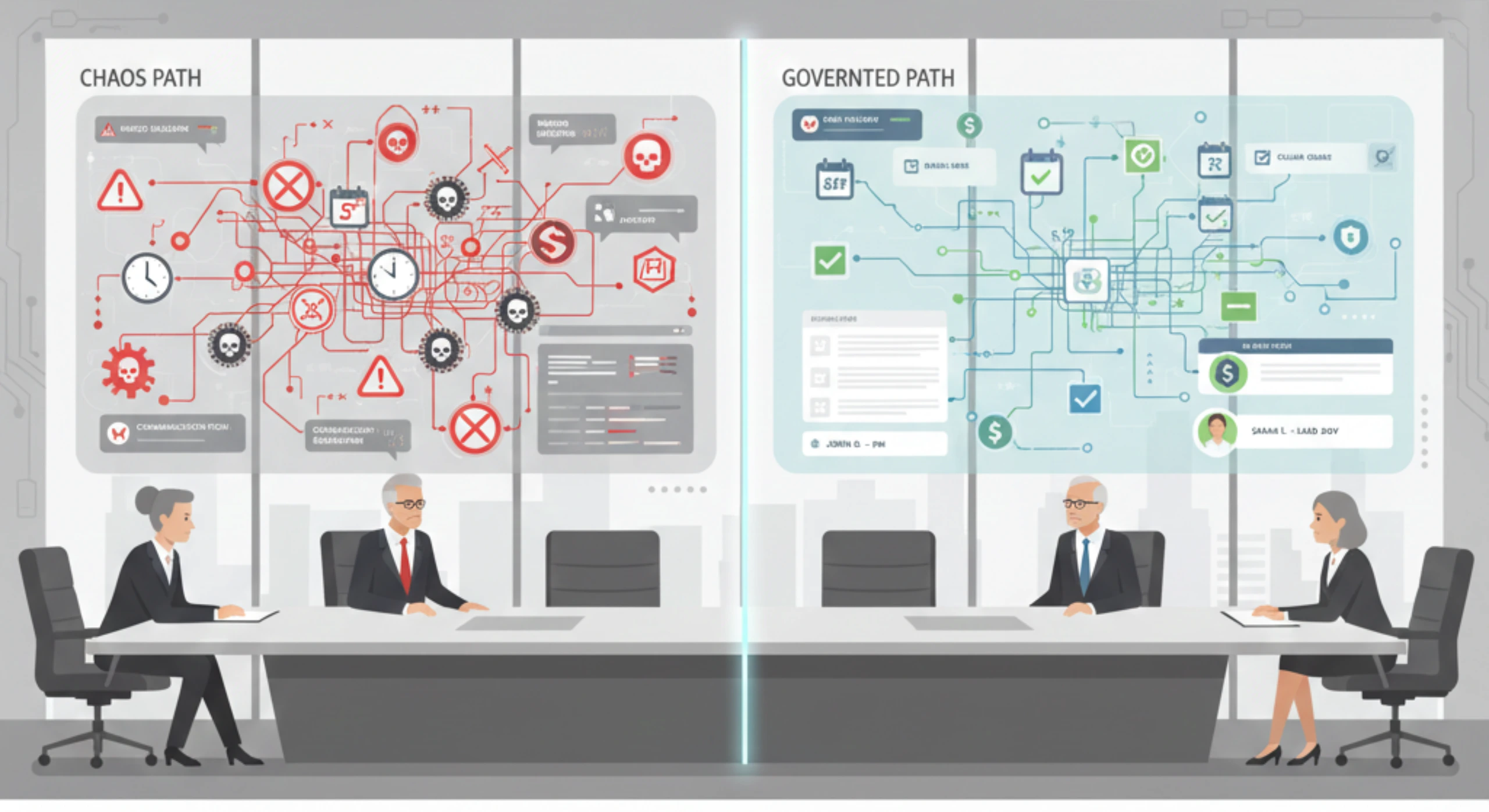
The real challenge is that enterprise technology risk isn’t just technical. It’s also organisational. Senior leaders often face incomplete visibility into what’s actually happening at the delivery layer. Project managers report green status while technical teams are quietly struggling with performance issues or security gaps. By the time a red flag is raised formally, the options for recovery are limited and costly.
Another common issue is the gap between the initial architecture and what gets built. Enterprises invest heavily in upfront design. But during implementation, compromises happen. Deadlines tighten, budgets shift, and technical debt accumulates. Without strong governance and senior oversight during execution, projects drift from the original plan in ways that create long-term problems.
The Most Common Sources of Technology Risk
Certain patterns appear repeatedly across enterprise programs. Understanding them helps leaders ask better questions and spot problems earlier.
Integration complexity is one of the most underestimated risks. Enterprises operate dozens or hundreds of existing systems. Any new initiative must connect to some of them. Each integration point introduces potential failure modes. APIs that don’t behave as documented. Data formats that change between environments. Authentication protocols that work in testing but fail in production.
These issues rarely surface during vendor demos or proof of concept phases. They emerge during actual implementation, when real data flows through real systems under real load. Managing this requires experienced technical teams who understand how enterprise systems actually behave, not just how they’re supposed to behave.
Another major source of risk is team capability and continuity. Enterprise projects often run for twelve to eighteen months or longer. Keeping the right people engaged throughout that period is difficult. Critical knowledge sits with individuals. When those individuals leave or move to other priorities, delivery slows and quality drops.
This problem gets worse when multiple vendors are involved. Each vendor manages their own team. Coordination happens through meetings and documentation, which creates friction and gaps. No single party has full visibility or accountability for the entire technical stack.
Security and compliance risk also escalates at enterprise scale. Large organisations operate under strict regulatory frameworks. Every technical decision must consider data protection, audit trails, access controls, and incident response. These requirements aren’t optional, and they can’t be retrofitted easily. They must be embedded in the architecture from the start and validated continuously during implementation.
Finally, there’s operational readiness. Many enterprises focus heavily on building the solution but underinvest in preparing to run it. When a new system goes live, it needs monitoring, support, incident management, and ongoing maintenance. If these capabilities aren’t in place, even a well-built system can fail in production.
How Senior Leadership Can Reduce Technology Risk
Technology risk can’t be eliminated, but it can be managed with the right approach. That starts with clear accountability at a senior level. Someone on the leadership team needs to own the technical delivery, not just the business case or the budget.
This doesn’t mean micromanaging developers. It means ensuring that the right technical decisions are being made, that problems are being surfaced early, and that the delivery team has the support and authority they need to succeed.
Another critical element is structured governance. Not bureaucratic status meetings, but regular technical reviews where actual progress and blockers are discussed openly. These reviews should include senior technical leaders who can assess whether the architecture is sound, whether the code quality is acceptable, and whether the team is building something that will actually work in production.
Visibility into the delivery process is essential. Leaders need access to real-time information about what’s being built, how testing is progressing, and where risks are emerging. This requires tooling and discipline, but more importantly, it requires a culture where bad news travels fast. Teams must feel safe raising concerns without fear that it will reflect poorly on them.
Vendor management also plays a major role in risk reduction. When working with external partners, enterprises should insist on clear ownership, senior involvement, and transparent delivery practices. The vendor relationship should feel like a partnership, not a transaction. If a vendor is slow to respond, hard to reach, or reluctant to commit to timelines, those are warning signs.
How Ozrit Approaches Enterprise Technology Risk
Ozrit works with enterprises that need to move quickly without compromising on quality or governance. The approach is built around reducing delivery risk through clear ownership, senior involvement, and structured execution.
Every engagement at Ozrit includes direct access to senior technical leaders. This isn’t a handoff model where requirements are gathered and then disappear into a delivery team. Senior engineers and architects stay involved throughout the project, making decisions, reviewing progress, and ensuring quality.
This matters because it eliminates one of the most common sources of risk in enterprise projects: the gap between planning and execution. When senior people remain accountable for delivery, not just design, the quality of decision-making improves and problems get resolved faster.
Ozrit also operates with a realistic view of timelines. Enterprise projects are complex, and overpromising on speed creates downstream problems. The focus is on delivering working, tested, production-ready solutions within realistic timeframes, not on hitting arbitrary dates that force compromises on quality or security.
Onboarding is another area where Ozrit reduces risk. When a new enterprise program starts, the first few weeks are critical. Ozrit invests time upfront to understand the existing architecture, the regulatory environment, the team structure, and the business objectives. This reduces misunderstandings and ensures that the technical approach aligns with the organisation’s needs from the start.
For enterprises that need continuous support, Ozrit provides 24/7 coverage. This is particularly important for programs that span multiple time zones or for systems that require high availability. Having access to senior technical expertise at any time reduces the cost of incidents and keeps delivery on track.
Ozrit also brings significant delivery capacity. With a team structured to handle multiple concurrent enterprise programs, the ability to scale support or add expertise in specific areas is built into the operating model. This matters when priorities shift or when unexpected complexity emerges mid-project.
Building for Long-Term Operational Success
Technology risk doesn’t end when a system goes live. In many ways, that’s when it begins. A solution that works perfectly in testing can still fail in production if it isn’t monitored properly, if performance degrades under real load, or if the support team doesn’t know how to respond to incidents.
Enterprises that manage technology risk well plan for operations from the beginning. They design systems with monitoring and observability built in. They document runbooks and incident response procedures. They train the operations team before go-live, not after.
They also plan for change. Technology systems aren’t static. Requirements evolve. Regulations change. New features are needed. A system that’s difficult to modify or extend becomes a liability, not an asset. Building for adaptability reduces long-term risk and protects the investment.
This requires thinking beyond the initial delivery. It requires architecture that supports evolution, code that’s maintainable, and teams that understand how the system works well enough to modify it confidently.
Final Thoughts
Technology risk in enterprise projects is inevitable, but it doesn’t have to derail delivery. The organisations that succeed are those that treat risk management as a core part of execution, not an afterthought.
That means involving senior technical leadership early and keeping them engaged throughout. It means building governance structures that provide real visibility, not just status theatre. It means choosing partners who understand enterprise complexity and take ownership seriously.
Above all, it means recognising that in large technology programs, the details matter. A missed integration test, a poorly designed API, a team that doesn’t understand the production environment. These are the things that turn a promising initiative into a troubled one.
Leaders who invest in managing these details, who insist on quality and clarity, and who build their programs around realistic execution rather than optimistic timelines, are the ones who deliver outcomes that last.