Most enterprise technology projects don’t fail because of bad technology. They fail because of bad execution.
If you’re reading this, you’ve likely sat through a boardroom presentation where a vendor promised seamless integration, rapid deployment, and transformational outcomes. You’ve probably also witnessed the reality six months later: delayed timelines, cost overruns, frustrated stakeholders, and a half-implemented system that nobody wants to use.
The gap between promise and delivery in enterprise software is not a technical problem. It’s an execution problem.
This article is about what actually happens when large organizations attempt to build data pipelines, implement analytics platforms, or scale automation across the enterprise. It’s about the decisions that matter, the risks that are real, and the difference between projects that deliver value and those that consume budgets without impact.
Why Data Pipeline Projects Are Different in Enterprises
Building a data pipeline in a startup is straightforward. You have one database, one team, and one decision-maker. You can move fast, break things, and iterate.
Enterprises don’t have that luxury.
In a mid-to-large enterprise, especially one operating in India or across multiple geographies, a single data pipeline project can involve dozens of source systems, multiple vendors, legacy infrastructure that predates cloud computing, compliance requirements across jurisdictions, and stakeholders with competing priorities.
The technical challenge is significant, but manageable. The organizational challenge is where most programs stall.
Consider a typical scenario: Your organization wants to build a unified analytics platform that pulls data from ERP systems, CRM platforms, supply chain applications, HR databases, and external market data sources. The objective is clear: enable real-time decision-making for leadership and operational teams.
What happens next is rarely what was planned.
The ERP team says their system can’t expose certain data fields without a major upgrade. The CRM vendor requires additional licensing for API access. The legacy HR system runs on outdated technology with no modern integration capabilities. Compliance flags concerns about moving employee data across environments. The finance team wants detailed audit trails. IT wants everything on-premise for security reasons, while the business wants cloud-based flexibility.
Six months in, you’re still negotiating access and architecture. The budget has doubled. The timeline has slipped. And the business unit that requested the platform has moved on to other priorities.
This is not a worst-case scenario. This is Tuesday in enterprise technology.
What Actually Goes Wrong
Enterprise technology programs fail in predictable ways. Understanding these patterns is the first step toward avoiding them.
Underestimating organizational complexity. Most project plans focus on technical milestones: data ingestion, transformation logic, dashboard design. They ignore the reality that getting sign-off from seven departments takes longer than building the pipeline itself. Every stakeholder has legitimate concerns. Every delay compounds.
Over-reliance on vendors who don’t understand your business. Technology vendors sell platforms. They don’t sell execution capabilities. A vendor can provide you with the best ETL tool, the most advanced analytics engine, or the latest automation framework. But they cannot navigate your internal politics, align your stakeholders, or ensure that the solution actually fits your operational reality.
Lack of clear ownership and accountability. Enterprise programs often suffer from diffused responsibility. IT owns the infrastructure. The business unit owns the requirements. A consulting firm owns the implementation. When something goes wrong, everyone points elsewhere. There’s no single throat to choke, as the saying goes. And without clear ownership, problems linger unresolved until they become crises.
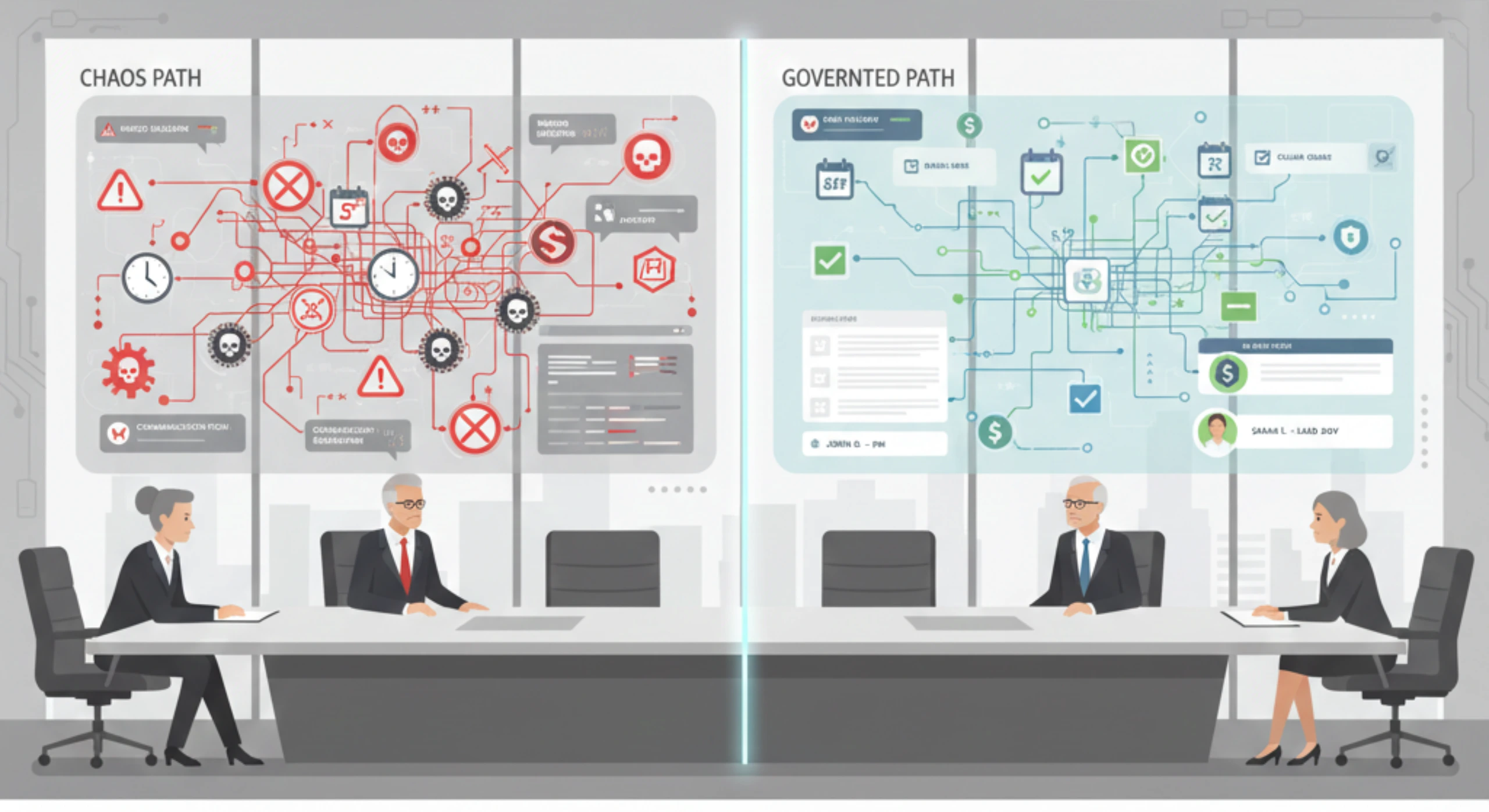
Governance without execution discipline. Enterprises love governance frameworks. Steering committees, review boards, stage gates, risk registers. These are necessary, but they are not sufficient. Governance without execution discipline becomes performative. You have all the meetings, all the documentation, all the approvals and still nothing ships on time or on budget.
Legacy systems that won’t retire gracefully. Every enterprise has that one system. It’s twenty years old, it’s business-critical, it’s undocumented, and the person who built it retired a decade ago. Any attempt to modernize it triggers risk conversations that kill momentum. So it stays. And every new initiative has to work around it, adding complexity and cost.
Scope creep disguised as business alignment. A data pipeline project starts with a clear objective: consolidate sales data for reporting. Then marketing wants customer behavior analytics. Then operations want supply chain visibility. Then finance wants real-time P&L dashboards. Each addition seems reasonable in isolation. Collectively, they turn a six-month project into a three-year program with unclear priorities.
These failures are not inevitable. But avoiding them requires a different approach to how enterprise programs are structured, managed, and delivered.
What Separates Successful Programs from Failed Ones
The enterprises that succeed at large-scale technology transformation share certain characteristics. They are not necessarily the ones with the biggest budgets or the most advanced technology. They are the ones that treat execution as seriously as they treat strategy.
They start with outcomes, not technology. Successful programs begin with a clear understanding of what business problems need to be solved and what success looks like in measurable terms. Revenue growth, cost reduction, faster decision cycles, regulatory compliance—whatever the driver, it’s defined upfront and remains the north star throughout execution. Technology choices follow from outcomes, not the other way around.
They design for their actual operating environment, not an ideal one. You cannot transform an organization by pretending it’s something it isn’t. If you have legacy systems, you design around them or plan their replacement explicitly. If you have regulatory constraints, you build compliance into the architecture from day one. If you have limited in-house technical talent, you plan for that reality rather than assuming capabilities will magically appear.
They establish clear ownership and decision rights. Someone has to own the program end-to-end. Not just sponsor it. Own it. That means accountability for delivery, authority to make decisions, and responsibility for outcomes. Governance structures support this owner, they don’t replace them.
They treat vendor management as a core competency. Enterprises that succeed with technology vendors don’t just sign contracts and hope for the best. They actively manage vendor relationships, hold them accountable to outcomes, and structure agreements that align incentives. They also recognize that vendors are service providers, not partners in the true sense. Real partnership requires shared risk and shared accountability.
They build internal capabilities alongside external delivery. Outsourcing execution doesn’t mean outsourcing learning. Successful enterprises ensure that their teams are embedded in delivery, gaining knowledge and building capabilities that persist after vendors leave. Otherwise, you end up dependent on external resources indefinitely.
They maintain execution discipline throughout the program lifecycle. This means tracking progress against real milestones, not just governance checkpoints. It means addressing issues when they emerge, not escalating them endlessly. It means killing initiatives that aren’t working rather than pouring good money after bad. Discipline is unsexy. It’s also what separates programs that deliver from programs that drift.
The Role of Leadership in Enterprise Technology Programs
C-suite executives often view technology programs as something to delegate. You hire a CIO or CTO, you approve the budget, you review quarterly updates. The assumption is that technology is a specialist domain best left to specialists.
This assumption is dangerous.
Enterprise technology programs fail or succeed based on decisions that only senior leadership can make. What gets prioritized when resources are constrained. How conflicts between business units are resolved. Whether the organization tolerates missed deadlines and expanded budgets or holds teams accountable. These are leadership questions, not technical ones.
Your role as a CEO, COO, or CFO is not to understand the intricacies of data pipeline architecture. Your role is to ensure that the program has clear objectives, appropriate resources, competent ownership, and consistent oversight. You need to ask the hard questions: What are we really trying to achieve? How do we know if we’re succeeding? What are the risks? What happens if this doesn’t work?
You also need to protect the program from the organization itself. Every enterprise has competing priorities, limited resources, and internal dynamics that can derail even well-designed initiatives. Leadership provides air cover, removes obstacles, and maintains focus when distractions inevitably arise.
And when things go wrong and they will, leadership sets the tone for how the organization responds. Do you hide problems or surface them quickly? Do you punish failure or learn from it? Do you double down on what’s working or chase every new idea? These choices cascade through the organization and determine whether programs recover from setbacks or collapse under them.
Building Data Pipelines That Actually Work
Let’s get practical. What does it take to build enterprise-scale data pipelines that deliver value rather than consume budgets?
Start small, prove value, then scale. The instinct in large organizations is to design comprehensive solutions that address every possible use case. Resist this. Start with a focused problem, deliver a working solution, demonstrate value, and then expand. This approach reduces risk, builds organizational confidence, and allows you to learn and adjust before you’ve committed massive resources.
Invest in data governance before you build pipelines. You cannot build reliable analytics on unreliable data. Enterprises often rush to build pipelines without addressing fundamental data quality issues, inconsistent definitions, or unclear ownership of data assets. The result is garbage in, garbage out except at enterprise scale and cost. Data governance is not glamorous. It’s fundamental.
Design for change, not perfection. Your business will evolve. Your technology landscape will change. Regulations will shift. If your data architecture requires months of rework every time something changes, you’ve built a liability, not an asset. Modular design, clear interfaces, and decoupled components are not just technical best practices, they’re business necessities.
Automate intelligently, not indiscriminately. Automation is valuable when it eliminates repetitive work, reduces errors, or accelerates processes. It’s wasteful when it’s applied to processes that are broken or unnecessary. Before you automate, streamline. Before you streamline, understand. Automation should amplify good processes, not calcify bad ones.
Build observability into your pipelines from day one. When something breaks in an enterprise data pipeline something will need to know immediately what failed, why it failed, and what data is affected. Logging, monitoring, alerting, and audit trails are not optional features to add later. They are core requirements that determine whether your pipelines are manageable or a constant source of firefighting.
Plan for the full lifecycle, not just initial deployment. Enterprise technology is not a one-time implementation. It’s an ongoing commitment. You will need to maintain systems, update integrations, onboard new data sources, adapt to business changes, and eventually retire and replace components. Programs that plan only for go-live inevitably struggle with everything that comes after.
Choosing Partners Who Understand Enterprise Realities
Technology implementation in large enterprises is not a purely technical exercise. It requires partners who understand how organizations actually work, how decisions get made, how stakeholders align, and how programs get delivered in environments with complexity, constraints, and competing priorities.
The challenge is that most technology vendors are optimized for sales, not delivery. They excel at presentations, proof-of-concepts, and contract negotiations. They struggle with the messy reality of enterprise execution: navigating internal politics, managing scope, coordinating across teams, adapting to changing requirements, and maintaining momentum over multi-year programs.
This is where firms like Ozrit become relevant. As an enterprise delivery and program execution partner, the value proposition is not about providing the newest technology or the most advanced features. It’s about understanding what it actually takes to get complex programs across the finish line in real-world enterprise environments. It’s about accountability, execution discipline, and delivery maturity.
The distinction matters. A technology vendor provides tools and platforms. An execution partner provides ownership and outcomes. One sells you software. The other helps you succeed.
When evaluating potential partners for enterprise-scale programs, the questions you should ask are not primarily about technology capabilities. Ask about their approach to stakeholder management. Ask about how they handle scope changes and timeline pressure. Ask about their experience with governance, compliance, and risk management in your industry. Ask for references from programs that faced difficulties and how those were navigated.
The answers will tell you whether you’re talking to someone who understands enterprise realities or someone who will oversell and underdeliver.
The Economics of Enterprise Technology Programs
Let’s talk about money, because that’s what CFOs and CEOs ultimately care about.
Enterprise technology programs have a tendency to cost more and take longer than planned. This is not because of incompetence or bad faith. It’s because initial estimates are usually based on ideal scenarios that rarely match reality.
The business case assumes clean data, cooperative stakeholders, stable requirements, and smooth execution. The reality involves data quality issues that require remediation, stakeholder conflicts that require negotiation, scope adjustments that require re-work, and execution challenges that require problem-solving.
Smart enterprises build buffers into budgets and timelines. Not because they expect failure, but because they expect reality. A program that has no room for course corrections is a program that will blow up when the inevitable challenges arise.
The other economic reality is that technology costs don’t end at implementation. Ongoing maintenance, support, updates, integration with new systems, and eventual modernization are all real costs that need to be planned for. A platform that costs ten crores to implement might cost two crores per year to maintain. Over a ten-year lifecycle, the total cost of ownership is not ten crores, it’s thirty.
This is why decisions about technology platforms, architecture, and vendors have long-term financial implications that go far beyond initial project budgets. Choosing cheap solutions that are expensive to maintain is not cost-effective. Choosing proprietary platforms that lock you into single vendors is risky. Choosing complex architectures that require specialized skills to operate creates dependencies.
The most economically sound approach is usually not the cheapest upfront. It’s the one that balances initial cost with long-term sustainability, flexibility, and risk.
Managing Risk in Large-Scale Technology Programs
Every enterprise technology program carries risk. The question is whether you’re managing those risks consciously or hoping they don’t materialize.
Technical risk: Will the technology actually work at the scale and performance required? Can it integrate with existing systems? Is it reliable and maintainable?
Execution risk: Can the program be delivered on time and on budget? Does the team have the necessary skills and experience? Are there dependencies that could cause delays?
Organizational risk: Will stakeholders support the program? Will users adopt the new system? Can the organization handle the change?
Vendor risk: Will the vendor deliver what they promised? What happens if they get acquired, go out of business, or shift strategic focus?
Compliance risk: Does the solution meet regulatory requirements? How do you ensure data privacy and security? What are the audit implications?
Most enterprises are reasonably good at identifying risks. Where they struggle is in actually managing them. Risk registers get created, reviewed in governance meetings, and then filed away. The real work of risk management monitoring, mitigation, contingency planning often doesn’t happen until a risk becomes a crisis.
Effective risk management is active, not passive. It means tracking leading indicators, not just documenting potential problems. It means having backup plans for critical dependencies. It means testing assumptions before you’re fully committed. It means being willing to pause or redirect programs when risks escalate beyond acceptable levels.
It also means being honest about risks, especially with senior leadership. The instinct in large organizations is to downplay problems and present optimistic scenarios. This is understandable but counterproductive. Leaders cannot manage risks they don’t know about. The earlier problems surface, the more options you have for addressing them.
What Good Execution Actually Looks Like
Execution is one of those words that gets used constantly in business but rarely defined clearly. What does good execution actually mean in the context of enterprise technology programs?
It means delivering what was promised, when it was promised, within the agreed budget—or communicating early and clearly when that’s not possible and why.
It means making decisions quickly when they need to be made, rather than letting issues linger in endless analysis and discussion.
It means solving problems as they arise, rather than escalating everything to governance committees or senior leadership.
It means tracking progress against real outcomes, not just activity metrics or process compliance.
It means maintaining quality standards even under timeline pressure, because cutting corners creates technical debt that compounds over time.
It means being transparent about status, honest about challenges, and accountable for results.
Good execution is boring. There are no heroics, no dramatic rescues, no last-minute miracles. Things just get done. Milestones get hit. Issues get resolved. Progress is steady and predictable.
This is much harder to achieve than it sounds, especially in large organizations where complexity, bureaucracy, and competing interests create constant friction. But it’s also the only reliable path to successful technology transformation.
The enterprises that consistently execute well on technology programs don’t have secret methods or magical tools. They have discipline, accountability, and maturity in how they approach delivery. They treat execution as a core capability worth investing in, not an afterthought to be delegated to whoever is available.
Looking Ahead: The Next Decade of Enterprise Technology
The technology landscape will continue to evolve. AI and machine learning will become more integrated into enterprise operations. Cloud infrastructure will mature further. Automation will expand into new domains. Data volumes will grow exponentially.
But the fundamental challenges of enterprise technology transformation will remain remarkably similar to what they are today. How do you align stakeholders? How do you manage complexity? How do you execute reliably? How do you deliver value, not just implement technology?
The enterprises that thrive in the next decade will be those that master execution alongside innovation. They will adopt new technologies, yes but they will do so with discipline, governance, and a clear focus on business outcomes. They will build internal capabilities while leveraging external expertise. They will treat technology transformation as a continuous journey, not a series of discrete projects.
And they will work with partners who understand that enterprise success is not about having the best technology. It’s about delivering real value in real-world conditions with all the complexity, constraints, and challenges that entails.
Final Thoughts
If you’re leading or sponsoring a large-scale technology program, the most important thing you can do is be realistic. Realistic about timelines, budgets, challenges, and risks. Realistic about your organization’s capabilities and limitations. Realistic about what technology can and cannot solve.
Realism is not pessimism. It’s the foundation for effective planning, honest communication, and successful delivery.
The gap between ambition and execution in enterprise technology is real. But it’s not insurmountable. With clear objectives, strong ownership, disciplined execution, and partners who understand enterprise realities, complex programs can and do succeed.
The question is whether your organization is ready to do what it actually takes, not just what the PowerPoint says it takes to get there.