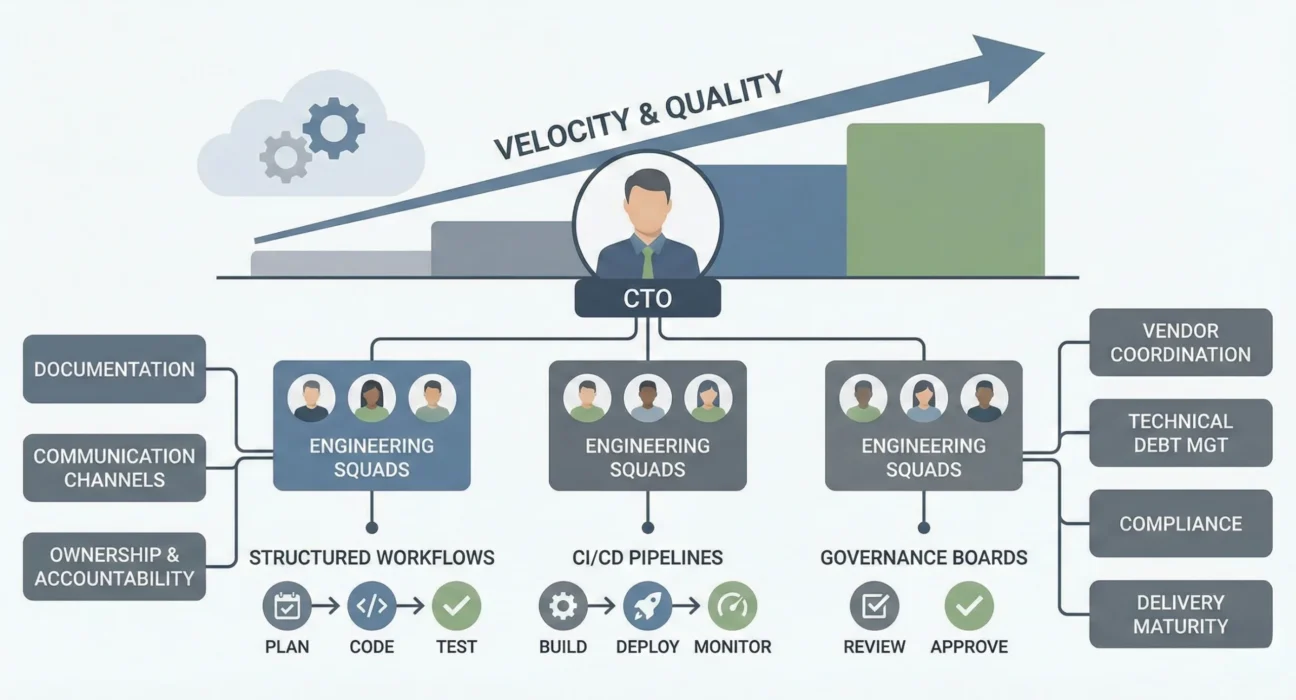
Every CTO knows the math doesn’t add up.
You double the team size, but delivery doesn’t double. Sometimes it slows down. Code quality drops. Communication breaks down. The system that worked with 20 engineers starts creaking under 50. By the time you hit 100, you’re spending more time managing the chaos than building the product.
This isn’t a technology problem. It’s an execution problem.
In enterprise settings, especially across Indian and global companies operating here, scaling engineering teams is rarely just about hiring more people. It’s about maintaining delivery velocity, preserving institutional knowledge, keeping technical debt under control, and ensuring that governance and compliance don’t become bottlenecks.
The difference between companies that scale well and those that don’t often comes down to how seriously they take the non-technical aspects of software delivery.
Why Scaling Engineering Teams Is Harder in Enterprises
Startups can move fast because they have fewer constraints. Enterprises can’t.
You have legacy systems that can’t be switched off overnight. You have compliance requirements that aren’t optional. You have stakeholders across multiple geographies, each with their own priorities. You have vendors, partners, and integrations that need to keep working even as you rebuild the foundation beneath them.
When you scale an engineering team in this environment, you’re not just adding developers. You’re adding complexity to an already complex system.
The hidden costs of rapid scaling
Bringing on 30 engineers in three months sounds like progress. But here’s what actually happens:
Onboarding takes longer than planned. New engineers need context on legacy systems, internal processes, and domain knowledge that isn’t documented anywhere. Senior engineers spend half their time answering questions instead of building.
Code quality becomes inconsistent. Different teams start following different standards. Technical debt accumulates faster than anyone notices. Six months later, you’re spending entire sprints just fixing what should have worked the first time.
Communication overhead explodes. What used to be a quick conversation now requires three meetings, two Slack channels, and a JIRA ticket. Decision-making slows down. Small changes require approvals from people who don’t understand the context.
And worst of all, accountability gets diluted. When everyone is responsible, no one is responsible.
What Actually Goes Wrong in Large-Scale Programs
Most enterprise software initiatives don’t fail because of bad technology choices. They fail because of execution gaps.
Governance without ownership
Governance frameworks look good on paper. RACI matrices, steering committees, approval workflows. But if no one actually owns the outcome, governance becomes theatre.
I’ve seen programs with 15-person steering committees where no single person could answer: “Who is accountable if this doesn’t ship on time?”
Real ownership means someone wakes up at night worrying about delivery. It means having the authority to make decisions, not just the responsibility to attend meetings.
Scope creep disguised as strategy
Enterprises are skilled at turning three-month projects into 18-month programs.
It starts innocently. A stakeholder asks: “While we’re rebuilding this system, can we also add this feature?” Then another department wants integration with their platform. Then compliance flags a requirement no one knew about.
Before long, the original goal is buried under layers of new asks, each one reasonable on its own, collectively impossible to deliver.
The best CTOs I know are ruthless about scope. They understand that saying no to good ideas is often the only way to say yes to great execution.
The vendor coordination trap
Many large enterprises rely on multiple vendors for different parts of a program. One vendor for infrastructure, another for application development, a third for testing, and someone else for deployment.
This creates a coordination nightmare.
When something goes wrong, everyone points at each other. Integration points become battlegrounds. Timelines slip because Vendor A is waiting for Vendor B, who is waiting for approval from your internal team.
The companies that manage this well treat vendor management as a core competency, not an afterthought. They have people whose only job is to ensure vendors deliver, integrate, and stay accountable to the overall program timeline.
Underestimating change management
Technology changes faster than organizations do.
You can build the most elegant microservices architecture in the world, but if your business teams don’t understand how to use it, or if your operations team isn’t trained to support it, you’ve built something beautiful that no one can operate.
Successful enterprise transformations invest as much in change management as they do in software development. Training, documentation, communication, and handholding aren’t optional. They’re the difference between adoption and abandonment.
What Separates Success from Failure
The enterprises that scale engineering teams successfully don’t do anything magical. They just do the basics really well.
They invest in delivery maturity, not just development capacity
Hiring more engineers is easy. Building a mature delivery culture is hard.
Mature teams have:
Clear coding standards and automated enforcement. You shouldn’t need to review every pull request to ensure consistency. Tools should catch most issues before humans see them.
Robust CI/CD pipelines that actually work. Deployment shouldn’t be a manual, nerve-wracking process. If you can’t deploy on a Friday afternoon without panic, your pipeline isn’t ready for scale.
Comprehensive documentation that gets updated. Not 200-page PDFs no one reads. Living documentation that explains why decisions were made, how systems connect, and where to find things.
Telemetry and observability are built in from day one. You can’t manage what you can’t measure. If you don’t know how your system is performing until users complain, you’re already behind.
They design team structures for accountability
Conway’s Law is real. Your system architecture will mirror your organizational structure, whether you intend it to or not.
Smart CTOs design teams around business capabilities, not technology layers. Instead of a “frontend team” and a “backend team,” they create teams that own entire features or services end to end.
This creates natural ownership. If something breaks, you don’t have to figure out which team is responsible. The team that owns the capability owns the fix.
They treat technical debt as a budget item, not an afterthought
Every enterprise accumulates technical debt. The question is whether you manage it deliberately or let it manage you.
High-performing teams allocate a fixed percentage of every sprint to paying down debt. Not when things break. Not when executives finally notice. Continuously, as part of normal work.
This prevents the debt from compounding to the point where entire quarters need to be spent on “stabilization” or “refactoring” instead of delivering value.
They recognize when to build and when to partner
Not every enterprise needs to build everything in-house.
The smartest technology leaders know their core competencies and partner for the rest. If you’re a bank, your competitive advantage probably isn’t in building deployment pipelines or setting up observability tools. It’s in understanding financial products and customer needs.
Bringing in the right partners, whether for specialized delivery capabilities or to supplement capacity during critical phases, isn’t a sign of weakness. It’s strategic.
This is where working with an enterprise delivery partner like Ozrit can make sense. Not as an outsourcing play, but as a way to access execution maturity and delivery muscle without having to build it all from scratch. The value isn’t just extra hands on keyboards. It’s structured governance, proven frameworks, and experience navigating the messy realities of large-scale enterprise programs.
The Role of Leadership in Scaling Quality
Scaling engineering teams is ultimately a leadership challenge, not a technical one.
Setting the standard
Quality doesn’t happen by accident. It happens because leadership insists on it, even when timelines are tight and pressure is high.
The moment executives signal that shipping fast matters more than shipping right, quality dies. Teams will always optimize for what gets rewarded. If cutting corners gets celebrated and thoughtful engineering gets criticized for being slow, you’ll get fast, broken software.
Creating space for thinking, not just doing
The best engineering work happens when people have time to think through problems, not just execute tickets as fast as possible.
Leaders who understand this create space for design reviews, architecture discussions, and technical spikes. They don’t treat every moment not spent coding as wasted time.
This is especially important as teams scale. The decisions made early, when the team is small, create constraints that last for years. Rushing those decisions to hit an arbitrary deadline often costs far more in the long run.
Building feedback loops that matter
Most enterprises have plenty of metrics. What they lack are meaningful feedback loops.
You need to know:
Are we shipping what matters, or just shipping? Velocity without value is waste.
Are we building technical capability, or just burning through budgets? If contractors leave and no one internal can maintain the system, you haven’t built anything sustainable.
Are teams getting better, or just getting by? Execution maturity should improve over time, not plateau.
Leaders who ask these questions and act on the answers build organizations that scale sustainably.
Practical Steps to Scale Without Breaking
If you’re leading an engineering organization through a growth phase, here’s what actually works:
Start with structure, not headcount. Before hiring 50 people, design the team structure. Define ownership boundaries. Establish how teams will communicate and integrate. Clarify decision rights. Then hire into that structure.
Codify what’s working before it breaks. When a team of 10 is working well, document what makes it work. The processes, the principles, the norms. This becomes your scaling blueprint. Don’t wait until you’re at 100 people and everything is chaos.
Invest in platforms and tooling. Every hour your engineers spend on repeated manual tasks is an hour not spent on valuable work. Build internal platforms that let teams move faster independently. Automate everything that can be automated.
Separate exploration from execution. Not all work should follow the same process. Exploratory work, where you’re figuring out what to build, needs flexibility. Execution work, where you’re building something well-defined, needs discipline. Don’t force everything through a one-size-fits-all process.
Measure what matters, not what’s easy. Lines of code written, story points completed, and hours logged tell you almost nothing about quality or impact. Better measures: cycle time from commit to production, defect escape rate, mean time to recovery, and customer-reported issues.
Build bridges between business and technology. The gap between what business stakeholders want and what engineering teams build is often the biggest source of waste. Invest in product management, business analysis, and translation layers that ensure everyone is building the right thing.
Plan for turnover. People leave. Contractors rotate off. Vendors change. If your system only works because one person understands it, you don’t have a system. You have a risk. Build knowledge redundancy into your teams.
Choosing the Right Partner for Enterprise-Scale Delivery
Not all partners are built for enterprise complexity.
Many vendors are excellent at building features. Far fewer understand enterprise program management, governance, stakeholder coordination, and the discipline required to deliver across multiple teams, geographies, and constraints.
When evaluating partners for large-scale programs, look beyond technical skills:
Do they have experience with programs of similar scale and complexity? A team that’s delivered three startups isn’t ready to lead a multi-year, multi-vendor enterprise transformation.
Do they understand governance and risk, or do they see it as bureaucracy to work around? Mature partners recognize that compliance, audit trails, and approval workflows exist for a reason.
Can they operate as an extension of your team, not just a vendor on the other side of a statement of work? The best partnerships feel like collaboration, not contracting.
Do they bring frameworks and discipline, or do they expect you to define everything? Enterprises need partners who can bring structure to ambiguity, not add to it.
This is the kind of maturity that organizations like Ozrit are built around. Not just software development, but program execution. Not just delivery, but delivery in the real-world context of enterprise constraints, timelines, and accountability.
The Long Game
Scaling engineering teams is not a sprint. It’s a long, deliberate process of building capability, not just capacity.
The enterprises that do this well don’t look for shortcuts. They invest in their people, their processes, and their platforms. They make hard choices about scope and priorities. They build partnerships based on trust and execution, not just cost.
And most importantly, they recognize that quality isn’t something you bolt on at the end. It’s something you build into every decision, every hire, and every line of code from day one.
The work is hard. The stakes are high. But for organizations willing to do it right, the payoff is an engineering culture that doesn’t just scale in size, but grows in capability, maturity, and impact.
That’s how you build technology organizations that last.