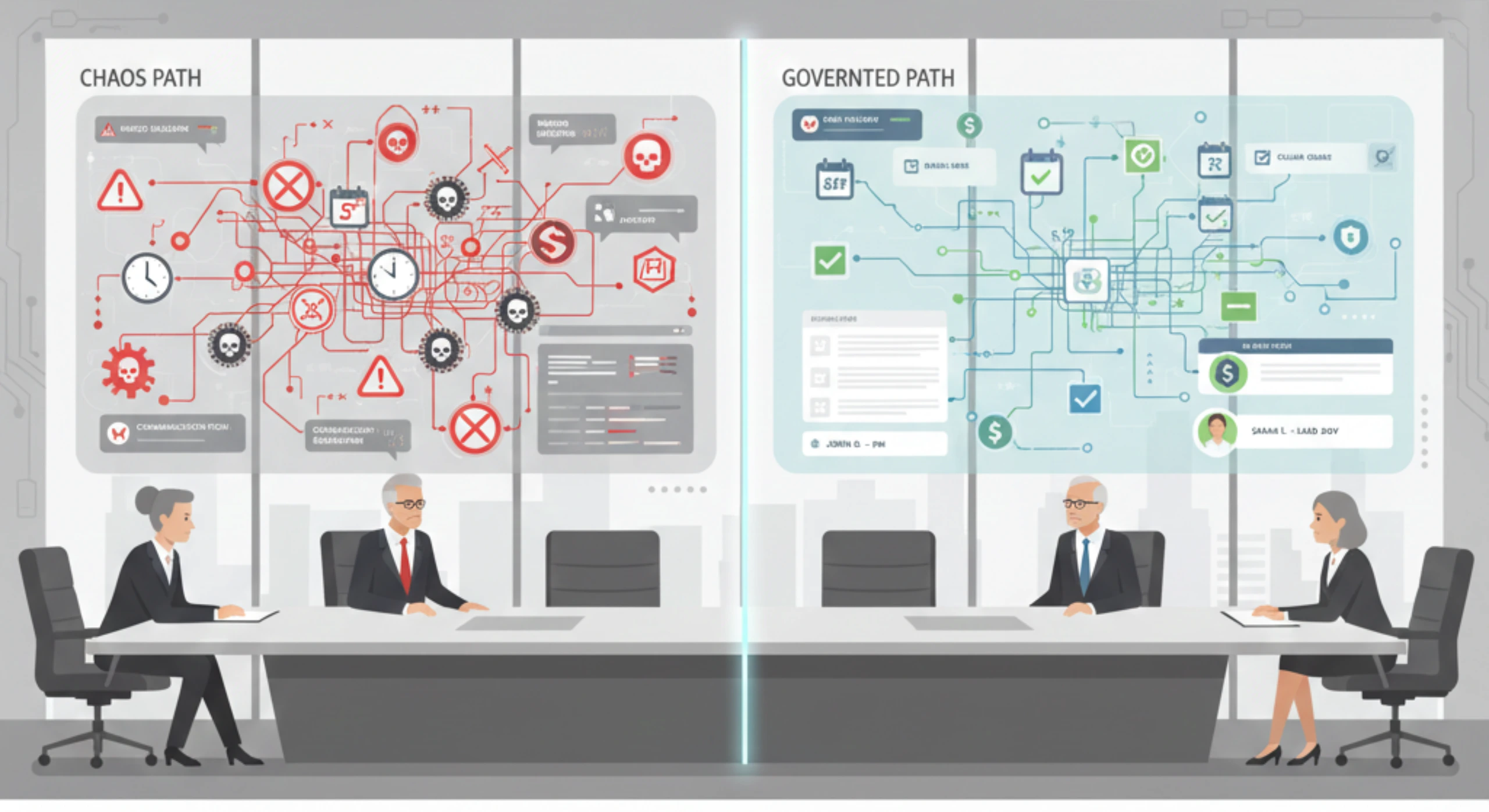
When a large enterprise decides to modernise its core systems or launch a multi-year digital transformation, the announcement is usually met with optimism. Boards approve budgets. Leadership sets ambitious timelines. Vendors are onboarded. Everyone believes this time will be different.
And then reality sets in.
Six months later, the program is behind schedule. Vendors are blaming each other. The internal IT team is overwhelmed. Costs are climbing. The business units that were supposed to benefit are frustrated because they are still filling spreadsheets manually. Meanwhile, the CIO is in the boardroom trying to explain why a program that was supposed to take 18 months is now projected to take three years.
This is not an exception. It is the norm in enterprise software delivery, especially in complex, multi-vendor environments.
The question is not whether these programs are important. They are. The question is why so many of them struggle, and what it actually takes to deliver them well.
Why Enterprise Programs Are Structurally Hard
Enterprise programs fail for predictable reasons. And most of those reasons have nothing to do with technology.
They fail because of governance, not because of code.
In a typical large-scale program, you will have multiple vendors. One for cloud infrastructure. Another for application development. A third for data integration. Perhaps a specialised partner for analytics or compliance. Then you have your internal teams IT, business operations, security, procurement, legal. Each group has its own priorities, timelines, and ways of working.
Who is responsible when a vendor delivers on time but the output does not integrate with another vendor’s module? Who decides when requirements change midstream because the business realised the original scope would not solve the real problem? Who ensures that what gets built today will not become technical debt two years from now?
Without clear governance, these questions do not get answered. They get escalated, debated, and delayed. And the program suffers.
Scale introduces complexity that cannot be managed casually.
A small product company can move fast because everyone sits in the same room and decisions happen in real time. An enterprise does not have that luxury. You have regional offices. You have legacy systems that have been running for 15 years and cannot simply be switched off. You have compliance requirements that vary by geography. You have stakeholders who have conflicting definitions of success.
This is not a problem you solve with better project management software. It is a problem you solve with structure, accountability, and disciplined execution.
The Governance Gap in Multi-Vendor Programs
Most enterprises underestimate what governance actually means in a multi-vendor context.
They think governance is about status meetings and steering committees. It is not. Real governance is about decision rights, escalation paths, integration ownership, risk monitoring, and delivery accountability across organisational boundaries.
Here is what typically goes wrong.
Vendors optimize for their own contracts, not the overall program.
This is rational behaviour. A vendor’s job is to deliver what is in their statement of work, on their timeline, within their budget. If another vendor is late, that is not their problem. If the enterprise changes a requirement, they will happily log a change request and extend the timeline.
The result is that everyone is individually compliant, but the program as a whole is failing.
Internal teams lack the bandwidth to govern effectively.
Enterprise IT teams are already running the business. They are managing incidents, handling security patches, supporting users, and keeping the lights on. Now you are asking them to also govern a multi-vendor transformation program with dozens of moving parts.
They do not have the capacity. And even when they do, they often lack the experience to manage vendor dependencies, enforce architectural standards, or intervene early when things are going off track.
No single party owns end-to-end delivery.
In most enterprise programs, ownership is fragmented. The program manager tracks milestones. The solution architect worries about design. The vendor leads focus on their modules. The business stakeholders define requirements.
But who is responsible for ensuring that all of this actually comes together into a working system that delivers business value on time?
Often, no one. And that is the governance gap.
What Actually Works: The Role of a Delivery Partner
Successful enterprise programs have one thing in common: someone owns delivery.
Not just coordination. Not just oversight. Actual delivery accountability.
This does not mean the enterprise abdicates responsibility. It means they bring in a partner who can operate as an extension of their leadership, someone who understands enterprise realities, can manage multiple vendors, enforce governance without becoming a bottleneck, and deliver outcomes, not just outputs.
A good delivery partner brings execution maturity.
They have done this before. They know what vendors will say when timelines slip. They know how to structure contracts so accountability is clear. They know when to escalate and when to solve problems quietly. They have seen enough enterprise programs to recognise early warning signs that internal teams might miss.
This experience matters. Because in large programs, you do not get many chances to recover from mistakes.
They act as the integration layer between business, IT, and vendors.
One of the hardest parts of multi-vendor programs is translation. Business teams speak in outcomes. Vendors speak in technical specifications. IT teams speak in constraints.
A delivery partner translates across these boundaries. They ensure that what the business needs actually gets built, that vendors are aligned on integration standards, and that IT’s operational concerns are addressed before go-live.
This is not glamorous work. But it is the work that prevents expensive failures.
They enforce delivery discipline without becoming bureaucratic.
Governance does not mean more paperwork. It means clarity. Clear ownership. Clear timelines. Clear escalation paths. Clear definitions of done.
A strong delivery partner builds just enough structure to keep things moving, without slowing down decision-making. They push vendors to deliver, but they also shield the enterprise from unnecessary noise. They create predictability in an inherently unpredictable environment.
At Ozrit, this is the work we do. We partner with enterprises not as another vendor, but as a delivery governance layer that ensures programs actually land. We have worked across industries banking, manufacturing, logistics, retail and the patterns are consistent. Execution discipline matters more than technology choice.
Building the Right Governance Model
So what does good governance actually look like in a multi-vendor enterprise program?
First, establish a single delivery authority.
Someone needs to own the end-to-end outcome. This could be an internal leader with the right mandate and experience, or it could be a delivery partner who reports directly to the program sponsor. Either way, this person or team must have the authority to make binding decisions, hold vendors accountable, and intervene when things go wrong.
Without this, you get governance by committee. And committees do not deliver software.
Second, define integration ownership explicitly.
In multi-vendor programs, integration is where things break. Make it clear who is responsible for ensuring that Module A talks to Module B, that data flows correctly, that security is consistent, and that the user experience is seamless.
Do not leave this to chance. Do not assume vendors will figure it out. They will not.
Third, create forcing functions for alignment.
Regular governance calls are necessary, but not sufficient. You need forcing functions, concrete deliverables that require vendors to work together, integration checkpoints that surface issues early, and review gates that ensure quality before moving forward.
These mechanisms create accountability. They prevent the program from drifting.
Fourth, measure outcomes, not just activity.
Most enterprise programs track the wrong things. They track how many user stories were completed, how many defects were fixed, how many modules were deployed.
But they do not track whether the system is actually solving the business problem. Whether users are adopting it. Whether it is reducing cost or increasing revenue or improving compliance.
Governance should focus on business outcomes, not technical activity.
Fifth, plan for the long term, not just go-live.
A successful enterprise program does not end at launch. It continues for years. The system needs to be maintained, enhanced, and scaled. New vendors may be added. Old ones may be replaced.
Good governance includes a sustainability plan. Who will own the system after the initial vendors leave? How will knowledge be transferred? What does the operating model look like in steady state?
These are not afterthoughts. They are part of the delivery model from day one.
The CFO’s Perspective: Governance as Risk Management
For CFOs, multi-vendor programs represent significant financial risk. Budgets are large. Timelines are long. Failure is expensive.
Good governance is not a cost. It is risk mitigation.
When a program runs over budget by 40%, it is rarely because the vendor quoted incorrectly. It is because requirements were unclear, dependencies were not managed, integration was underestimated, or scope creep was not controlled.
All of these are governance failures.
A well-governed program reduces financial risk by creating predictability. It surfaces cost overruns early, when they can still be managed. It prevents rework by enforcing quality gates. It protects the enterprise from vendor lock-in by ensuring architectural independence.
From a CFO’s perspective, investing in delivery governance is not overhead. It is insurance.
What CIOs and CTOs Should Demand from Their Partners
If you are leading a large transformation, you cannot afford partners who are just good at coding.
You need partners who understand delivery at scale. Who can manage complexity? Who will tell you the truth when things are not working. Who will own the outcome, not just their piece of it.
Ask potential partners about their governance approach.
How do they manage multi-vendor dependencies? What does their escalation process look like? How do they handle scope changes? How do they ensure integration quality? What is their track record with programs of similar scale?
If their answers are vague or focused only on technical capability, keep looking.
Look for partners who have enterprise maturity.
Enterprise delivery is different from startup delivery. It requires patience, process discipline, stakeholder management, risk awareness, and a willingness to operate within constraints.
Not every technology partner has this maturity. Many are excellent at building products but struggle in complex enterprise environments where politics, legacy systems, and compliance matter as much as code quality.
Choose partners who have actually done this before.
Ensure your partner can operate as an extension of your leadership.
The best delivery partners do not just take instructions. They bring perspective. They challenge assumptions. They propose solutions. They take ownership.
You should feel like they are on your side of the table, not across from it.
Practical Steps to Improve Delivery Governance Today
If you are in the middle of a struggling program, or planning a new one, here are some concrete steps you can take.
Conduct a governance audit. Map out who currently owns what. Where are the gaps? Where is accountability unclear? Where are decisions getting stuck? Fix the structural issues before adding more processes.
Simplify your vendor landscape if possible. Every additional vendor adds coordination overhead. If you can consolidate without sacrificing quality, do it.
Invest in integration architecture early. Do not wait until vendors are halfway through development to figure out how things will connect. Define integration standards, APIs, data models, and security protocols upfront.
Create a delivery rhythm. Regular checkpoints, consistent reporting, predictable review cycles. These create stability and make problems visible.
Empower your delivery leader. Whether internal or external, this person needs authority, access to leadership, and the ability to make binding decisions. Do not undermine them by allowing vendors to escalate around them.
Build trust with your vendors. Governance is not about control. It is about alignment. The best vendor relationships are partnerships, not transactions. Treat your vendors well, pay them on time, involve them in decisions, and they will go the extra mile when you need it.
The Long Game: Building Delivery Capability
The hardest truth about enterprise delivery is that it is not a one-time problem.
You will run multiple large programs over the next decade. Cloud migrations. ERP upgrades. Digital commerce platforms. Data modernisation. AI integrations.
Each one will be complex. Each one will involve multiple vendors. Each one will require governance.
The question is whether you build that capability internally, or whether you rely on trusted partners who bring it with them.
Most enterprises do both. They build some internal capability program management, architecture, vendor management. And they partner with firms who can scale that capability up and down as needed, who bring lessons from other industries, and who can operate at the intersection of business, technology, and delivery.
This is where companies like Ozrit add value. We are not trying to replace your internal teams. We are trying to make them more effective by providing the structure, discipline, and experience that large programs require.
Closing Thoughts
Enterprise programs fail quietly. They do not collapse overnight. They drift. Timelines slip. Costs creep up. Quality degrades. And by the time leadership realises something is wrong, the program is too far gone to recover easily.
The antidote is governance. Not the bureaucratic kind. The kind that creates clarity, accountability, and relentless focus on delivery.
The kind that ensures someone is always asking: Are we building the right thing? Are we building it well? Are we on track to deliver real business value?
If you are leading a multi-vendor enterprise program, or planning one, the technology will mostly work itself out. The hard part is governance. The hard part is keeping dozens of people and organisations aligned, moving in the same direction, solving the same problem.
Get that right, and your program has a chance.
Get it wrong, and it does not matter how good your vendors are.