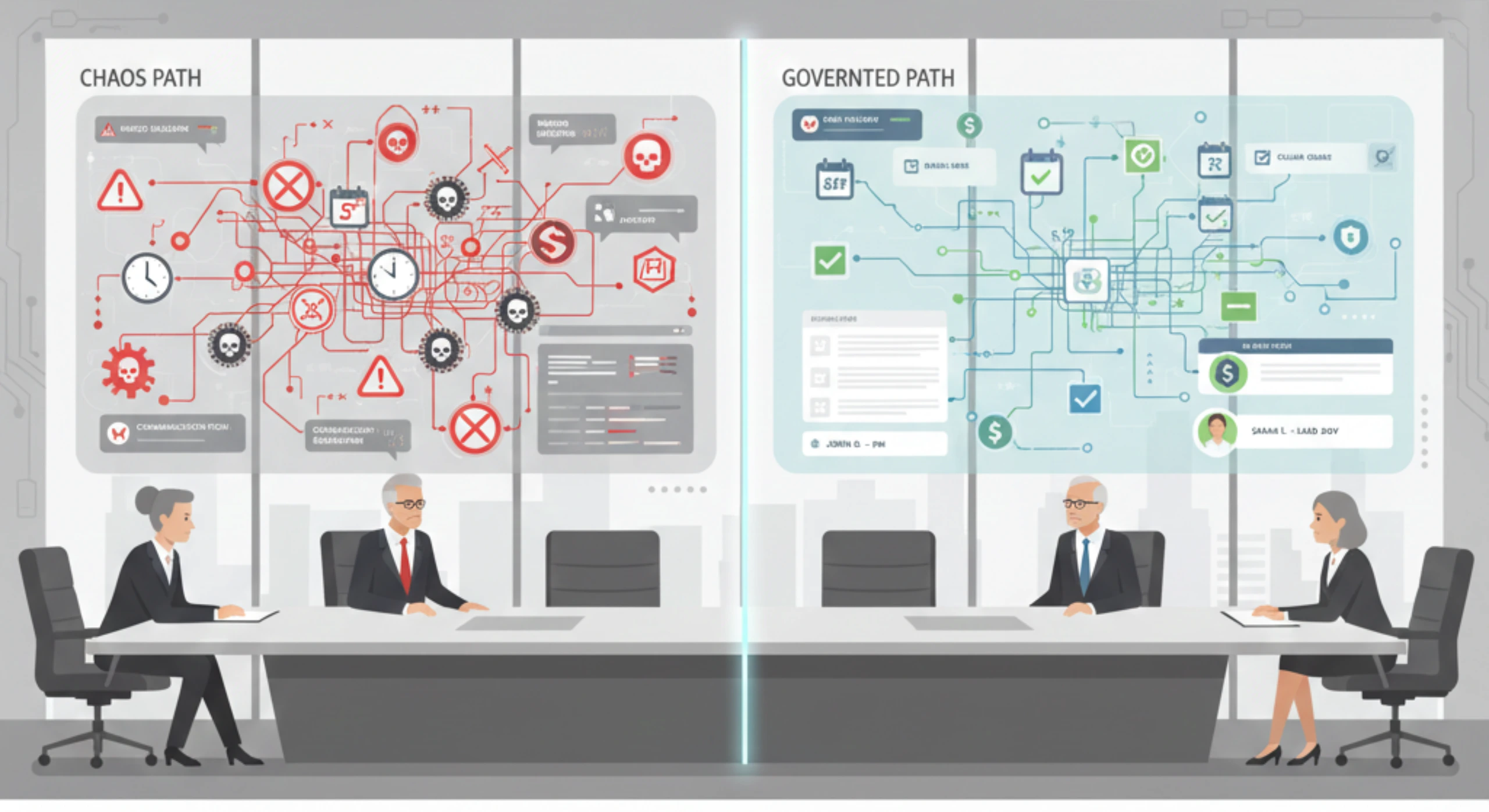
When a large enterprise decides to build or modernise a critical application, security is almost always on the list of priorities. It appears in the project charter, gets discussed in steering committee meetings, and finds a place in vendor contracts.
Yet, when things go wrong, and they often do, security is rarely the reason projects get delayed or budgets spiral. Instead, enterprises struggle with scope creep, unclear ownership, vendor misalignment, integration nightmares, and compliance surprises that surface too late.
The real question is not whether security matters. Of course it does. The question is: why do so many enterprise programs treat security as a checklist item rather than a foundational engineering principle?
The Gap Between Intent and Execution
Most enterprise leaders understand the importance of security. Data breaches make headlines. Regulatory penalties are real. Customer trust, once lost, is hard to rebuild.
But understanding the importance and embedding security into the delivery process are two different things.
In practice, security often enters the conversation at the wrong time. It gets tagged on during user acceptance testing, or worse, after go-live, when an audit flags gaps. By then, fixing issues means rework, delays, and cost overruns, all the things enterprises are trying to avoid.
This happens because security is treated as a separate workstream, owned by a different team, and reviewed at specific gates. It becomes something to “clear” rather than something to build with.
Security-first engineering is different. It means security is part of the architecture, the code review, the deployment pipeline, and the vendor agreement from day one. It means developers, architects, and delivery leads think about threat models and access controls as naturally as they think about performance and scalability.
What Actually Goes Wrong in Enterprise Programs
Large-scale enterprise initiatives fail or underperform for predictable reasons. Over years of working with mid-to-large organisations, especially in India, where regulatory complexity and legacy infrastructure add layers of challenge, certain patterns emerge.
Late discovery of compliance requirements. Enterprises operate in regulated environments. Banking, healthcare, manufacturing, and retail all have compliance obligations that vary by geography and industry. Yet projects often start without a clear mapping of these requirements to system design. When an auditor or legal team reviews the application months into development, gaps surface. Fixing them means going back to architecture decisions that were supposed to be locked.
Unclear ownership of security responsibilities. Who owns security in an enterprise program? The CISO’s office sets policy. The delivery team builds the application. The vendor provides the platform. Internal IT manages infrastructure. When something goes wrong, everyone points elsewhere. This diffusion of accountability is one of the biggest predictors of security failure.
Vendor contracts that don’t reflect reality. Enterprises often rely on external vendors for development, integration, or platform services. Contracts mention security, but rarely with the specificity needed. What does “enterprise-grade security” actually mean? Who is responsible for patching? What happens when a zero-day vulnerability emerges? These questions get answered in the middle of a crisis, not upfront.
Underestimating integration complexity. Enterprise applications don’t run in isolation. They connect to ERP systems, CRMs, data lakes, payment gateways, identity providers, and third-party APIs. Each integration point is a potential security risk. Many programs treat integration as a technical afterthought, only to discover that securing data flows across legacy and modern systems is the hardest part of the entire program.
Governance fatigue. Enterprises love governance structures, steering committees, programme boards, and risk councils. But governance without execution discipline is theatre. Security becomes a slide in a monthly status deck, not a lived practice in the engineering process.
What Separates Success from Failure
Successful enterprise programs share certain characteristics. They are not always the ones with the biggest budgets or the most advanced technology. They are the ones where leadership, process, and accountability align.
Security is a delivery outcome, not a review gate. In well-run programs, security is built into sprint planning, code repositories, and CI/CD pipelines. Threat modelling happens during design. Penetration testing happens before user acceptance, not after. Security is not something you check at the end—it’s something you deliver throughout.
Ownership is explicit and tracked. Clear RACI frameworks matter. Someone owns the security architecture. Someone owns compliance mapping. Someone owns vendor security performance. And these people have authority, not just responsibility. They can stop a release if risks are unmitigated. That clarity prevents finger-pointing and ensures accountability.
Vendors are treated as partners, not just suppliers. The best enterprise delivery partners, firms like Ozrit, which work with large organisations on complex digital transformation programs, understand that security is not a handover item. It requires collaboration between the vendor’s engineering team and the enterprise’s internal stakeholders. Contracts reflect this. SLAs include security metrics. Vendor performance reviews assess not just feature delivery, but how well security practices are embedded in the development lifecycle.
Legacy systems are respected, not ignored. Many enterprise applications must integrate with systems that were built decades ago. These systems were not designed with modern security standards in mind. Successful programs acknowledge this reality. They invest in secure middleware, API gateways, and data isolation layers. They do not pretend legacy constraints will disappear.
Compliance is mapped early and revisited often. Regulatory requirements evolve. A program that begins in compliance can drift out of it if requirements change mid-stream. Best-in-class programs maintain a living compliance map, updated as regulations shift and as system design evolves. This is not a one-time exercise it is continuous.
The Role of Leadership in Security-First Engineering
Technology choices matter, but leadership matters more.
A CIO or CTO who insists on security-first engineering signals priorities to the entire organisation. When security is a standing agenda item in executive reviews, not buried in technical appendices, teams pay attention.
Leadership also means making hard trade-offs. Enterprises are always balancing speed, cost, and risk. A security-first approach does not mean zero risk. It means understanding risk, accepting it consciously, and having mitigation plans in place. It means saying no to shortcuts that create long-term vulnerabilities, even when timelines are tight.
This is where execution maturity shows. Mature enterprises do not treat security as a blocker. They treat it as a design constraint that shapes better systems.
Choosing the Right Partner
For most enterprises, delivering large-scale applications means working with external partners. The choice of partner is one of the most consequential decisions in any program.
The wrong partner treats security as a compliance box to tick. The right partner treats it as a shared responsibility and a measure of delivery quality.
When evaluating potential partners, ask these questions:
How do they embed security in their development process? Look for evidence of automated security testing in CI/CD, mandatory threat modelling in design sprints, and security-focused code reviews.
What is their track record with regulated industries? Partners who have delivered in banking, healthcare, or government sectors understand compliance complexity. They do not learn from your program.
How do they handle incidents and vulnerabilities? No system is perfect. What matters is how quickly and transparently a partner responds when issues surface.
Do they take ownership beyond the contract? The best partners do not hide behind SOWs. They escalate risks early, suggest mitigations proactively, and stay engaged through go-live and beyond.
Firms like Ozrit have built their reputation by understanding these realities. They work with enterprises not just as development vendors, but as program execution partners who share accountability for outcomes, including security outcomes.
Practical Steps to Embed Security-First Engineering
For an enterprise embarking on a large digital transformation or application modernisation program, where do you start?
Invest in threat modelling upfront. Before a single line of code is written, map out the threat landscape. What are the high-value assets? Who are the potential attackers? What are the likely attack vectors? This exercise shapes architecture decisions and prioritises security investments.
Build security into sprint definitions of done. A feature is not complete until it passes security review. This means static code analysis, dependency scanning, and secure configuration checks are part of every sprint. Not at the end throughout.
Create a security champion network. Not every developer is a security expert, but every development team can have a security champion, someone trained to spot common vulnerabilities, advocate for secure coding practices, and liaise with the central security team. This distributes responsibility without creating bottlenecks.
Test continuously, not periodically. Penetration testing and vulnerability assessments should not be annual events. Automate security testing in the CI/CD pipeline. Run regular red team exercises. Treat security like performance, something you monitor and improve continuously.
Document security decisions and trade-offs. When you choose to accept a risk, document why. When you implement a control, document what it protects and how it works. This creates institutional memory and helps future teams understand the security posture.
Review vendor security performance regularly. If you are working with external partners, security performance should be part of every review. Are vulnerabilities being patched on time? Are security incidents being reported transparently? Is the vendor keeping pace with evolving threats?
The Cost of Getting It Wrong
The cost of weak security is not always visible upfront. It accrues over time.
There are the direct cost regulatory fines, breach response, and legal liabilities. There is the operational costof downtime, emergency patches, and rework. There is the strategic cost of delayed launches, lost customer trust, and damage to brand reputation.
And there is the hidden cost, the technical debt that accumulates when security is bolted on instead of built in. Fixing insecure code is exponentially more expensive than writing secure code in the first place.
Enterprises that treat security as an afterthought pay these costs repeatedly, across multiple programs. Enterprises that embed security from the start pay once, upfront, and reap the benefits for years.
Building for the Long Term
Enterprise applications are not short-term assets. They run for years, sometimes decades. They undergo multiple rounds of enhancement, integration, and scaling. They outlast vendors, technologies, and sometimes even the executives who commissioned them.
Security-first engineering is about building systems that remain secure over time, not just at launch.
This means designing for change. Threat landscapes evolve. Regulatory requirements tighten. New attack vectors emerge. A well-engineered system can adapt without fundamental re-architecture.
It means investing in maintainability. Secure code is readable code. It is code that can be reviewed, tested, and updated without introducing new vulnerabilities. It is code that does not rely on obscure configurations or undocumented workarounds.
It means planning for succession. The team that builds the system will not be the team that runs it five years later. Documentation, training, and knowledge transfer are security issues, not just operational ones.
Final Thoughts
Security-first engineering is not about perfection. No system is perfectly secure. It is about discipline, accountability, and maturity.
It is about making security a core part of how you deliver, not a separate function you hand off.
It is about leadership that sets the tone, governance that enforces the practice, and partners who share the responsibility.
For enterprises navigating complex digital transformations, especially in markets like India, where scale, regulation, and legacy infrastructure intersect the question is not whether to prioritise security. The question is how to make it real, how to embed it in the DNA of your delivery process, and how to choose partners who understand that execution matters as much as intent.
Because in enterprise software, intent is cheap. Execution is what counts.