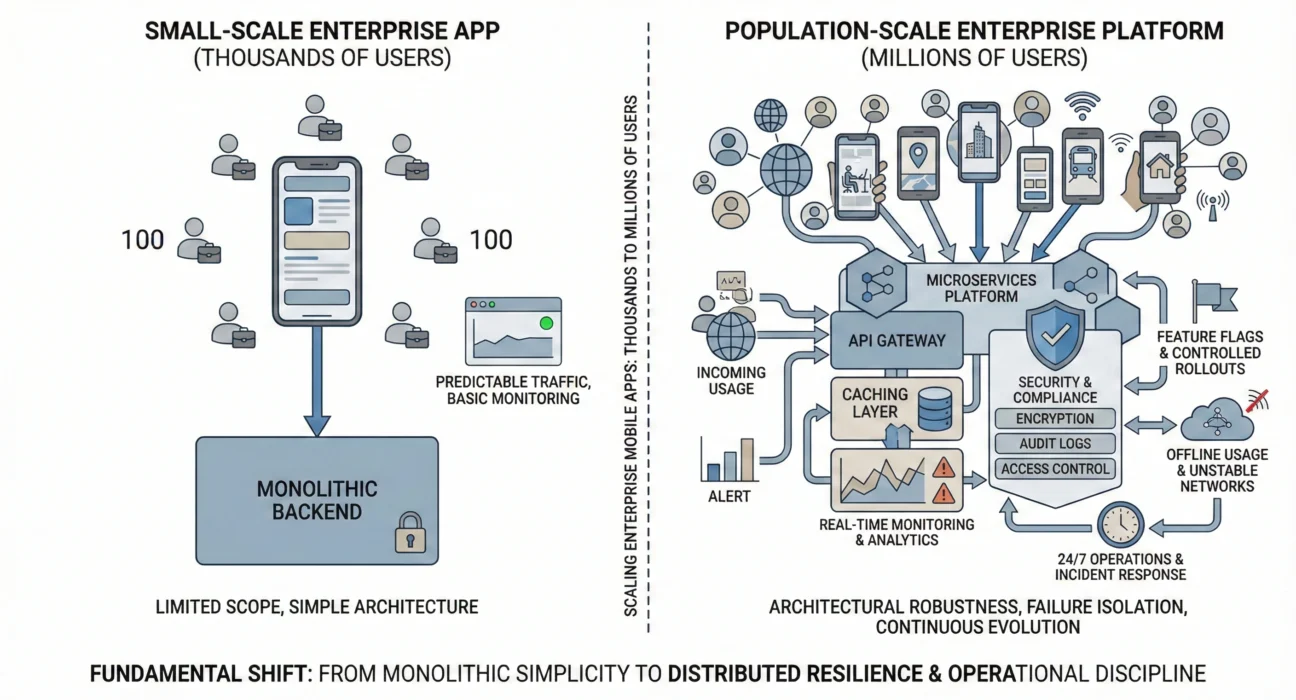
Most mobile apps built for internal corporate use serve a few hundred or a few thousand users. The technical requirements are straightforward. A competent development team can build something functional in a reasonable timeframe, and if something breaks, the impact is contained.
Then there are enterprise mobile apps built for external users at scale. Apps that serve millions of customers, partners, or field workers. Apps where downtime translates directly into revenue loss, brand damage, and regulatory scrutiny. Apps where a poor user experience doesn’t just frustrate a handful of internal employees but creates customer churn measured in millions of dollars.
The shift from thousands to millions of users is not just a scaling problem. It fundamentally changes what you’re building, how you build it, and what kind of team you need to succeed.
The Architecture Problem Nobody Talks About Early Enough
When you’re building for a small user base, you can get away with architectural shortcuts. You can use monolithic structures, rely on vertical scaling, and patch problems as they emerge. The system works because the load is predictable and the failure scenarios are limited.
At scale, these shortcuts become catastrophic liabilities. A poorly designed database query that takes 200 milliseconds might be fine for 500 concurrent users. For 2 million active users, that same query can bring down your entire infrastructure. The system doesn’t just slow down. It collapses.
Enterprises often underestimate this transition. They assume that scaling is about adding more servers or increasing cloud capacity. That’s part of it, but the real challenge is architectural. You need microservices that can fail independently without cascading. You need caching strategies that reduce database load by orders of magnitude. You need API gateways that can handle traffic spikes without choking. You need monitoring that tells you where the system is about to break before it actually does.
This level of architectural planning needs to happen at the beginning, not after you’ve already built something that doesn’t scale. Retrofitting architecture is expensive, time-consuming, and high-risk. Most large-scale app failures in enterprise environments trace back to architectural decisions made when the system was still small.
Security and Compliance at Population Scale
Security for internal apps is mostly about access control and data protection within a controlled environment. When your app serves millions of external users, the threat landscape changes completely.
You’re now dealing with credential stuffing attacks, API abuse, fraudulent account creation, and sophisticated attempts to exploit any weakness in your system. A vulnerability that might affect 50 internal users now potentially exposes millions of customer records. The regulatory and legal consequences multiply accordingly.
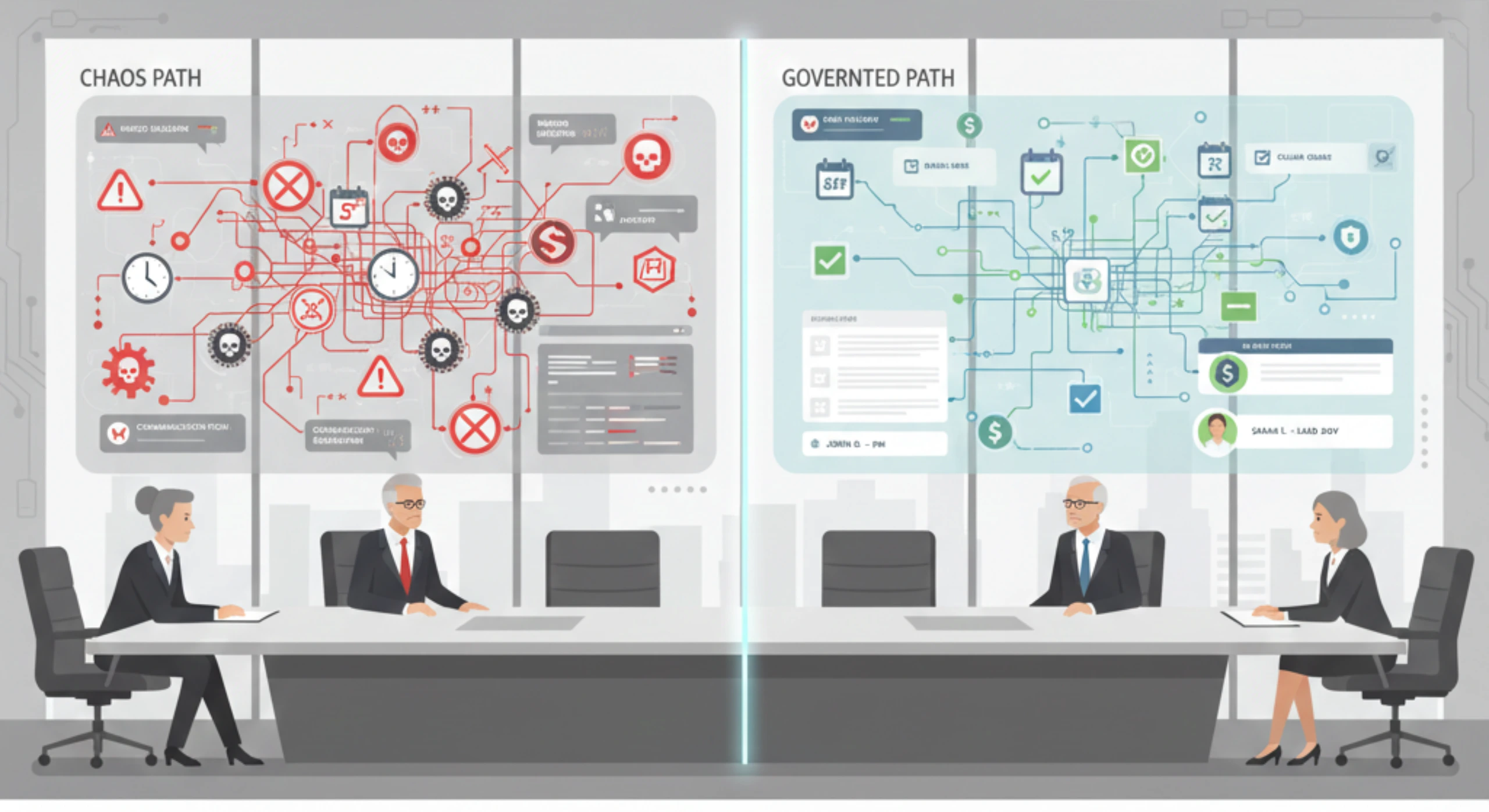
Enterprises in regulated industries face additional complexity. Financial services apps must meet PCI-DSS standards while handling millions of transactions daily. Healthcare apps must maintain HIPAA compliance across distributed systems with multiple points of data access. Retail apps must comply with GDPR, CCPA, and a growing list of regional privacy regulations.
Compliance at this scale isn’t a checkbox exercise. It requires continuous monitoring, automated compliance testing, and architecture designed specifically to support regulatory requirements. Data residency rules mean you might need different infrastructure in different regions. Audit requirements mean you need logging and traceability for every transaction. Incident response plans need to account for breaches that could affect millions of users simultaneously.
The cost of getting this wrong is not just financial. It’s reputational damage that takes years to repair and regulatory attention that creates ongoing operational burden.
Performance Under Real-World Conditions
Lab testing tells you very little about how an app performs when millions of people use it in unpredictable ways. Real users don’t follow test scripts. They use the app on aging devices with inconsistent network connections. They interact with features in sequences your QA team never anticipated. They generate edge cases faster than you can document them.
Performance problems that seem minor in testing become major barriers at scale. A loading screen that takes three seconds might be acceptable for internal users who understand the system. For external customers comparing your app to competitors, three seconds is the difference between engagement and abandonment. Research consistently shows that conversion rates drop significantly with each additional second of load time.
Network resilience becomes critical. Your users aren’t all on corporate WiFi. They’re on subway platforms with spotty 4G coverage, in rural areas with limited bandwidth, and in regions where network infrastructure is unreliable. Your app needs to function gracefully in these conditions, not just fail with generic error messages.
This means aggressive optimization. Image compression that doesn’t compromise quality. API responses that send only essential data. Offline functionality that lets users accomplish critical tasks without connectivity. Caching strategies that balance freshness with performance. These aren’t nice-to-have features. They’re requirements for acceptable user experience at scale.
The Operations Challenge That Enterprises Underestimate
Launching an app for millions of users is not the finish line. It’s the starting line for an ongoing operational commitment that many enterprises are unprepared for.
You need 24/7 monitoring because your users are global and problems don’t wait for business hours. You need incident response procedures that can triage and address issues before they affect large user populations. You need deployment processes that allow frequent updates without service disruption. You need analytics that tell you not just what users are doing, but where they’re experiencing friction.
Support becomes a significant operational challenge. When something goes wrong for 1% of your user base, that’s potentially 10,000 or 50,000 or 100,000 affected users. Your support infrastructure needs to scale accordingly. You need clear escalation paths, comprehensive logging that helps diagnose user-specific issues, and the technical capability to push targeted fixes quickly.
Enterprises often build apps with development teams that aren’t structured for this operational reality. They plan for launch but not for the ongoing maintenance, monitoring, and iteration required to keep a large-scale app functioning well. The result is technical debt that accumulates rapidly and operational fire-fighting that becomes the norm rather than the exception.
Why Ozrit Approaches This Differently
Ozrit has built mobile apps for enterprise clients where the user base reaches into the millions. The lessons from that work shape how the company approaches every large-scale engagement.
The most important difference is upfront planning. Before any code gets written, Ozrit’s senior architects work directly with clients to map out the system architecture, identify scaling bottlenecks, and design for operational sustainability. This isn’t delegated to junior team members. The people who’ve solved these problems before are the ones making the critical decisions early.
The team structure reflects enterprise reality. Ozrit doesn’t just provide developers. They provide complete delivery teams that include security specialists, DevOps engineers, QA automation experts, and technical architects who’ve built systems at scale. These aren’t roles filled by one person wearing multiple hats. They’re distinct specialists working together.
Onboarding is structured to reduce enterprise risk. Ozrit typically runs a discovery phase that maps existing infrastructure, identifies integration points, and validates technical assumptions before committing to full-scale development. This phase produces detailed technical specifications and project plans that give enterprises clear visibility into what’s being built and why.
Timelines are realistic. A well-architected enterprise mobile app for millions of users takes six to nine months to build properly, sometimes longer depending on integration complexity and regulatory requirements. Ozrit doesn’t promise compressed timelines that create downstream quality problems. They plan for the actual work required, including comprehensive testing, security hardening, and operational preparation.
Post-launch support is structured into the engagement from the beginning. Ozrit provides 24/7 monitoring and support for production systems, with clear escalation procedures and service level commitments. This isn’t an afterthought. It’s part of how they define successful delivery.
The company works with enterprises that need certainty more than they need speed. Organizations where the cost of failure is measured in millions of dollars and where reputational risk makes experimental approaches unacceptable.
The Hidden Complexity of Feature Evolution
Large-scale apps need continuous evolution, but making changes when millions of users depend on your app is fundamentally different from updating internal systems.
Every feature addition needs backward compatibility testing. Every API change needs versioning strategy. Every UI modification needs gradual rollout with the ability to roll back instantly if problems emerge. You can’t just push updates and hope for the best.
Feature flags become essential infrastructure, not optional tooling. You need the ability to enable features for specific user segments, test in production with controlled populations, and disable problematic features without deploying new code. This requires planning and infrastructure that most enterprises don’t initially budget for.
The feedback loop changes at scale. You’re not getting dozens of support tickets. You’re analyzing user behavior data from millions of sessions, correlating crash reports, and identifying patterns in customer complaints. This requires analytics infrastructure, data analysis capability, and product management processes sophisticated enough to prioritize what matters.
Enterprises that don’t plan for this evolution end up with apps that ossify. They become afraid to make changes because the risk seems too high and the process too cumbersome. The app that was cutting-edge at launch becomes a legacy system within two years.
Making the Investment Decision
Building a mobile app for millions of users is not a modest technology project. It’s a significant enterprise investment that requires sustained commitment, appropriate budget, and realistic timeline expectations.
The enterprises that succeed with these apps share common characteristics. They understand that cheap and fast are not compatible with scale and reliability. They involve senior technical leadership in planning, not just approval. They allocate budget for the actual requirements, including post-launch operations. They choose partners based on relevant experience and delivery capability, not just price.
The question isn’t whether to build something that scales. If your user base is measured in millions, you don’t have a choice. The question is whether to build it right the first time or to rebuild it later after an expensive failure. The math consistently favors doing it properly from the start.
For enterprises facing this decision, the differentiator is rarely the technology itself. Every competent development organization can access the same cloud platforms and development tools. The differentiator is experience with the specific challenges that emerge at scale and the discipline to address them systematically rather than reactively. That experience determines whether your enterprise mobile app becomes a competitive advantage or an operational liability.