How Customer Feedback and NPS Can Improve Field Service
Most field service businesses only hear from customers when something goes wrong. A technician arrives late, a repair doesn’t hold, a visit gets logged but never really happened. By then, the damage is done.
Systematic field service customer feedback changes this. You hear from customers after every visit, spot patterns early, and fix problems before they cost you contracts. This guide explains how feedback and Net Promoter Score (NPS) work in field operations, which metrics matter, and how to build a feedback loop your team will actually use.
What Is Field Service Customer Feedback?
Field service customer feedback is the structured input customers give about a service visit, such as punctuality, technician behavior, work quality, and whether the issue was resolved. It can be collected through surveys, ratings, calls, or in-app forms, and it is used to improve service quality, technician performance, and customer retention.
Unlike office-based businesses, field service companies can’t observe the customer experience directly. Your team works at customer sites, often unsupervised. Feedback becomes your window into what actually happened.
What Is NPS and How Does It Work in Field Service?
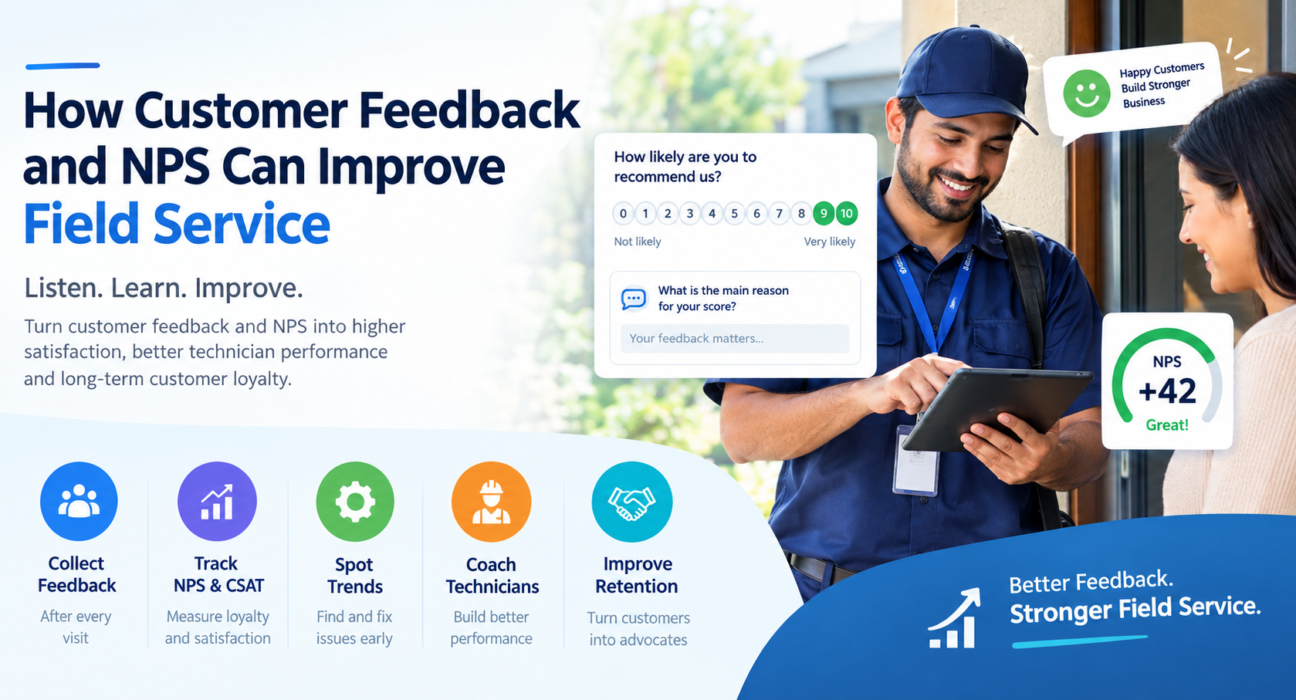
Net Promoter Score (NPS) measures how likely a customer is to recommend your business, using a single question on a 0–10 scale. The method was introduced by Fred Reichheld of Bain & Company in a 2003 Harvard Business Review article.
Customers are grouped by their answer:
- Promoters (9–10): Loyal customers likely to recommend you.
- Passives (7–8): Satisfied but not enthusiastic, and open to competitors.
- Detractors (0–6): Unhappy customers who may switch or speak negatively.
NPS = % of Promoters − % of Detractors. The score ranges from −100 to +100.
In field service, the standard question can be tailored to the visit: “How likely are you to recommend us to a colleague or friend based on your recent service experience?” Add one open-ended follow-up, such as “What is the main reason for your score?”, and the number comes with an explanation.
Why Feedback Matters More in Field Operations
Field work has built-in blind spots. Here is how feedback fills them.
1. You can’t supervise every visit. Feedback acts as a quality check on work you never saw.
2. Problems are often invisible in your reports. A visit may be marked “completed” in your system while the customer is still dissatisfied. Feedback shows the gap between completion and satisfaction.
3. Issues hide in individual performance. A single technician with repeated low ratings is easy to miss without data. Feedback tied to each visit makes patterns visible.
4. Retention depends on the field experience. For many service businesses, the technician is the face of the company. Customers judge you by that one interaction.
Key Metrics to Track Alongside NPS
NPS gives a loyalty snapshot, but it works best with other measures.
| Metric | What It Measures | Best Used For |
|---|---|---|
| NPS | Likelihood to recommend | Overall loyalty and brand perception |
| CSAT (Customer Satisfaction Score) | Satisfaction with a specific visit | Post-visit quality checks |
| CES (Customer Effort Score) | How easy it was to get service | Booking, scheduling, and communication |
| First-time fix rate | Issues resolved on the first visit | Technician skill and preparation |
| SLA compliance | Whether visits met promised timelines | Punctuality and response commitments |
| Repeat visit rate | Visits needed to resolve one issue | Root-cause quality problems |
CSAT vs NPS: CSAT measures satisfaction with a single interaction, while NPS measures overall loyalty. Use CSAT right after each visit and NPS at regular intervals or after key milestones.
How to Collect Field Service Customer Feedback
Choose the Right Moment
Timing affects both response rates and accuracy. The strongest moments are:
- Immediately after a visit is marked complete
- After a job is closed or a ticket is resolved
- After an installation or a scheduled service cycle
Asking too late means customers forget details. Asking too early, before the work is confirmed, produces unreliable answers.
Keep Surveys Short
Two to five questions is enough for most visits. A practical structure:
- One rating question (CSAT or NPS)
- One question on technician behavior or punctuality
- One open-ended comment field
Use Simple Channels
Customers respond when it’s easy. Common options include SMS or WhatsApp links, email surveys, mobile forms filled in during the visit, and short follow-up calls for high-value accounts.
Sample Field Service Survey Questions
- How likely are you to recommend us based on this visit? (0–10)
- Did the technician arrive within the promised time?
- Was the issue fully resolved?
- How would you rate the technician’s professionalism?
- What could we have done better?
Turning Feedback Into Better Field Service
Collecting feedback is the easy part. The value comes from what you do next. Here is a simple process to follow.
Step 1: Centralize the data. Feedback scattered across emails, calls, and spreadsheets can’t be analyzed. Bring it into one place, linked to the visit, customer, and technician.
Step 2: Segment the results. Break scores down by technician, region, service type, and time period. A strong overall NPS can hide a weak territory.
Step 3: Follow up with detractors quickly. A prompt call from a manager can turn an unhappy customer around. Set an internal rule, such as responding within one business day.
Step 4: Look for root causes in comments. Tag recurring themes such as late arrivals, missing parts, or poor communication. Open-text answers often reveal fixable process issues.
Step 5: Coach, don’t just score. Use feedback in one-on-one conversations with technicians. Share positive comments, too, since recognition motivates field teams.
Step 6: Close the loop with customers. Tell customers what changed because of their feedback. This builds trust and improves future response rates.
Common Mistakes to Avoid
- Surveying only happy customers. Send surveys after every visit, not selectively.
- Asking too many questions. Long surveys lower completion rates.
- Ignoring negative comments. Detractor feedback is the most useful data you have.
- Treating NPS as a vanity number. A score means little unless it triggers action.
- Using feedback only to blame. Punitive use discourages honest reporting by teams.
- Not linking feedback to visit data. A rating without context (who, when, where) is hard to act on.
How Field Force Management Software Supports Customer Feedback
Running feedback manually works for a handful of technicians. Across dozens or hundreds of field employees, it becomes difficult to track.
Field force management software helps by connecting feedback to operational data. Visit records, task status, location verification, and service timelines sit alongside customer ratings, so you can see why a score was low, not just that it was.
Businesses looking to simplify these processes can use field force management software such as FieldExecutives. Based on the platform’s capabilities, teams can use it to:
- Capture structured data at the visit using custom forms and workflows, which can be adapted to include feedback or service-completion checks
- Verify customer visits with location-based records, so you can compare what was reported with what customers experienced
- Manage tasks and visits so follow-ups on low-rated visits are assigned and tracked
- Monitor SLA and timelines to see whether punctuality issues are driving dissatisfaction
- Review real-time reports on field team activity and productivity, helping managers connect performance patterns with customer feedback
(Confirm each feature against the current FieldExecutives website before publishing.)
The aim isn’t to replace human judgment. It is to give managers the context they need to act on feedback quickly and fairly.
Building a Feedback-Driven Field Service Culture
Tools only work if the team believes in the process. A few practices help:
- Share results openly. Let teams see their scores and the reasons behind them.
- Set realistic targets. Improve NPS gradually, rather than demanding sudden jumps.
- Reward service quality, not just speed. If incentives focus only on job count, quality suffers.
- Review feedback regularly. A weekly or monthly review makes feedback part of normal operations.
- Involve technicians in solutions. They often know what’s causing the problems customers report.
Conclusion
Strong field service customer feedback practices turn customer opinions into a practical improvement tool. NPS shows how loyal your customers are. CSAT and related metrics show how individual visits went. Together with visit data, they help you coach technicians, fix process gaps, and win repeat business.
The takeaway is simple: collect feedback after every visit, tie it to operational data, follow up with detractors fast, and share what you learn with your team. Field force management platforms like FieldExecutives can help bring visits, tasks, and field activity data into one place, making it easier to act on what customers tell you.