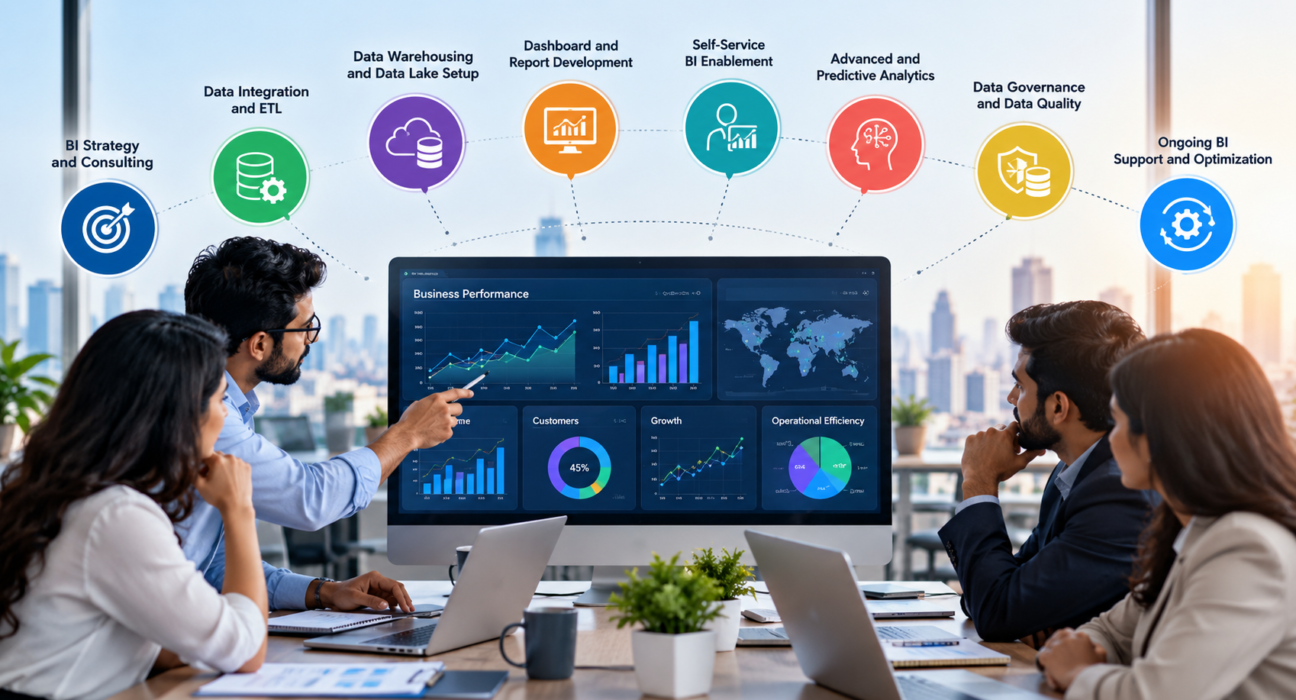
Business intelligence services help companies collect data from different systems, organize it, and turn it into dashboards, reports, and insights that support better decisions. The key business intelligence services include BI strategy and consulting, data integration, data warehousing, dashboard development, self-service analytics, advanced analytics, data governance, and ongoing BI support.
If you’re a founder, operations lead, or IT manager, you’ve probably felt the problem these services solve. Sales numbers live in a CRM, while financials sit in accounting software and campaign results stay in marketing tools. As a result, nobody agrees on which spreadsheet is right. Business intelligence services replace that guesswork with a single, trusted view of performance.
This guide explains what each service involves, who needs it, and how to choose a provider that fits your business.
What Are Business Intelligence Services?
Business intelligence (BI) services are professional services that help organizations plan, build, and maintain systems for analyzing business data. Providers typically handle everything from connecting data sources to designing the dashboards your team uses every day.
BI services differ from simply buying a BI tool. For example, Power BI or Tableau gives you software, but a BI service provider helps you decide what to measure, prepare the data, and build the reports. Just as importantly, they make sure people actually use them.
When Do Companies Need BI Services?
Companies usually seek out business intelligence services when they:
- Spend hours each week building manual reports
- Have data scattered across many disconnected systems
- Can’t answer basic questions quickly, such as which customers are most profitable
- Are growing and need reporting that scales
- Want to move from basic reporting to forecasting
What Are the Key Business Intelligence Services?
Below are the core services offered by BI consulting firms, analytics companies, and software development partners. Some projects need all of them, while others need only two or three.
1. BI Strategy and Consulting
This is where good BI projects start. First, consultants work with leadership to define business goals and identify the questions that matter. Then they select key performance indicators (KPIs), assess your current data setup, and recommend tools and a roadmap.
Skipping this step is a common reason BI projects fail. Without a clear goal, teams build dozens of dashboards that nobody needs.
2. Data Integration and ETL
Data integration connects your source systems, such as CRM, ERP, e-commerce platforms, and marketing tools, and moves the data into one place. ETL stands for extract, transform, load. In other words, data is pulled out, cleaned and standardized, and then loaded into a central system.
Without this layer, reports are only as reliable as whoever exported the last spreadsheet.
3. Data Warehousing and Data Lake Setup
A data warehouse is a central repository that stores structured, cleaned data for reporting and analysis. A data lake, on the other hand, stores larger volumes of raw or mixed data, including logs, documents, and event streams.
Providers help you design the architecture and choose between cloud and on-premise options. They also set up storage that stays fast as your data grows.
4. Dashboard and Report Development
This is the most visible BI service. Developers build interactive dashboards and scheduled reports tailored to different roles. For instance, the revenue team gets a sales dashboard, while finance gets a cash-flow view.
Good dashboard design focuses on clarity. The best dashboards show the right metrics, use sensible filters, and make trends obvious without a training session.
5. Self-Service BI Enablement
Self-service BI lets non-technical employees explore data on their own instead of waiting for the analytics team. To make this work, providers set up governed data models, templates, and permissions, and then train staff to use them.
Consequently, report backlogs shrink and managers get faster answers. However, this only works when the underlying data is well structured.
6. Advanced and Predictive Analytics
Beyond describing what happened, advanced analytics services help you anticipate what is likely to happen next. Common examples include demand forecasting, customer churn prediction, and customer segmentation. Some providers also add machine learning for more complex use cases.
That said, most businesses should build a solid reporting foundation first, because predictive models depend on clean, consistent data.
7. Data Governance and Data Quality Management
Governance covers who can access which data, how it’s defined, and how accuracy is maintained. For example, it settles what counts as an “active customer” so every department uses the same definition.
Data quality services, in addition, include cleansing duplicates, fixing inconsistencies, and monitoring for errors. If your industry has privacy or compliance requirements, governance also supports those needs. Even so, confirm specific legal obligations with a qualified professional.
8. BI Migration and Modernization
Many companies still run outdated reporting systems or legacy BI platforms. Migration services move reports and data models to newer, often cloud-based platforms. Meanwhile, they preserve business logic and keep disruption to a minimum.
9. Embedded Analytics
If you run a SaaS product, embedded analytics adds dashboards and reports directly inside your application so customers can view their own data. Because this is a specialized service, it’s worth working with a provider that has software development experience as well as BI expertise.
10. Managed BI Support, Maintenance, and Training
BI systems need ongoing care. Data pipelines break, reports must change as the business evolves, and new users need onboarding. Therefore, many providers offer retainers or managed services so you don’t need a full in-house team.
Business Intelligence Services at a Glance
| Service | What It Does | Best For |
|---|---|---|
| BI strategy and consulting | Defines goals, KPIs, and a roadmap | Companies starting BI or restarting a stalled project |
| Data integration / ETL | Connects and cleans data from multiple sources | Businesses with scattered systems |
| Data warehousing | Centralizes data for analysis | Growing companies with rising data volume |
| Dashboard development | Builds reports and visual dashboards | Teams needing day-to-day visibility |
| Self-service BI | Lets staff explore data independently | Organizations with report backlogs |
| Advanced analytics | Forecasts and predicts outcomes | Companies with mature, clean data |
| Data governance | Sets rules for access, quality, and definitions | Larger or regulated organizations |
| Migration / modernization | Moves legacy reporting to modern platforms | Businesses with outdated BI systems |
| Embedded analytics | Adds analytics inside your product | SaaS and software companies |
| Managed support and training | Maintains and improves BI over time | Teams without in-house BI staff |
How Do Business Intelligence Services Work?
Most engagements follow a similar path:
- Discovery: The provider interviews stakeholders and identifies goals, questions, and data sources.
- Data assessment: Next, they review data quality, structure, and gaps.
- Architecture design: After that, they plan the warehouse, pipelines, and tool selection.
- Development: Data pipelines, models, and dashboards are then built, usually in phases.
- Testing and validation: Numbers are checked against trusted sources before anyone relies on them.
- Training and rollout: Teams learn how to use the reports and ask questions.
- Support and iteration: Finally, reports evolve as the business changes.
A phased approach usually delivers value faster than trying to cover the whole company at once. For example, you might start with one department or a handful of KPIs and expand from there.
Which Business Intelligence Services Does Your Business Need?
Your needs depend on company size and data maturity.
Startups and Early-Stage Companies
Startups usually need lightweight setups, such as basic data integration, a few well-designed dashboards, and a clear set of KPIs. Heavy infrastructure can wait until the business grows.
Small and Mid-Sized Businesses
SMBs often benefit most from data integration, a central warehouse, and self-service dashboards. At this stage, replacing manual reporting saves real time. Likewise, shared KPI definitions prevent arguments between teams.
Enterprises and SaaS Companies
Enterprises typically need governance, scalable architecture, migration from legacy systems, and advanced analytics across departments. SaaS companies, in contrast, may also want embedded analytics so customers can see their own data inside the product.
A Simple Way to Decide
If your team can’t trust the numbers, start with integration and data quality. If the numbers are trusted but slow to get, focus on dashboards and self-service. Finally, if reporting is solid and you want foresight, consider predictive analytics.
Common BI Tools Providers Work With
Providers generally specialize in specific platforms. Well-known options include Microsoft Power BI, Tableau, Looker, Qlik, and Apache Superset. Cloud data platforms such as Snowflake, Google BigQuery, and Amazon Redshift are also common.
The right choice depends on your existing software, budget, team skills, and scale. Ideally, a good provider recommends tools based on your needs rather than defaulting to the one they know best.
How to Choose a Business Intelligence Services Provider
Picking the right partner matters as much as the technology. Use this checklist to evaluate your options.
What to Look For
- Relevant experience: Have they worked in your industry or with similar data systems?
- Tool expertise: Do they have proven experience with the platforms you use or plan to use?
- Business focus: Do they ask about your goals before talking about tools?
- Data security practices: How do they handle access, storage, and confidentiality?
- Process clarity: Can they explain their delivery process, timelines, and communication approach?
- Training and support: Will your team be able to use the system after launch?
- References and portfolio: Can they share case studies or client feedback you can verify?
- Pricing transparency: Do they explain what drives cost, such as data volume, number of sources, and complexity?
How to Compare Providers
Compare at least three providers and ask each to outline how they would approach the same problem. Often, the questions a provider asks tell you more than their sales deck does.
A directory like GoFirms can help at this stage. You can browse and compare technology and IT service companies, review their profiles and service focus areas, and build a shortlist before reaching out. Of course, verify details directly with providers before making a decision.
Common Mistakes to Avoid
- Buying tools before defining goals. Instead, start with the questions you need answered.
- Ignoring data quality. Beautiful dashboards built on messy data erode trust fast.
- Trying to do everything at once. Begin with high-impact use cases and expand later.
- Neglecting user adoption. Reports nobody uses deliver no value, so involve end users early.
- Overlooking ongoing costs. Licensing, cloud storage, and maintenance continue after launch.
- Skipping governance. Without shared definitions, departments will keep disagreeing on the numbers.
Frequently Asked Questions
What are business intelligence services?
Business intelligence services are professional services that help organizations collect, organize, analyze, and visualize business data. They typically include strategy, data integration, warehousing, dashboard development, analytics, and ongoing support. As a result, decision-makers can rely on accurate, timely information instead of manual reports or guesswork.
What is the difference between business intelligence and data analytics?
Business intelligence mainly focuses on describing past and current performance through dashboards and reports. Data analytics, by comparison, is broader and often includes deeper statistical analysis, forecasting, and modeling. In practice, the two overlap, so many providers offer both as part of a combined data strategy.
How much do business intelligence services cost?
Costs vary widely based on the number of data sources, data volume, tool choice, project scope, and provider location. For instance, a small dashboard project costs far less than an enterprise data warehouse build. Therefore, request detailed quotes from several providers and ask what’s included, such as licensing, support, and training.
Do small businesses need business intelligence services?
Not always at full scale, but many small businesses benefit from a basic setup. If you rely on spreadsheets from several systems and spend significant time compiling reports, a small BI engagement can save time and improve decisions. Start with a few essential KPIs, and expand as needs grow.
How long does a BI implementation take?
It depends on scope. A focused dashboard project may take a few weeks, whereas a full data warehouse and multi-department rollout can take several months. Because phased delivery shows results early, you don’t have to wait for a single large launch.
Should I hire an in-house BI team or outsource?
Outsourcing suits companies that need specialized skills quickly or lack ongoing demand for a full team. In-house teams, on the other hand, work better when BI is central to daily operations. Many businesses use a hybrid model, with a provider building the foundation and internal staff managing day-to-day use.
How do I find a reliable business intelligence services provider?
First, define your goals. Then shortlist providers with relevant tool and industry experience, review their portfolios, and ask for references. Directories such as GoFirms can help you research and compare IT and technology service companies before you make contact.
Conclusion
Business intelligence services cover the full journey from raw data to confident decisions. They include strategy, integration, warehousing, dashboards, self-service analytics, governance, and ongoing support. However, you don’t need every service on day one. Instead, match them to your current stage, fix data quality before chasing advanced analytics, and start with the questions your business most needs answered.
When you’re ready to find a partner, take time to compare options. Browsing relevant providers on GoFirms can give you a starting shortlist, and from there you can evaluate fit based on experience, approach, and communication.