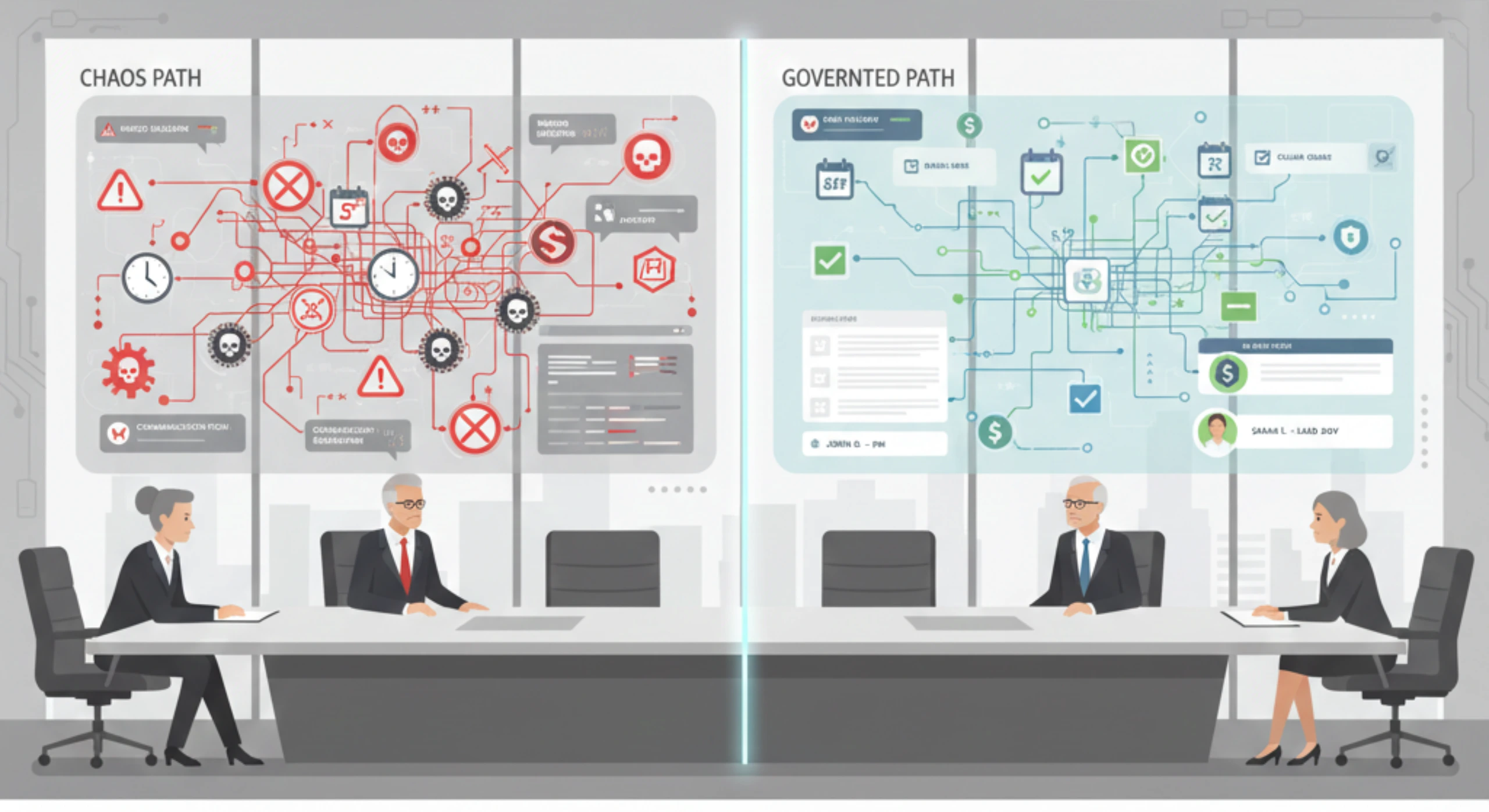
Most enterprise software projects don’t fail because of bad code. They fail because risks that were visible early get ignored, downplayed, or discovered too late to matter.
A CFO approves a budget based on best-case assumptions. A CIO commits to a timeline that assumes perfect execution. Six months later, the project is over budget, behind schedule, and delivering less than promised. The board wants answers. The blame begins.
This pattern repeats across Indian enterprises with predictable regularity. The problem isn’t that risks exist, they always do. The problem is how organisations identify, communicate, and manage them.
Why Traditional Risk Management Fails in Software Projects
Most enterprise risk registers are theatre. They list generic risks “resource attrition,” “scope creep,” “integration delays” , assign red-amber-green ratings, and get reviewed in monthly steering committees. Then the project derails anyway.
Risks get sanitised before they reach leadership. Project managers don’t want to look incompetent. Vendors don’t want to lose contracts. So risks get softened, categorised as “yellow” instead of “red,” and presented with mitigation plans that sound reassuring but lack substance.
By the time a risk turns into an issue, options have narrowed. When a critical integration dependency is flagged in month two, there are alternatives re-scope, parallel-track, and bring in specialists. When it surfaces in month eight as a blocker to go-live, the only options left are delay the launch or compromise on functionality.
Nobody wants to be the person who raises uncomfortable truths. Enterprise cultures often punish bearers of bad news. Teams learn to keep risks quiet until they become unavoidable. Leadership then complains they weren’t informed earlier, reinforcing the cycle.
Risk ownership is ambiguous. Who owns the risk that your legacy billing system can’t handle real-time API calls? Is it the vendor building the new platform? The internal IT team managing infrastructure? The business owner who delayed system upgrades for five years? When ownership is unclear, risks don’t get managed they get debated.
The Real Risks That Derail Enterprise Software Projects
Some risks are universal. Others are uniquely painful in the Indian enterprise context.
Legacy system complexity is consistently underestimated. Organisations assume their existing systems are documented, understood, and ready for integration. Reality is messier. Critical business logic exists only in the heads of employees nearing retirement. Data quality is poor. Systems that were supposed to be decommissioned years ago are still running mission-critical processes.
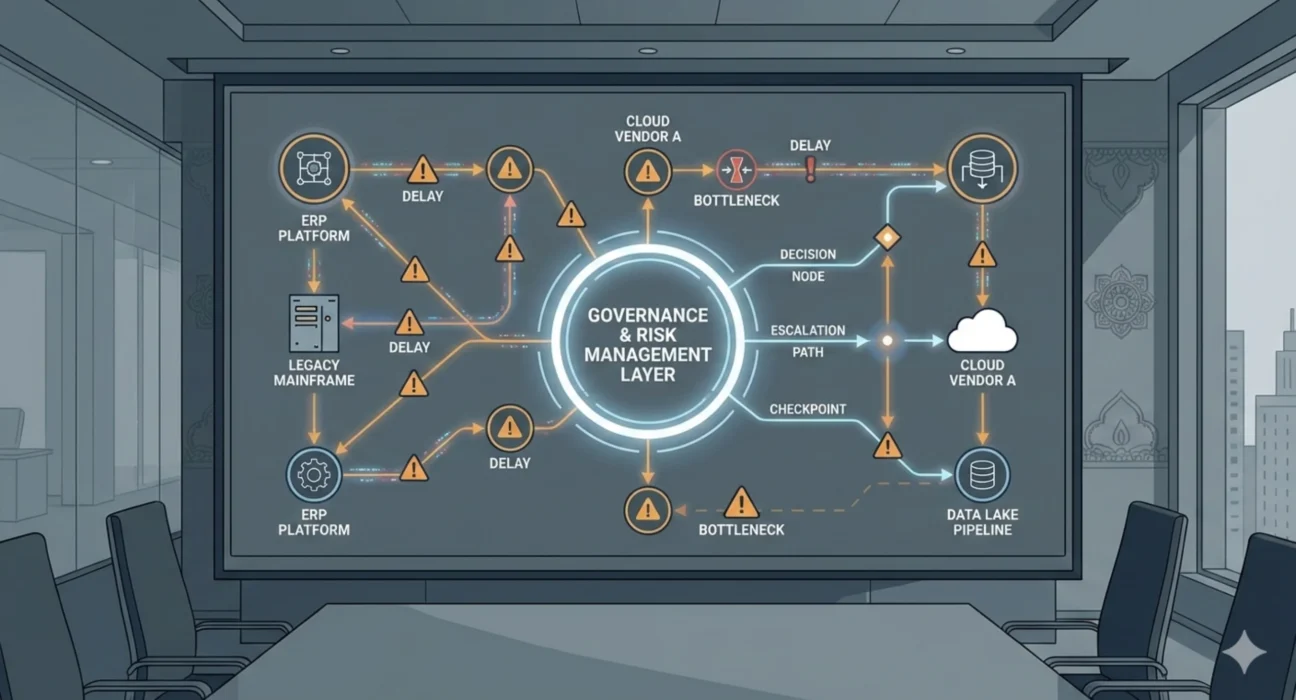
Vendor dependencies create hidden fragilities. Your new ERP depends on middleware from one vendor, data migration from another, custom integrations from a third. When one vendor misses a milestone, the entire chain breaks. Enterprises often lack the technical depth to even understand these dependencies, let alone manage them.
Compliance and audit requirements emerge mid-project. What started as a straightforward application modernisation suddenly needs SOC 2 certification, RBI audit trails, or GDPR compliance. These aren’t nice-to-haves. They’re hard gates that can delay go-live by months.
Stakeholder alignment dissolves under pressure. In the planning phase, everyone agrees on priorities. Six months in, when trade-offs become real, alignment evaporates. Sales wants features that marketing doesn’t care about. Finance wants controls that operations finds cumbersome. Without clear decision rights, the project stalls in committee debates.
Business continuity gets tested only at go-live. Most enterprises don’t truly stress-test cutover plans. They assume rollback will work, data migration will be clean, and users will adapt quickly. Then production breaks on day one, rollback fails, and there’s no contingency plan.
What Mature Risk Management Actually Looks Like
Mature organisations don’t eliminate risk. They create systems to surface, assess, and respond to risk quickly.
Risks are discussed in the language of business impact, not technical jargon. A CTO telling the board about “database replication lag” gets glazed eyes. Framing it as “transaction processing delays that could affect month-end close” gets attention and budget.
Risk escalation is structured and time-bound. If a risk cannot be resolved at the project level within 48 hours, it escalates to the program level. If unresolved in a week, it reaches the steering committee. No risk lives in ambiguity for long.
Risk mitigation is resourced, not theoretical. Saying “we’ll bring in additional expertise if needed” isn’t risk management. Identifying who that expertise is, pre-negotiating contracts, and having a budget allocated is.
Independent risk assessment happens at stage gates. Relying solely on vendor-reported status is naïve. Mature enterprises bring in third-party reviews at critical milestones architecture validation, security audits, integration readiness checks. This is where partners like Ozrit add value not just delivering programs, but providing the governance maturity to assess and course-correct before risks become crises.
The Role of Leadership in Managing Software Project Risk
Risk management isn’t a project manager’s job. It’s a leadership responsibility.
CEOs and CFOs must insist on honest risk reporting. If every project status is green until suddenly it’s red, the culture is broken. Leaders need to reward early risk identification, not punish it. The question shouldn’t be “why didn’t you prevent this risk?” but “when did you first flag it, and what options do we have?”
CIOs must translate technical risks into business language. The board doesn’t need to understand Kubernetes orchestration failures. They need to understand that the planned launch date is at risk, customer onboarding will be delayed, and revenue targets may be affected.
Program sponsors must make hard calls quickly. When a risk surfaces that requires trade-offs, cut scope, extend timeline, add budget indecision is the worst option. Mature sponsors make the call, communicate it clearly, and move forward.
Accountability must be explicit. Every significant risk needs a name attached not a role, a person. “IT team will resolve” is meaningless. “Rajesh owns resolution by Friday” creates accountability.
Common Risk Patterns and How to Address Them
Certain risks appear so frequently in enterprise software projects that they should be assumed by default.
Resource attrition will happen. Key developers will leave. Domain experts will move to other roles. Planning for zero attrition is planning to fail. Mature programs build in knowledge transfer protocols, documentation standards, and overlapping expertise from day one.
Requirements will change. Businesses evolve. Regulations shift. Competitors move. Locking requirements and refusing changes creates brittle systems that are obsolete before launch. The answer isn’t to freeze scope, it’s to build change management into the delivery model.
Integration will take longer than estimated. Always. API documentation is incomplete. Test environments don’t match production. Legacy systems behave unpredictably under load. Smart programs allocate 30-40% more time for integration than initial estimates suggest.
Go-live will surface unforeseen issues. No matter how thorough your UAT, production will reveal problems. Mature enterprises plan for hypercare dedicated support teams, rapid hotfix capability, and clear escalation paths for the first 30-60 days post-launch.
Vendor relationships will be tested. When timelines slip or quality issues emerge, vendor partnerships reveal their true nature. Are they collaborative problem-solvers or contract lawyers pointing to fine print? This is why enterprises increasingly look for partners like Ozrit who operate as integrated delivery teams rather than transactional vendors.
Building Risk Resilience into Enterprise Programs
The best risk management is preventative, not reactive.
Start with rigorous discovery. Most projects fail because assumptions made in the first month turn out to be wrong. Spend more time upfront understanding legacy landscapes, data quality, integration touchpoints, and stakeholder expectations. It’s cheaper to extend discovery by two weeks than to re-baseline the program six months in.
Insist on proof-of-concept for high-risk elements. Don’t assume complex integrations will work. Build spikes. Test early. Validate assumptions before committing to full-scale delivery.
Create financial buffers for known unknowns. Every enterprise program should have contingency not for scope expansion, but for managing risks that materialise. A 15-20% buffer isn’t pessimism; it’s realism.
Build modular delivery roadmaps. Monolithic releases create monolithic risks. Breaking programs into smaller, independent releases reduces blast radius. If one module fails, others can still go live.
Test business continuity before you need it. Run tabletop exercises. Simulate data centre failures. Practice rollback procedures. The time to discover your contingency plan doesn’t work is not during a production outage.
The Governance Structures That Enable Risk Management
Risk management doesn’t happen in a vacuum. It requires organisational structures that support it.
Weekly risk reviews, not monthly. By the time a monthly steering committee meets, a week-old risk has compounded into a crisis. High-stakes programs need weekly risk check-ins with decision-making authority.
Dedicated program management offices with teeth. PMOs that just collect status reports are useless. Effective PMOs have authority to challenge timelines, escalate issues, and enforce delivery standards.
Clear decision rights at every level. When a risk requires a trade-off, who decides? If the answer is “it depends” or “the committee will discuss,” decisions will lag until options evaporate.
Transparent dashboards that tell the truth. Real-time visibility into program health burndown charts, defect trends, integration test results makes it harder to hide problems. Sunlight is the best disinfectant.
What CFOs Should Demand from Technology Partners
For CFOs, software projects are capital allocation decisions. Risk management is fiduciary responsibility.
Demand realistic estimates, not optimistic ones. A vendor who promises the moon is either inexperienced or dishonest. A vendor who presents a range of outcomes based on different risk scenarios is worth listening to.
Demand accountability for outcomes, not outputs. Paying for “delivered features” creates incentives to ship fast, not ship right. Paying for business outcomes system uptime, transaction throughput, user adoption aligns incentives with enterprise success.
Demand visibility into risks before they become budget requests. By the time a vendor asks for more money because of unforeseen complexity, it’s too late to negotiate. Contracts should require proactive risk disclosure and mitigation planning.
Demand sustainability, not just delivery. A system that works at launch but requires expensive maintenance or constant vendor intervention is a liability, not an asset. Risk management includes planning for long-term operational resilience.
Why Risk Management Is a Competitive Advantage
Enterprises that manage software project risk well don’t just avoid failures. They build institutional capabilities that compound over time.
They deliver programs on time and on budget, building board confidence in technology investments. They retain vendor relationships that mature into strategic partnerships. They develop internal teams that understand delivery discipline, not just technical skills.
Most importantly, they create organisations capable of managing complexity. In a world where digital transformation is continuous, not episodic, the ability to execute complex programs while managing risk is the ultimate competitive advantage.
Final Thoughts: Execution Discipline Over Optimism
Software project risk is inevitable. What’s not inevitable is being blindsided by it.
The enterprises that manage risk well don’t rely on heroics, luck, or vendor promises. They build systems governance structures, escalation protocols, honest reporting cultures that surface and address risks when they’re manageable.
They choose partners who understand that enterprise software delivery is fundamentally a risk management exercise. Not every vendor gets this. Those that do partners focused on program execution maturity rather than just technical delivery become long-term assets, not project-by-project transactions.
Risk management in software projects isn’t about eliminating uncertainty. It’s about creating the discipline, transparency, and accountability to navigate it successfully.
And that discipline is what separates enterprises that thrive from those that simply survive.