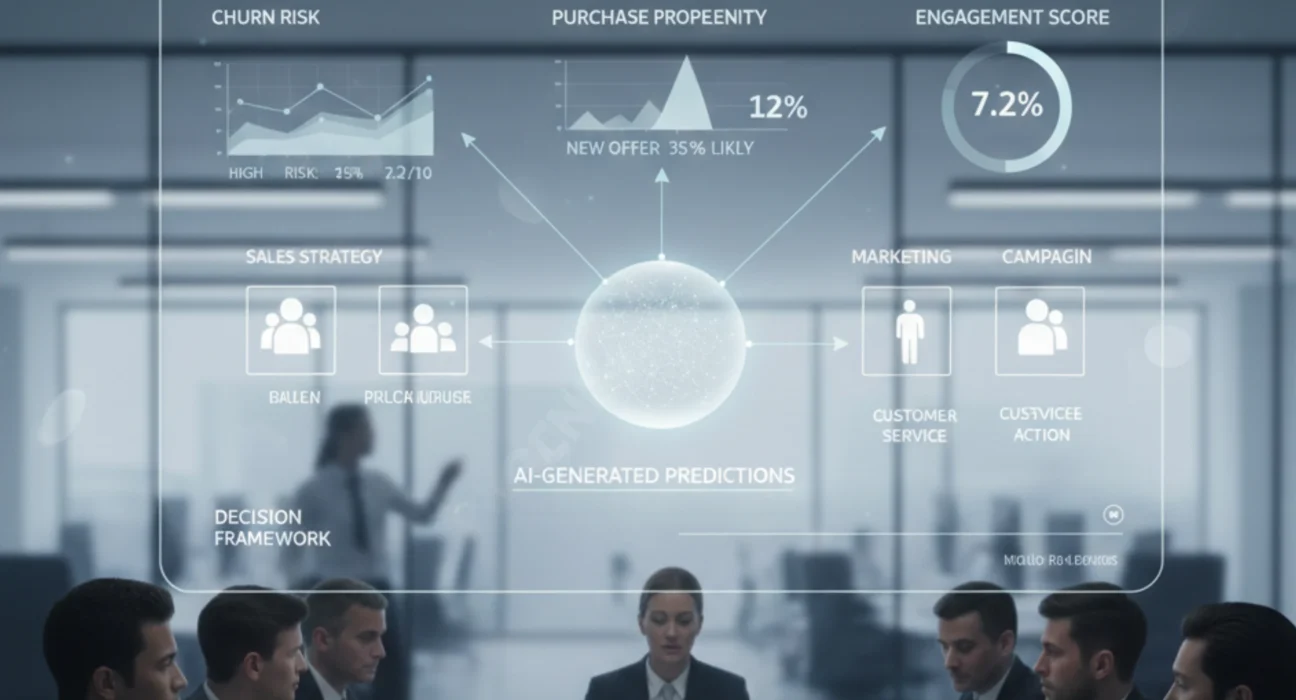
The promise sounds compelling: deploy AI to predict what your customers will do next, and you’ll sell more, retain better, and operate smarter. Every enterprise software vendor has a pitch about customer behavior prediction. Every consulting firm has a framework.
But here’s what I’ve learned after years of seeing these initiatives play out in large organisations: the technology for predicting customer behavior exists and works. The challenge is almost never the algorithm. It’s whether your organisation can actually use the predictions once you have them.
I’ve sat in boardrooms where executives approved multi-million rupee investments in predictive AI. Eighteen months later, the models were technically accurate, but nobody in the business was acting on them. The predictions sat in dashboards that nobody checked. The insights went into reports that nobody read.
The gap wasn’t technological. It was operational, organisational, and deeply human.
Why Customer Behavior Prediction Matters More Now
Your customers leave digital footprints everywhere. Website visits, app interactions, purchase history, support tickets, social media engagement, email responses. In mid-to-large enterprises, especially those operating across India and globally, you’re collecting millions of data points daily.
Traditional analytics tell you what happened. Business intelligence tells you what’s happening. Predictive AI tells you what’s likely to happen next, which customers will buy, which will churn, which will respond to an offer, which needs proactive support.
The business case is straightforward. If you know a high-value customer is likely to leave in the next sixty days, you can intervene. If you know which prospects are most likely to convert, you can focus your sales effort there. If you can predict demand patterns, you can optimize inventory and staffing.
The ROI calculations look excellent. The board approves the budget. And then reality hits.
The Realities Nobody Mentions in the Sales Pitch
Most enterprise initiatives around customer behavior prediction stumble over the same obstacles. These aren’t technical problems. They’re execution problems that technology alone cannot solve.
Your customer data is fragmented across systems that don’t talk to each other. Sales uses one CRM. Marketing uses a different platform. Customer service uses something else. E-commerce runs on its own stack. Your offline channels collect data differently than your online channels.
Before AI can predict anything useful, someone has to unify this data. That means integrating systems that were never designed to integrate. It means resolving customer identities across platforms. Is the person who visited your website the same one who called customer service and later made a purchase in your store?
This data integration work is expensive, time-consuming, and politically challenging. Different business units own different systems. Each has invested in their own tools. Nobody wants to compromise. Getting agreement on a single customer view often takes longer than building the AI model itself.
The data quality problem is worse than you think. I’ve seen organisations discover that thirty percent of their customer records have incorrect information. Email addresses that bounce. Phone numbers that are outdated. Geographic data that’s wrong. Duplicate records for the same customer.
Garbage in, garbage out isn’t just a cliché. It’s the reason most predictive models fail in production. You can have the most sophisticated algorithm, but if it’s learning from bad data, the predictions will be useless.
Fixing data quality requires sustained operational discipline. Data governance policies. Validation rules. Regular audits. Training for the people who enter data. This isn’t exciting work, but it’s essential.
Legacy systems can’t deliver predictions in real time. Let’s say your AI predicts that a customer calling your contact centre right now is likely to churn. Useful prediction. But if your contact centre system can’t surface that prediction to the agent while the call is happening, what’s the point?
Many enterprise systems weren’t built for real-time data exchange. They work in batch modes. Updates happen overnight. By the time the prediction reaches someone who can act on it, the moment has passed.
Solving this often requires either significant upgrades to legacy systems or building complex integration layers. Both options are expensive and risky.
Your organisation isn’t ready to act on predictions. This is the hardest problem and the least discussed. Even when you have accurate predictions delivered at the right time, your business processes and incentive structures might not support using them.
Your sales team has always worked the same way. Now you’re telling them to prioritise differently based on an AI prediction. Your customer service team has standard scripts. Now you’re asking them to personalise based on churn risk scores. Your marketing team has campaign calendars locked in. Now you want them to be dynamic based on propensity models.
People resist changing how they work, especially when their compensation and performance metrics are tied to the old way. Technology can change overnight. Organisations change slowly.
What Separates Successful Implementations From Failed Ones
After watching dozens of these initiatives across industries, clear patterns emerge. The organisations that successfully use AI to predict customer behavior share common characteristics. None of them are about having the best algorithms.
They start with a specific business problem, not a technology exploration. Unsuccessful initiatives begin with “let’s implement predictive AI for customer behavior.” Successful ones begin with “our customer retention in the premium segment is declining and we need to identify at-risk customers early enough to intervene.”
The business problem defines what you’re predicting, for whom, and why it matters. It creates clear success metrics. It focuses on technical work. Without this clarity, you build impressive technology that delivers no business value.
They solve the data problem first. The best implementations spend months sometimes over a year just getting their data house in order before training any models. Customer data platforms. Master data management. Data quality initiatives. Integration layers.
This feels slow. Executives get impatient. Why are we spending so much on plumbing when we could be building AI? But organisations that rush past this step end up rebuilding everything later, at much higher cost.
They design for operational integration, not just technical accuracy. A model that’s eighty percent accurate but integrated into your customer service workflow delivers more value than a model that’s ninety-five percent accurate but exists in isolation.
Successful implementations think through the entire operational flow. How will predictions reach the people who need them? What actions should they take? How do we measure whether those actions work? How do we create feedback loops to improve the model?
This requires involving operations teams, frontline managers, and business users from the beginning. Not just IT and data science.
They establish clear governance around AI usage. Who decides which predictions the business will act on? How do we ensure the AI isn’t introducing bias against certain customer segments? What happens when predictions are wrong? Who monitors model performance over time?
In regulated industries banking, insurance, healthcare these questions have compliance implications. But even in less regulated sectors, reputation risk is real. If your AI-driven decisions harm customers or create unfair outcomes, the brand damage can be significant.
Good governance means policies, oversight committees, audit trails, and regular reviews. It means treating AI predictions as recommendations that humans validate, not black boxes that make autonomous decisions.
They manage change as seriously as they manage technology. The most successful implementations I’ve seen invest as much in change management as in technical development. Training programs for users. Communication about why predictions matter. Adjustments to incentive structures. Pilot programs that let teams learn gradually.
They accept that adoption will be uneven. Early adopters will embrace the predictions. Skeptics will resist. The middle majority will wait to see if it works. Managing this means celebrating wins, addressing concerns honestly, and giving people time to adapt.
They choose partners who understand enterprise delivery. Building predictive models is different from deploying them in large organisations. Academic researchers can create brilliant algorithms. Startups can build impressive demos. But enterprise deployment requires different expertise.
You need partners who understand procurement cycles, compliance requirements, vendor management, stakeholder politics, and change resistance. Partners who’ve navigated the gap between “it works in the sandbox” and “it’s running in production supporting business operations.”
Companies like Ozrit, for instance, position themselves around this delivery maturity understanding that enterprise success requires more than technical capability. It requires program management discipline, risk management, and the ability to work within organisational constraints.
The Hard Truths About Enterprise-Scale Predictive AI
Let me be direct about several things that most vendors and consultants won’t tell you.
Your first models will underperform. Plan for it. Your initial predictions will miss important variables. You’ll discover data quality issues in production. You’ll find that customer behavior is more nuanced than your training data captured. This is normal. What matters is having a process to learn, iterate, and improve.
ROI takes longer than projected. The business case shows payback in twelve months. Reality is usually twenty-four to thirty-six months. Why? Because data preparation takes longer than estimated. Integration work uncovers unexpected complexity. Adoption is slower than assumed. Budget accordingly and set realistic expectations with stakeholders.
Vendor timelines are fiction. When a vendor says six-month implementation, translate that to twelve or eighteen months in your environment. They’re estimating based on ideal conditions with clean data, cooperative systems, and fast decision-making. You have none of those.
Add time for your procurement process, security reviews, compliance approvals, testing cycles, and the reality that key people will be unavailable when you need them. Better to plan conservatively and deliver early than overpromise and explain delays.
Technology debt compounds quickly. Building predictive AI creates new systems, new data pipelines, new integration points, and new dependencies. If you’re not thoughtful about architecture and documentation, you’ll create technical debt that becomes expensive to maintain.
I’ve seen organisations where nobody understands how the prediction model works two years after deployment. The original team has moved on. Documentation is incomplete. Making changes becomes risky and expensive. Plan for long-term sustainability from day one.
Compliance and privacy constraints are real. In India, regulations around customer data are evolving. Globally, requirements vary by jurisdiction. Using AI to predict customer behavior means processing personal data, making automated decisions, and potentially treating customers differently based on predictions.
Legal, compliance, and risk teams need to be involved early. Not after you’ve built everything. The regulatory landscape around AI is changing rapidly. What’s acceptable today might not be tomorrow. Build flexibility to adapt.
Practical Guidance for Executive Leadership
If you’re a CEO, CIO, or CTO considering predictive AI for customer behavior, here’s what actually matters.
Define clear business outcomes before approving technology investments. Don’t approve of a “customer behavior prediction initiative.” Approve specific outcomes: reduce churn in the enterprise segment by fifteen percent, improve conversion rates in digital channels by twenty percent, decrease customer acquisition cost by thirty percent.
Clear outcomes drive clear scope. They make it possible to measure success. They help you say no to scope creep.
Assign a business owner, not just a technical lead. Predictive AI for customers is a business capability, not an IT project. The owner should come from the business side—someone from sales, marketing, customer service, or customer experience. Someone who understands the operational reality and can drive adoption.
IT and data science are critical partners, but they shouldn’t own the outcome. Business owns it.
Invest in data foundations even though it’s unglamorous. The work of integrating customer data, improving data quality, and building robust data governance isn’t exciting. It doesn’t get applause in board meetings. But it’s what makes everything else possible.
Organisations that shortcut this step end up rebuilding multiple times. The ones that invest properly build capabilities that serve multiple initiatives beyond just predictive AI.
Plan for incremental rollout with learning cycles. Don’t try to predict all customer behaviors for all customer segments across all channels simultaneously. Start with one high-value use case. Build it, deploy it, learn from it, then expand.
Maybe you start with predicting churn for your top twenty percent of customers. Prove the value there. Build confidence. Then expand to broader segments or add other predictions like purchase propensity or lifetime value.
Each cycle teaches your organisation something about working with predictive AI. Compound that learning.
Build internal capability, don’t just outsource. Yes, bring in external partners for expertise and delivery capacity. But ensure your internal teams are learning, developing skills, and building the capability to sustain and enhance what’s built.
Over-reliance on vendors creates dependency. When the vendor leaves, knowledge leaves. Your people should be able to explain how the models work, adjust them as business conditions change, and troubleshoot when things go wrong.
Create feedback loops between predictions and outcomes. The AI predicts a customer will churn. You intervene. Did they churn anyway? Did the intervention work? What did you learn?
Without systematic feedback loops, you can’t improve the models or the operational responses. Build mechanisms to track what predictions were made, what actions were taken, and what actually happened.
Be realistic about organisational readiness. Sometimes the honest answer is “we’re not ready yet.” If your customer data is fragmented across dozens of systems with no integration, if your data quality is poor, if your organisation struggles to execute complex programs, fix those things first.
Rushing into predictive AI before you’re ready just means expensive failure. Better to build foundations properly.
Managing the Program Execution Reality
The technology for predicting customer behavior is mature. What isn’t mature in most organisations is the ability to execute large-scale digital transformation programs that cut across business units, systems, and processes.
This is where program management discipline becomes critical. You’re not just building a model. You’re integrating systems, changing processes, training people, managing vendors, navigating compliance, and sustaining change.
Stakeholder management is complex. Marketing wants predictions that support campaign targeting. Sales wants predictions that prioritise leads. Customer service wants predictions that identify support needs. Finance wants predictions that forecast revenue. Each stakeholder has different priorities, different timelines, and different definitions of success.
Managing this requires active orchestration. Regular stakeholder alignment. Clear decision rights. Mechanisms to resolve conflicts. Someone with authority to make trade-offs and keep things moving.
Vendor management requires orchestration. You’re probably working with multiple vendors. Your cloud provider. Your customer data platform vendor. Your AI/ML platform. Your systems integrator. Potentially specialists for specific components.
Each vendor has different commercial models, different support structures, different escalation paths. Getting them to work together rather than pointing fingers when things go wrong requires active management and clear contracts.
Cost overruns happen when scope expands invisibly. “While we’re integrating customer data, let’s also add this other data source.” “Since we’re building a prediction model, let’s add these three other predictions.” Each addition seems small. Collectively they double the timeline and budget.
Preventing this requires ruthless scope control. Every addition gets evaluated for impact on cost, timeline, and risk. Someone has to be willing to say no.
Timeline pressure creates shortcuts that become problems. When projects run late, pressure builds to cut corners. Skip proper testing. Reduce documentation. Deploy without full user training. These shortcuts create technical debt and operational risk.
Better to be honest about timelines, adjust expectations, and deliver properly than to rush and deal with the consequences later.
The Role of the Right Partnership
The partner you choose for implementing predictive AI matters enormously. Not all partners are created equal.
Look for partners who’ve actually delivered enterprise-scale programs, not just built impressive demos. Ask about their experience with data integration in complex enterprise environments. Ask how they handle change management and user adoption. Ask about their approach to governance and compliance.
The best partners don’t oversell. They ask hard questions about your data readiness, your organisational capability, and your governance maturity. They help you see risks early. They bring program management discipline, not just technical skills.
In the enterprise context particularly in Indian and global organisations operating in India this often means partners who understand how large companies actually work. The approval hierarchies. The procurement complexity. The stakeholder dynamics. Partners like Ozrit, who focus on delivery excellence and enterprise program execution, tend to understand these realities better than pure-play technology vendors.
Moving Forward With Clarity
Using AI to predict customer behavior is not theoretical anymore. It works. Organisations across industries are doing it successfully and generating real business value.
But success requires more than buying the right technology. It requires execution discipline, clear ownership, realistic planning, investment in data foundations, and commitment to organisational change.
The organisations that succeed are the ones that match their ambition with their capability. That starts with clear business problems. That invests in unsexy data plumbing. They manage change as seriously as they manage technology. That builds incrementally and learns continuously.
Your customers are already behaving in predictable patterns. The question isn’t whether AI can predict those patterns it can. The question is whether your organisation is ready to execute the transformation required to use those predictions effectively.
Start with that honest assessment. Build from there.