The average enterprise mobile application gets deleted within 72 hours of installation. Not because the technology is wrong. Because the experience is.
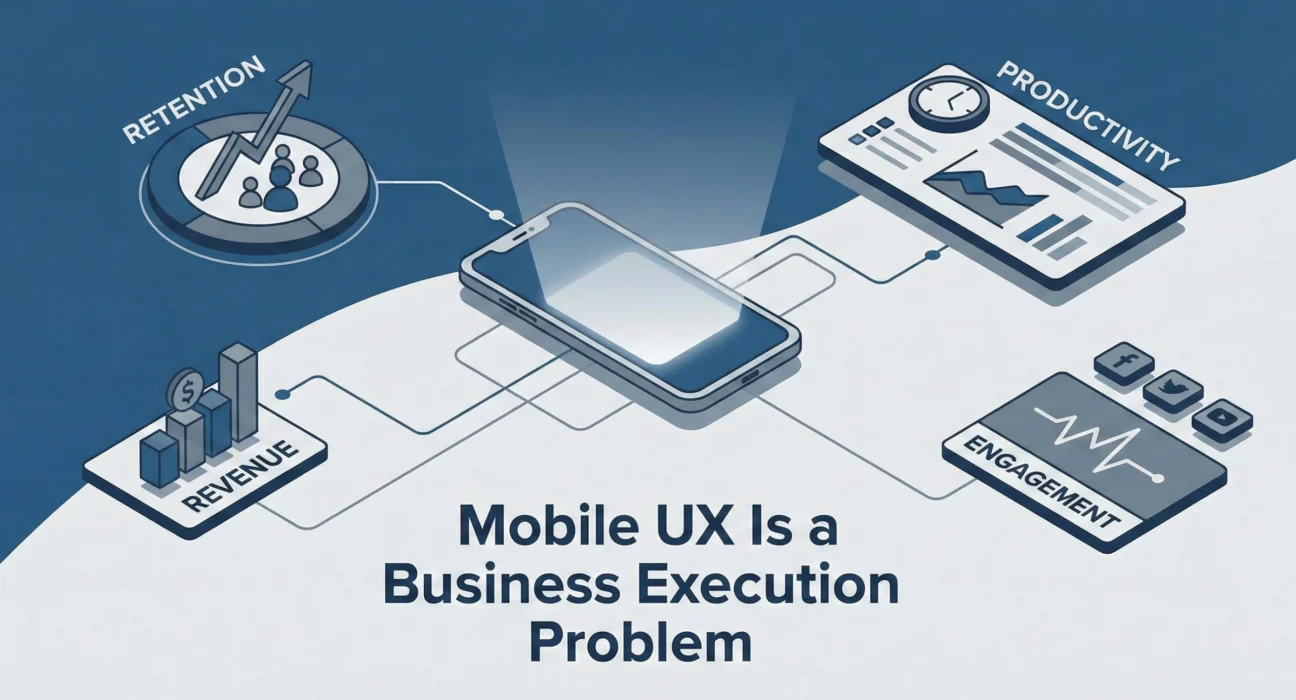
For C-level executives overseeing digital transformation programs, mobile UX is no longer a design conversation. It’s a business execution problem that directly impacts customer retention, employee productivity, and revenue realisation. Yet most large enterprises still treat mobile experience as a feature to be added late in the development cycle, rather than a strategic priority that requires governance, accountability, and sustained investment.
The gap between what users expect and what enterprise mobile applications deliver has widened in 2026. Consumer apps have set a benchmark that enterprise systems struggle to match not because of technology limitations, but because of how these programs are planned, funded, and executed.
Why Enterprise Mobile Programs Underdeliver
Most enterprise mobile initiatives fail to engage users for reasons that have little to do with the UX trends themselves.
The real issues start upstream. Stakeholder alignment breaks down early. Business units want speed, IT wants security, compliance wants documentation, and the user, the person who actually needs to use the application, rarely has a voice in the room when decisions are made. By the time the mobile app reaches production, it reflects internal compromises rather than user needs.
Budget models don’t help. Enterprises still allocate mobile budgets as one-time capital expenses rather than ongoing product investments. A mobile application is not a project that ends at launch. It requires iteration, monitoring, feedback loops, and continuous refinement. Without sustained funding and ownership, even the best UX trends become irrelevant.
Legacy constraints are another reality. Enterprises operate with decades-old backend systems that were never designed for mobile-first experiences. Integrating modern mobile UX with legacy infrastructure is not a technical challenge alone, it’s a program management challenge that requires clear ownership, phased execution, and ruthless prioritisation.
Then there’s vendor management. Many enterprises hand over mobile development to vendors who deliver to specification but don’t own outcomes. When user engagement drops, accountability is unclear. Was it a design issue? A backend performance issue? A business process issue? Without end-to-end ownership, enterprise mobile programs drift.
What Actually Drives Mobile Engagement in 2026
The trends that matter in 2026 are not about novelty. They’re about removing friction, building trust, and aligning technology execution with how people actually work.
Predictive and contextual interfaces have moved from experimental to expected. Users no longer tolerate applications that make them search, navigate, and hunt for what they need. In enterprise contexts whether it’s a field service app, an employee portal, or a customer-facing platform, the application should anticipate intent based on role, location, time, and past behaviour.
This requires more than smart algorithms. It requires clean data, well-integrated systems, and governance frameworks that define what predictions are permissible and what crosses privacy boundaries. Enterprises that execute this well treat it as a cross-functional program, not a feature sprint.
Voice and conversational interfaces are no longer optional in mobile experiences, especially in markets like India where multilingual support and hands-free operation are not convenience features, they’re access requirements. But implementing voice well in an enterprise context means dealing with accent variations, domain-specific terminology, backend integrations, and compliance with data residency laws.
These are not problems a design team solves in isolation. They require program-level coordination, vendor evaluation, pilot execution, and staged rollouts with feedback mechanisms. Enterprises that treat voice as a checkbox feature end up with implementations that users ignore.
Micro-interactions and interface responsiveness are table stakes in 2026. A mobile app that hesitates, lags, or requires unnecessary steps loses users immediately. Consumer apps have conditioned users to expect instant feedback, smooth transitions, and zero tolerance for waiting.
For enterprises, this means confronting hard truths about backend performance, API response times, caching strategies, and infrastructure investments. It also means accepting that mobile-first does not mean mobile-only. A user who starts a task on mobile and finishes on desktop expects continuity, not re-entry of data. Achieving this requires integration maturity and testing discipline that most enterprise programs underestimate.
Privacy-first design and transparent data use have shifted from regulatory compliance to user expectation. Users in 2026 whether customers or employees want to know what data is being collected, why, and how to control it. Mobile interfaces that bury privacy controls or use dark patterns to extract permissions are not just unethical; they’re business risks.
Enterprises that get this right treat privacy as a design principle, not a legal checklist. That requires alignment between legal, compliance, product, and engineering teams. It requires documentation, training, and accountability mechanisms that span the entire delivery chain.
Offline-first functionality and resilient design remain critical in real-world enterprise use cases. Field employees, delivery agents, sales teams, and service workers operate in environments where connectivity is intermittent at best. A mobile app that breaks when offline is not just inconvenient it’s operationally unacceptable.
Building offline-first experiences requires architectural decisions early in the program, not bolted-on solutions late in development. It requires sync logic, conflict resolution, error handling, and testing scenarios that reflect actual working conditions. These are program execution capabilities, not technology tricks.
What Separates Success from Failure in Enterprise Mobile Programs
The difference between a mobile initiative that drives engagement and one that becomes shelfware comes down to execution maturity.
Successful programs have clear ownership from the top. A CIO or CDO who treats mobile as a strategic priority assigns a senior leader to own outcomes, not just delivery. That leader has authority, budget, and accountability. They attend steering committees, escalate blockers, and make trade-off decisions in real time.
They also establish governance without bureaucracy. Effective governance in mobile programs means fast decisions, clear escalation paths, and ruthless focus on user outcomes. It does not mean endless approvals, matrix reporting, or committees that delay progress. Enterprises that confuse governance with control end up with slow, risk-averse mobile programs that miss market windows.
Delivery partners who understand enterprise realities make a measurable difference. A partner who has delivered large-scale mobile transformations knows that the hard part is not building features, it’s navigating stakeholder complexity, managing legacy constraints, and maintaining momentum through organisational inertia. Firms like Ozrit, which specialise in enterprise program execution, bring not just development capability but delivery discipline. They understand timelines, governance models, change management, and what it takes to get things actually done in a large organisation.
Successful enterprises also invest in continuous feedback and iteration. They don’t wait for quarterly reviews to discover that user engagement is dropping. They instrument their mobile applications, monitor usage patterns, collect feedback, and iterate based on evidence. This requires product thinking, not project thinking.
Finally, they budget realistically. Mobile programs that engage users are not one-time expenses. They require ongoing investment in performance optimisation, feature refinement, security updates, and platform evolution. Enterprises that fund mobile initiatives as multi-year product investments see sustained engagement. Those that treat them as capital projects see declining usage and eventual abandonment.
The Reality of Scale and Sustainability
Enterprise mobile programs operate at a scale that consumer apps rarely face. Thousands of users across geographies, multiple device types, varying network conditions, integration with dozens of backend systems, compliance with conflicting regulations, and dependencies on vendor roadmaps.
Sustaining mobile engagement at this scale requires platform thinking. Instead of building one-off applications, leading enterprises are investing in mobile platforms, reusable components, shared services, design systems, and governance frameworks that accelerate delivery and ensure consistency across multiple applications.
This doesn’t happen by accident. It requires deliberate architectural decisions, investment in tooling, training of teams, and leadership that values long-term capability building over short-term project wins.
It also requires vendor relationships built on outcomes, not outputs. Contracts that measure success by story points delivered or features shipped miss the point. What matters is user engagement, operational impact, and business value realised. Partners who align incentives around these outcomes behave differently. They push back on bad requirements, suggest alternatives, and invest in quality because their success is tied to yours.
What This Means for Enterprise Leaders
If you’re leading a large-scale digital transformation or overseeing mobile initiatives, the trends themselves are less important than how you execute them.
Start by asking hard questions. Who actually owns mobile engagement in your organisation? Is it a product? IT? Marketing? If the answer is unclear, you have a governance problem before you have a technology problem.
Next, evaluate your funding model. Are you funding mobile as projects or products? If your budget ends at launch, your engagement will too.
Then, assess your delivery capability. Do you have the in-house talent, processes, and tools to sustain mobile excellence? If not, choose partners who bring execution maturity, not just development capacity. Working with firms like Ozrit that understand enterprise program realities can compress timelines, reduce risk, and improve outcomes but only if leadership is clear about what success looks like.
Finally, commit to iteration. Mobile engagement is not achieved in version 1.0. It’s achieved through disciplined, continuous improvement driven by real user feedback and real usage data.
The Path Forward
Mobile UX trends in 2026 are not about chasing novelty. They’re about execution discipline, sustained investment, and a relentless focus on removing friction for the people who use your applications.
Enterprises that treat mobile as a strategic capability, fund it appropriately, govern it effectively, and partner with organisations that understand delivery at scale will see sustained engagement and measurable business impact.
Those that treat it as a technology experiment or a one-time project will continue to see high uninstall rates, low adoption, and missed opportunities.
The question is not whether your enterprise should invest in modern mobile UX. The question is whether you have the execution maturity to deliver it at scale, sustain it over time, and make it a competitive advantage rather than a compliance checkbox.
Because in 2026, mobile engagement is not won by following trends. It’s won by executing well.