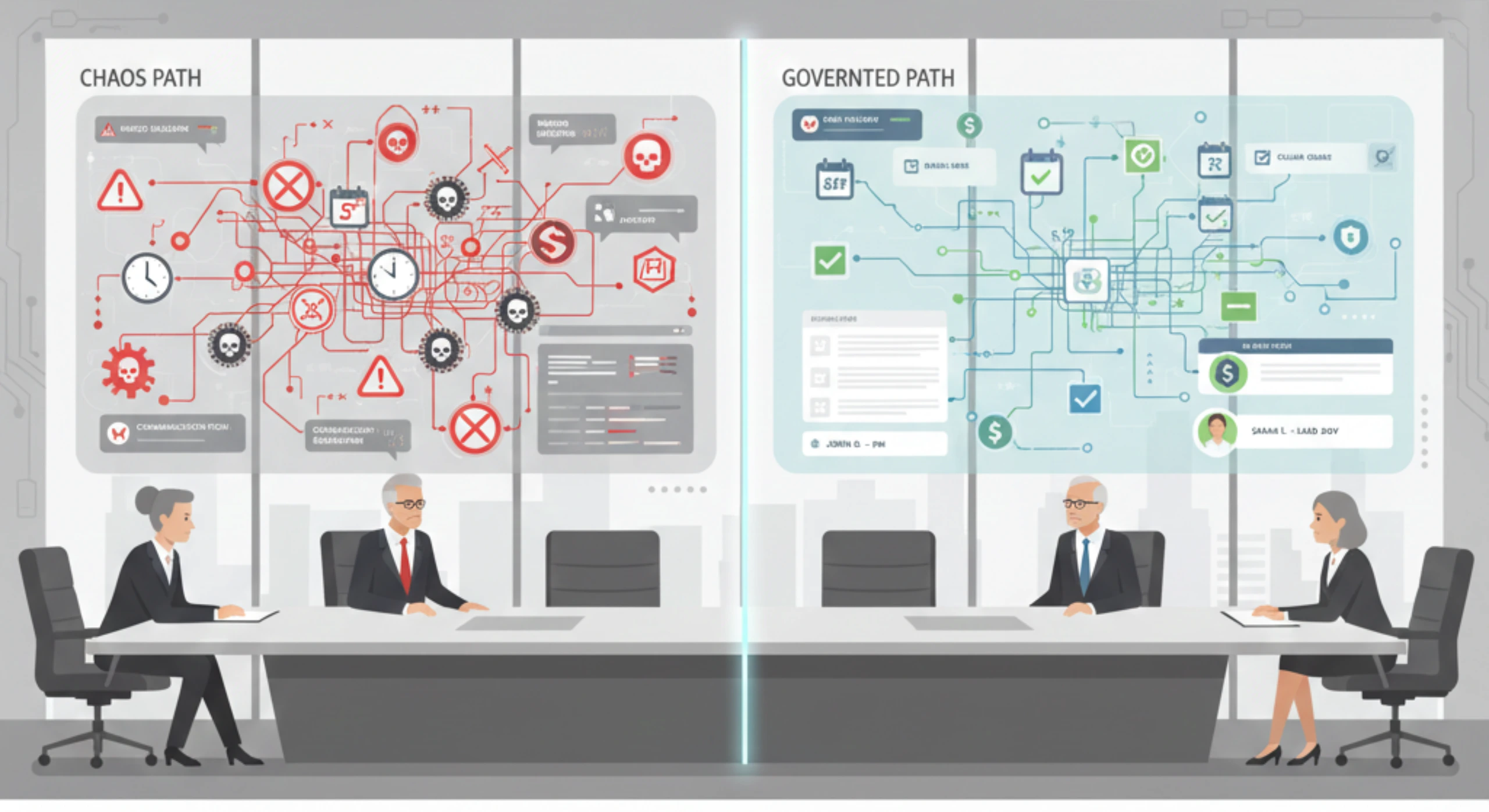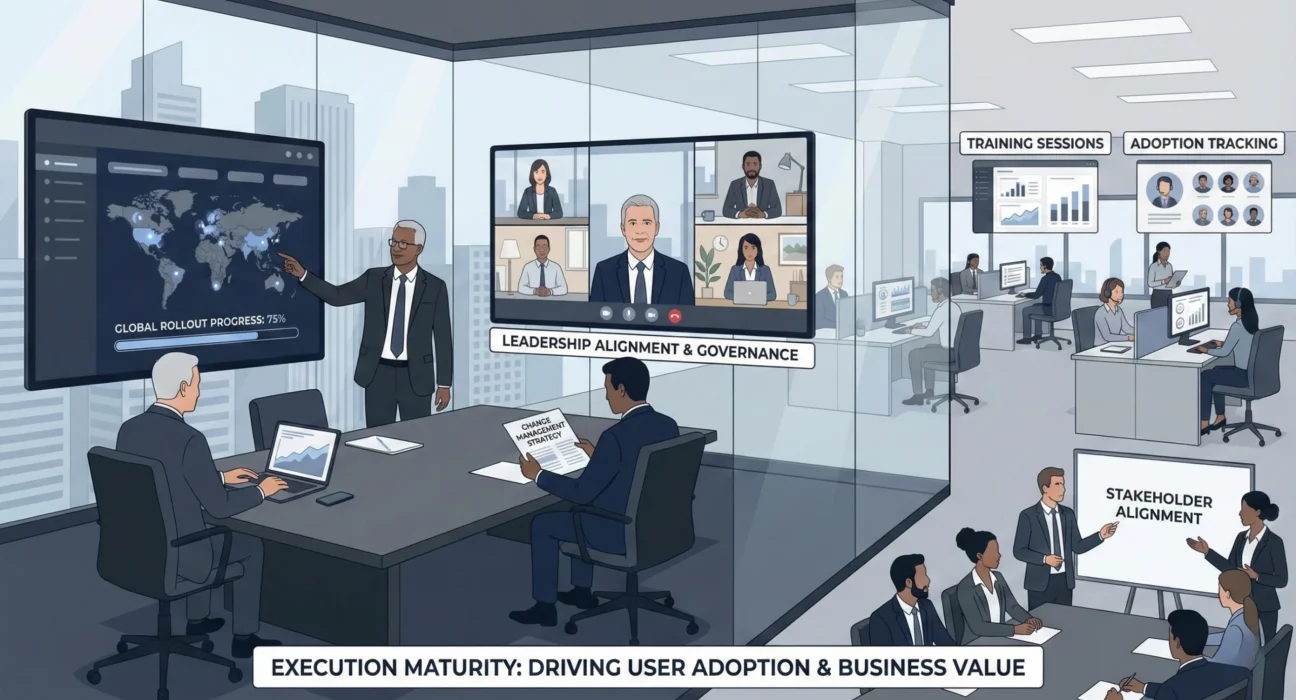
When a large enterprise decides to roll out a new ERP system, migrate to cloud infrastructure, or transform its digital operations, the announcement often comes with great confidence. Budgets are approved, timelines are drawn, and stakeholders nod in agreement.
Then reality arrives.
Six months in, the project is behind schedule. Key users are resisting the new system. The vendor is blaming the internal team, and the internal team is blaming the vendor. Budget overruns are being discussed in closed-door meetings. And somewhere in the middle of all this, the original business case starts looking less convincing.
This is not a hypothetical scenario. It is the lived experience of most large-scale enterprise rollouts, whether in India or anywhere else in the world.
Why Enterprise Rollouts Are Harder Than They Look
The challenge with large enterprise programs is not just technical. In fact, technology is often the easier part to manage. The real complexity lies in managing change across an organisation that has its own history, culture, politics, and ways of working.
When you are rolling out a system that affects thousands of employees, multiple business units, and sometimes even customers or partners, you are not just implementing software. You are asking people to change how they work, what they prioritise, and how they measure success.
This is where most programs stumble.
Scale Amplifies Everything
In a small company, you can gather everyone in a room and explain the new process. In a large enterprise, you have regional offices, distributed teams, different time zones, and varying levels of digital maturity. What works in the head office may not work in a branch office in tier-2 or tier-3 cities.
Scale also means that small issues become big problems. A minor data migration error might affect a few hundred records in a small setup. In a large enterprise, it could impact lakhs of transactions and bring operations to a halt.
Legacy Systems Don’t Retire Quietly
Most enterprises are not starting from scratch. They have legacy systems that have been running for years, sometimes decades. These systems hold critical data, support essential workflows, and are deeply embedded in daily operations.
The challenge is not just technical integration. It is about managing the transition without disrupting business continuity. It is about ensuring that the people who have been using the old system for 15 years do not feel abandoned or overwhelmed.
Stakeholders Have Competing Priorities
In any large organisation, different departments have different goals. Finance wants cost control. Operations want efficiency. IT wants stability. Sales wants speed. Compliance wants documentation.
A successful rollout needs to balance all these priorities, which is easier said than done. If you optimize for one group, you risk alienating another. If you try to please everyone, you end up with a bloated, compromised solution.
What Actually Goes Wrong
Let us talk about the common failure points, the ones that do not make it into vendor presentations but are well known to anyone who has managed an enterprise program.
Underestimating the Human Factor
Most enterprise rollouts focus heavily on system configuration, data migration, and technical testing. What often gets less attention is user adoption.
If users do not understand why the change is happening, or if they feel the new system makes their work harder, they will resist. Sometimes openly, sometimes quietly. Quiet resistance is more dangerous because it shows up as low adoption, workarounds, and eventually, failure to realise the intended benefits.
Change management is not an HR exercise or a training calendar. It is a continuous effort to bring people along, address concerns, and ensure that the new way of working makes sense to those who have to live with it every day.
Poor Governance and Accountability
In many large programs, there are too many people involved and not enough clarity on who is responsible for what. Decisions get delayed because approvals need to pass through multiple layers. Issues get escalated but not resolved because no single person owns the outcome.
Governance is not about having more meetings. It is about having clear decision-making authority, defined escalation paths, and accountability at every level.
Vendor Management Gaps
Enterprises often assume that hiring a reputed vendor guarantees success. It does not.
Vendors bring expertise and resources, but they do not understand your organisation the way you do. They may not know your internal politics, your legacy constraints, or your specific compliance requirements.
Managing a vendor relationship requires active oversight, clear contracts, and honest communication. If something is not working, it needs to be addressed immediately, not six months later when the damage is already done.
Ignoring the Middle Layer
Senior leadership approves the vision. The vendor builds the solution. But the success of the program depends on the middle layer, the department heads, team leads, and power users who will actually drive adoption and sustained usage.
If this group is not convinced, or if they are not equipped to lead the change in their teams, the rollout will struggle no matter how good the technology is.
What Separates Success from Failure
Successful enterprise rollouts are not the ones that finish on time and within budget, though that certainly helps. They are the ones that deliver real business value and achieve lasting adoption.
Here is what successful programs do differently.
They Start with Why
Before diving into system selection or implementation timelines, successful programs spend time clarifying why the change is necessary and what success looks like.
This is not about drafting a vision statement. It is about understanding the real business drivers, whether it is reducing operational costs, improving customer experience, enabling regulatory compliance, or preparing for future growth.
When the why is clear, it becomes easier to make trade-offs, prioritise features, and communicate the rationale to stakeholders.
They Invest in Change Leadership
Change management cannot be delegated to a junior team or handled as an afterthought. It needs senior leadership involvement and dedicated resources.
This means regular communication from the top, visible commitment to the change, and accountability for adoption metrics, not just technical milestones.
It also means investing in training, not just one-time sessions, but ongoing support as users encounter real-world scenarios and edge cases.
They Manage Risk Proactively
Large programs are full of risks, technical, operational, financial, and reputational. The question is not whether risks will emerge, but how quickly they are identified and addressed.
This requires honest reporting, a culture where bad news can travel up without fear, and a willingness to adjust course when needed.
Too often, enterprise programs suffer from optimism bias. Everyone wants to believe things are on track until it becomes impossible to deny the problems.
They Focus on Delivery Maturity
Technology is important, but execution is what separates successful programs from failed ones.
Delivery maturity means having clear processes for requirements gathering, testing, deployment, and post-go-live support. It means knowing how to manage dependencies, handle scope changes, and coordinate across multiple teams.
This is where experience matters. A partner who has delivered similar programs, at similar scale, in similar industries, brings valuable lessons and patterns that can save months of trial and error.
Ozrit, as an enterprise delivery and program execution partner, works with organisations to bring this kind of execution discipline. The focus is not just on building systems, but on ensuring that programs are delivered in a way that aligns with enterprise realities, governance needs, and long-term sustainability.
The Role of Leadership in Enterprise Rollouts
If you are a C-level executive sponsoring a large transformation program, your role is not to approve the project and then wait for updates. Active leadership is essential.
Set Clear Expectations
Be explicit about what success looks like, not just in terms of technical deliverables, but in terms of business outcomes. Define the metrics that matter, adoption rates, process efficiency, cost savings, revenue impact, and hold the team accountable for tracking them.
Stay Engaged
Attend key governance meetings. Review progress honestly. Ask tough questions. If something is not working, acknowledge it and drive corrective action.
Your involvement signals to the organisation that this matters, and that gives the program team the authority and air cover they need to push through resistance.
Protect the Team from Scope Creep
Every large program faces pressure to add more features, accommodate more exceptions, or extend timelines. Your job is to protect the core scope and ensure the team stays focused on delivering what was agreed.
There will always be time for phase two. But phase one needs to succeed first.
Choosing the Right Partner
Not all technology partners are created equal. Some are great at building software but weak at enterprise execution. Others understand technology but do not grasp the complexities of large-scale change management.
When evaluating a partner, look beyond technical credentials. Ask about their experience with programs of similar scale. Understand how they manage governance, risk, and stakeholder alignment. Talk to references who have worked with them on long, complex rollouts.
A good partner does not just deliver code. They bring a structured approach to execution, a mature understanding of enterprise dynamics, and the ability to navigate the inevitable challenges that arise in large programs.
They also bring accountability. If something goes wrong, they do not point fingers. They own the problem and work with you to fix it.
What Happens After Go-Live
One of the biggest mistakes enterprises make is treating go-live as the finish line. In reality, it is just the beginning.
Post-go-live support is critical. Users will encounter issues that were not caught in testing. Processes will need fine-tuning. Integrations may behave differently under real-world load.
This phase requires patience, responsiveness, and a commitment to continuous improvement. It also requires keeping the core team together for a few months after launch, rather than disbanding them immediately and moving to the next project.
Sustained success also depends on measuring outcomes and not just outputs. Are users actually adopting the system? Are the intended business benefits being realised? If not, why not, and what needs to change?
Practical Takeaways for C-Suite Executives
If you are leading or sponsoring a large enterprise rollout, here are a few principles worth keeping in mind.
Invest in change leadership, not just change management. This is not a training problem. It is a leadership problem. Own it.
Governance is about decisions, not meetings. Make sure someone has the authority to make calls quickly and move things forward.
Manage your vendors like partners, not contractors. Hold them accountable, but also give them the information and access they need to succeed.
Risks do not go away if you ignore them. Create a culture where problems can surface early and be addressed honestly.
Execution discipline matters more than technology choice. The best system in the world will fail if it is poorly implemented.
Think beyond go-live. Plan for the first six months after launch as carefully as you plan for the implementation itself.
Finally, recognise that large-scale enterprise rollouts are difficult. They test organisational resilience, leadership commitment, and execution maturity. But when done right, they create lasting value and position the organisation for sustained growth.
Closing Thoughts
Managing change in large enterprise rollouts is not about having the perfect plan. It is about having the discipline to execute well, the humility to learn from challenges, and the leadership to keep people aligned and motivated through a long, complex journey.
Technology will continue to evolve. New platforms and tools will emerge. But the fundamentals of enterprise execution remain constant: clarity of purpose, strong governance, active stakeholder engagement, and relentless focus on delivery.
The organisations that succeed are the ones that treat transformation programs not as technology projects, but as change programs that happen to involve technology. They invest in people, processes, and partnerships that support long-term success, not just short-term milestones.
Whether you are embarking on a new ERP rollout, migrating critical systems to the cloud, or driving digital transformation across your enterprise, the question is not whether challenges will arise. They will. The question is whether you have the execution maturity and leadership commitment to navigate them successfully.
That is what separates programs that deliver real value from those that become cautionary tales.