Most enterprise technology programs fail not during implementation, but after go-live.
You’ve seen it happen. A major digital transformation initiative gets launched with fanfare. Consultants present glossy roadmaps. Vendors promise seamless integration. The project goes live, often late and over budget. And then, six months later, the platform starts breaking down. Users complain. Business processes slow down. The IT team scrambles to keep things running. What was supposed to transform your business becomes a liability.
The problem isn’t always the technology. It’s what happens after the contract is signed and the implementation team moves on. It’s the absence of a real strategy for keeping enterprise platforms running, evolving, and delivering value over years, not just months.
For C-level executives managing large-scale IT programs in India or running global operations with significant India presence, this isn’t an academic concern. It’s a business continuity risk. It affects revenue, compliance, customer experience, and your ability to compete.
This article addresses what actually works when it comes to long-term support and maintenance of enterprise platforms. Not theory. Not vendor promises. What works in practice when you’re responsible for platforms that serve thousands of users, process millions of transactions, and can’t afford to fail.
Why Enterprise Platforms Break Down After Go-Live
Enterprise software doesn’t fail dramatically. It degrades slowly.
Performance issues emerge as data volumes grow. Integrations break when third-party APIs change. Security vulnerabilities appear as new threats evolve. User requirements shift as business models adapt. Regulatory frameworks tighten. The team that built the system moves on, taking critical knowledge with them.
What you’re left with is a platform that costs crores to build, but nobody truly owns. IT teams firefight issues without understanding root causes. Business units work around system limitations instead of fixing them. Technical debt accumulates. The platform becomes increasingly expensive to maintain and impossible to evolve.
Three things typically go wrong:
Ownership gets fragmented. Development teams hand over to operations teams. Operations teams escalate to vendors. Vendors point to implementation partners. Implementation partners have moved to other projects. Nobody has end-to-end accountability. Issues bounce between teams while business impact grows.
Knowledge gets lost. The architects who designed the system have left. Documentation is incomplete or outdated. Custom configurations aren’t properly recorded. Integration logic exists only in someone’s head. When problems arise, diagnosis takes weeks because nobody fully understands how things work.
Planning gets short-term. Maintenance becomes about patching problems, not preventing them. Upgrades get postponed because they’re risky and expensive. Technical improvements get deprioritized in favor of new features. The platform calcifies. Eventually, the cost and risk of change become so high that you’re trapped with a system you can’t evolve and can’t replace.
These aren’t technology problems. They’re execution problems. They’re governance problems. They’re what happens when organizations treat enterprise platforms as projects instead of long-term assets.
What Long-Term Support Actually Means at Enterprise Scale
Support and maintenance in enterprise environments isn’t help desk tickets and bug fixes. It’s everything required to keep a complex platform running, secure, compliant, and valuable as your business evolves.
Operational stability. Your platform needs to be available when users need it. Performance must remain acceptable as transaction volumes grow. Incidents need to be detected, diagnosed, and resolved before they impact business operations. This requires monitoring, proactive maintenance, capacity planning, and rapid response capabilities that actually work under pressure.
Security and compliance. Threat landscapes change constantly. Regulatory requirements evolve, especially in India where frameworks like the Digital Personal Data Protection Act create new obligations. Your platform needs continuous security patches, vulnerability assessments, compliance audits, and the ability to implement controls without breaking functionality. This isn’t optional. It’s a board-level risk.
Evolution and enhancement. Business requirements don’t freeze after go-live. You need new features, modified workflows, additional integrations, and improved user experiences. The platform must adapt without destabilizing what already works. This requires disciplined change management, proper testing, and teams that understand both the technology and your business context.
Knowledge continuity. Platforms outlive the people who build them. You need comprehensive documentation, knowledge transfer processes, and institutional memory that survives personnel changes. When someone leaves, their understanding of the system shouldn’t leave with them.
Vendor and partner management. Enterprise platforms involve multiple vendors, implementation partners, and service providers. Managing these relationships, enforcing SLAs, coordinating activities, and ensuring accountability requires constant attention. Without proper governance, vendor dependencies become vendor lock-in and service commitments become vague promises.
Cost management. Maintenance costs in enterprise environments can easily exceed initial implementation costs over a platform’s lifetime. License renewals, infrastructure expenses, support contracts, enhancement budgets, and opportunity costs of downtime add up quickly. Effective long-term support means controlling these costs while maintaining quality.
Getting this right requires structure, discipline, and teams that understand enterprise realities.
The Governance Problem Nobody Talks About
The single biggest challenge in enterprise platform maintenance isn’t technical. It’s governance.
Who decides what gets fixed and what gets deferred? Who prioritizes enhancement requests from different business units? Who approves changes that might introduce risk? Who ensures vendors deliver what they promised? Who balances short-term firefighting against long-term stability?
Without clear governance, these decisions get made reactively, politically, or not at all.
In practice, effective governance for enterprise platform support requires several things:
A steering mechanism that actually steers. Not just quarterly meetings where people review dashboards. A working group with clear authority that makes decisions, resolves conflicts, allocates resources, and holds teams accountable. This group needs representation from IT, business leadership, operations, and risk management. It needs the authority to say no to bad ideas and yes to necessary investments.
Clear escalation paths. When issues arise, everyone needs to know who makes what decisions at what level. Minor incidents shouldn’t need CXO approval. Major outages shouldn’t sit unresolved while teams argue about whose responsibility they are. Escalation criteria, response protocols, and decision authority must be defined in advance and actually followed.
Realistic SLAs with consequences. Service level agreements in enterprise contracts are often aspirational documents that nobody enforces. Effective SLAs define measurable commitments, specify response and resolution timeframes, include penalty clauses that actually matter, and get reviewed regularly against actual performance. If your vendors miss SLAs consistently without consequences, you don’t have SLAs. You have suggestions.
Change control that balances safety and speed. Enterprise platforms need stability. They also need to evolve. Effective change management processes assess risk, require proper testing, maintain rollback capabilities, and document everything, while also enabling changes to happen at business speed when necessary. Overly rigid processes create shadow IT. Overly loose processes create chaos.
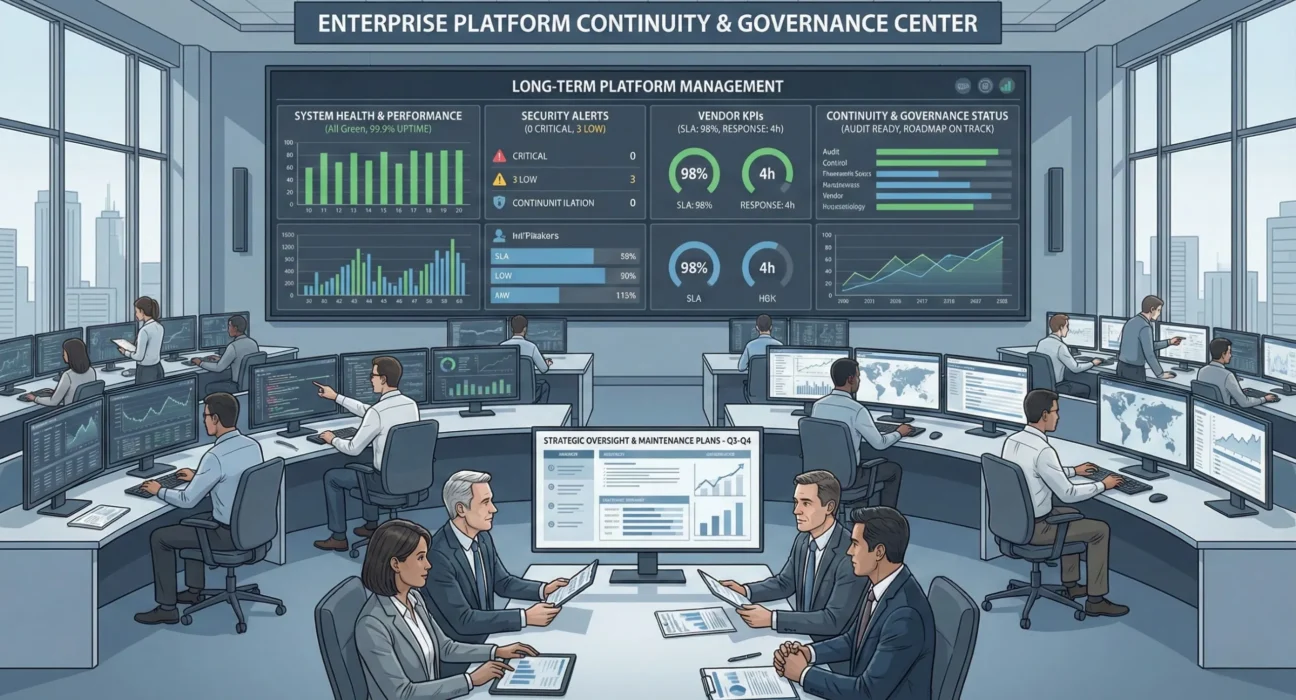
Transparent reporting. Executives need visibility into platform health, not just during crises. Regular reporting on availability, performance, security incidents, enhancement delivery, budget consumption, and vendor performance should be standard. Not 50-slide PowerPoints. Simple, honest dashboards that show what’s working and what isn’t.
Most organizations have some version of these governance structures on paper. The difference is whether they actually function when pressure builds, priorities conflict, and difficult decisions need to be made.
Building Teams That Can Actually Support Enterprise Platforms
Technology is easy to buy. Capability is harder to build.
Enterprise platform support requires people who understand your business context, your technical architecture, your integrations, your data, and your constraints. Finding these people, retaining them, and ensuring continuity as people inevitably move on is one of the hardest parts of long-term platform management.
Internal teams or external partners? Both, usually. Internal teams provide business context, institutional knowledge, and continuity. External partners provide specialized expertise, capacity flexibility, and broader experience across similar platforms and problems. The question isn’t which model to choose. It’s how to combine them effectively.
Purely internal support teams often struggle with specialized skills, capacity during peak periods, and keeping up with platform evolution. Purely external support creates dependency, knowledge loss, and misaligned incentives where partners benefit from problems persisting.
The organizations that do this well maintain a core internal team that owns the platform, understands the business, and makes key decisions, supported by external partners who provide specialized skills, extra capacity, and execution horsepower. The internal team stays small and focused. The external team scales with need.
What makes a good support partner? Not all implementation partners make good support partners. Building something new requires different skills than maintaining something complex over years.
Good support partners demonstrate several characteristics: They maintain continuity in their teams instead of rotating people constantly. They invest in understanding your business, not just your technology. They fix root causes instead of applying band-aids. They communicate proactively when problems arise instead of hoping you won’t notice. They propose improvements instead of just executing tickets. They have skin in the game through meaningful SLA penalties and success-based incentives.
Organizations like Ozrit that specialize in enterprise delivery understand this difference. Supporting an enterprise platform isn’t about providing warm bodies or logging tickets. It’s about ownership, accountability, and treating your platform as a long-term asset they’re responsible for protecting and improving.
Knowledge transfer that actually works. Most knowledge transfer programs fail. Vendor teams run through documentation during handover sessions. People nod politely. Then the vendor leaves and you realize nobody actually understands how anything works.
Effective knowledge transfer happens over time, through direct collaboration, with internal teams working alongside external experts on real problems, not presentations. Documentation matters, but hands-on experience solving actual issues builds real capability. Plan for at least three to six months of overlap where internal and external teams work together before transition.
The Hidden Costs Everyone Underestimates
Enterprise platform costs don’t end at implementation. For most platforms, lifetime support and maintenance costs exceed initial build costs by multiples.
License and subscription creep. Software licensing in enterprise environments is complex and expensive. User counts grow. Feature requirements expand. Vendors adjust pricing. What started as a predictable annual cost becomes an escalating expense that’s difficult to control or even fully track across different modules, environments, and user types.
Infrastructure and hosting. Cloud costs grow with usage. On-premise infrastructure requires refresh cycles. Data storage expands. Disaster recovery environments need maintenance. Security tools require licenses. These costs compound year after year.
Enhancement and customization. The platform you launched isn’t the platform you’ll need next year. Business requirements evolve. Integrations with other systems multiply. Custom workflows become necessary. Each enhancement carries development cost, testing effort, deployment risk, and ongoing maintenance burden.
Technical debt interest. Every shortcut taken during implementation, every upgrade postponed, every workaround instead of proper fix creates technical debt. Like financial debt, technical debt accrues interest. The longer you defer proper solutions, the more expensive they become to implement and the more they constrain future changes.
Opportunity cost of downtime. When enterprise platforms fail, business processes stop. Revenue gets delayed. Customers get frustrated. Compliance gets breached. The direct cost of outages is measurable. The indirect cost in damaged relationships, lost opportunities, and eroded trust is often larger.
The exit cost nobody plans for. Eventually, every platform gets replaced. Migration to new systems, data extraction, parallel operations during transition, and decommissioning old environments all cost money and effort. Organizations that haven’t maintained their platforms properly find migration nearly impossible without starting from scratch.
Understanding these costs upfront changes how you think about platform decisions. The cheapest implementation option often becomes the most expensive to maintain. The vendor offering the lowest initial price may have the highest lifetime cost. Making smart long-term decisions requires looking beyond the initial purchase.
What Success Actually Looks Like
Organizations that manage enterprise platforms successfully over years share common patterns.
They treat platforms as assets, not projects. Projects have end dates. Assets need continuous investment. Successful organizations budget for ongoing platform improvement, not just break-fix maintenance. They allocate resources to reduce technical debt, improve performance, enhance security, and evolve capabilities even when no crisis demands it.
They maintain clear ownership. One person or team is accountable for platform health. Not just responsible. Accountable. When something breaks, when costs overrun, when users complain, there’s no ambiguity about who needs to fix it. This doesn’t mean one person does everything. It means one person coordinates everything and can’t pass the buck.
They invest in monitoring and observability. You can’t manage what you don’t measure. Effective platform management requires real-time visibility into system health, performance trends, security events, user behavior, and business impact. Not after problems occur. Before they become critical.
They manage vendors actively, not passively. Vendor relationships don’t run themselves. Regular business reviews, performance evaluations against SLAs, escalation when commitments aren’t met, and willingness to change vendors when necessary keep relationships productive. Successful organizations treat vendors as partners but verify everything and maintain leverage.
They balance standardization and flexibility. Overly rigid platforms that can’t adapt to changing business needs become obstacles. Overly flexible platforms that allow unlimited customization become unmaintainable. Finding the right balance between standard processes and necessary customization is critical.
They plan for the long term. Technology refresh cycles, platform evolution roadmaps, skill development for internal teams, budget allocation for future needs, and eventual migration strategies all require forward planning. Organizations that think in multi-year horizons make better decisions than those that optimize for this quarter.
Choosing Partners Who Understand Enterprise Execution
Most technology vendors and implementation partners focus on selling and delivering projects. Far fewer understand what it takes to keep enterprise platforms running successfully over years.
The partners who get it right demonstrate certain qualities consistently:
They acknowledge complexity honestly instead of oversimplifying. They commit to outcomes, not just activities. They maintain continuity in their teams. They share risk through their commercial models. They bring experience from multiple similar engagements and apply lessons learned. They challenge your assumptions when necessary instead of just saying yes.
When evaluating potential support partners, pay attention to these signals: How long do their team members typically stay on client engagements? Can they provide references from clients they’ve supported for years, not just implemented for? What’s their response when you ask about difficult scenarios or past failures? Do they ask substantive questions about your business context or just about your technical stack?
Working with firms like Ozrit that specialize in enterprise program execution means engaging with teams who’ve lived through the full lifecycle of platform delivery, support, evolution, and eventual migration. They understand that enterprise success isn’t about delivering projects on time and on budget, though that matters. It’s about platforms that continue delivering value year after year while remaining stable, secure, compliant, and evolvable.
The best partnerships aren’t transactional. They’re built on shared understanding of what enterprise platforms actually require and mutual commitment to long-term success.
Practical Steps You Can Take Now
If you’re responsible for enterprise platforms and concerned about long-term support and maintenance, several things you can do immediately will improve your position:
Audit your current state honestly. Who actually owns each platform? What’s the real cost including licenses, infrastructure, support contracts, and internal effort? How many critical systems depend on knowledge that exists only in specific people’s heads? What would happen if your top vendor stopped supporting you tomorrow? Don’t accept comfortable answers. Dig until you understand reality.
Establish clear governance if you don’t have it. Define decision rights. Create escalation paths. Set up regular review mechanisms. Ensure someone senior has accountability for each critical platform. This doesn’t require massive organizational change. It requires clarity and commitment to follow through.
Inventory your technical debt. What upgrades have been postponed? What customizations were temporary workarounds that became permanent? What documentation is missing? What security patches haven’t been applied? What integration points are fragile? Understanding the accumulated debt is the first step to addressing it.
Review your vendor relationships critically. Are SLAs being met? Are you getting value for what you’re paying? Do you have leverage if performance deteriorates? Have vendor teams maintained continuity or rotated constantly? Are you dependent on specific individuals who might leave? Honest evaluation often reveals concerning patterns.
Build your internal capability. Identify platform knowledge that exists only in vendor teams. Create plans to transfer that knowledge internally. Invest in training key people. Document critical processes and configurations. Reduce dependency systematically while maintaining necessary expertise.
Budget realistically for the long term. Stop treating platform costs as one-time investments. Model lifetime costs including maintenance, enhancement, infrastructure, licenses, support, and eventual migration. Allocate budget accordingly. Underfunding platform maintenance creates much larger problems later.
Plan your exit even if it’s years away. Every platform eventually gets replaced. Understanding how you would migrate off your current platforms, what data you’d need to extract, what processes would need redesign, and what it would cost helps you maintain strategic flexibility and make better decisions about continued investment versus replacement.
None of these steps are glamorous. None involve exciting new technology. All of them improve your ability to manage enterprise platforms successfully over time. That’s what separates organizations that get value from their technology investments from those that accumulate expensive problems.
The Reality of Enterprise Platform Management
Enterprise platform management is unglamorous work. It doesn’t generate headlines. It rarely gets celebrated. But it’s what determines whether your technology investments deliver sustained value or become expensive liabilities.
The executives who understand this don’t chase every new trend. They don’t get distracted by vendor promises of easy transformation. They focus on fundamentals: clear ownership, disciplined governance, realistic budgeting, capable teams, managed vendors, honest assessment of risks, and continuous improvement.
They recognize that long-term platform success requires sustained attention from leadership, not just during implementation but throughout the platform’s life. They understand that the partner who helps you build something may not be the right partner to help you maintain it. They’re willing to make difficult decisions about platforms that aren’t working, vendors who aren’t performing, and processes that need to change.
Most importantly, they treat enterprise platforms as what they are: critical business assets that require professional management, appropriate investment, and serious accountability.
Your platforms will outlast most technology trends. They’ll outlast many of your vendors. They may outlast some of your executives. Treating them with the seriousness they deserve, planning for the long term, and working with partners who understand enterprise realities isn’t the exciting part of technology leadership.
But it’s the part that actually matters.