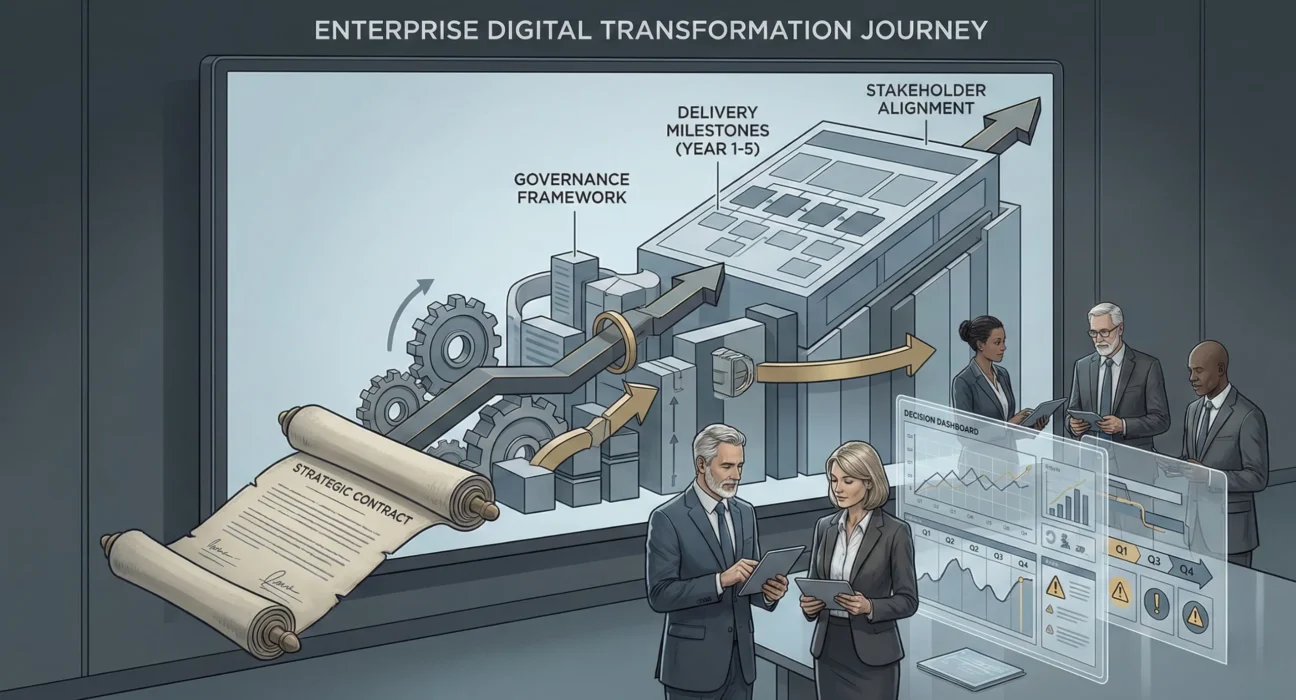
Most enterprise software programs don’t fail because of bad technology. They fail because the contract that governed them was built for speed, not sustainability.
If you’ve led or overseen a large-scale digital transformation, you’ve likely seen this pattern. The initial conversations are promising. Timelines seem tight but manageable. Costs are estimated with confidence. The vendor presents well. Leadership signs off. Everyone commits.
Then reality sets in.
Scope creeps in quietly. Timelines stretch. Key resources leave mid-project. Integration challenges surface late. What was supposed to be a twelve-month program enters its third year. Budgets balloon. Stakeholders grow frustrated. And somewhere buried in the fine print of the contract, the accountability framework starts to crack.
This isn’t about blame. It’s about structure. Enterprise contracts are often treated as legal formalities when they should be strategic instruments. The way you structure a contract determines how a program behaves under pressure, how decisions get made when things go wrong, and whether your partners stay committed when the work gets hard.
Why Enterprise Contracts Break Down
Large programs operate in environments of genuine uncertainty. You’re not buying a product off the shelf. You’re commissioning a complex effort that will touch legacy systems, require coordination across departments, navigate regulatory requirements, and adapt to business changes that haven’t happened yet.
The standard contract models don’t account for this. Fixed-price contracts assume perfect foresight. Time-and-material contracts shift all risk to you. Milestone-based contracts often measure activity instead of outcomes. And almost all of them treat change as an exception rather than the norm.
What actually happens in a multi-year enterprise program? Requirements evolve as business priorities shift. Technical dependencies reveal themselves only after discovery work begins. Integration points turn out to be more complex than documented. Compliance needs change with new regulations. Leadership changes, and new stakeholders bring new expectations.
A contract that doesn’t anticipate this will either lock you into the wrong path or create endless renegotiation cycles. Both outcomes are expensive.
The Hidden Costs of Poor Contract Structure
The damage from a poorly structured contract isn’t always visible in the budget line. It shows up in other ways.
Erosion of accountability. When contracts don’t clearly define who owns what, decision-making slows down. Teams wait for approvals. Vendors point to ambiguous clauses. Internal stakeholders avoid taking positions. The program drifts.
Loss of momentum. Enterprise programs need sustained energy over long periods. Contracts that front-load risk or create adversarial dynamics drain that energy. People start protecting themselves instead of solving problems.
Compromised quality. When a vendor is locked into an unprofitable engagement, quality suffers. Not always visibly, but in the places that matter later documentation, testing rigor, knowledge transfer, maintainability.
Governance theatre. Contracts often mandate governance structures, steering committees, review boards, and escalation paths. But if the contract doesn’t give these bodies real authority or tie their decisions to commercial terms, they become performative. Everyone attends the meetings. Nothing changes.
What Actually Matters in an Enterprise Contract
The contracts that support long-term program success share certain characteristics. They’re not perfect, but they’re honest about what the program is and what it will require.
Clarity on outcomes, not just outputs
Most contracts specify deliverables, modules, features, environments, documentation. That’s necessary but insufficient. What matters more is what those deliverables need to achieve.
A well-structured contract defines success in business terms. If you’re modernising your supply chain systems, the contract should articulate improvements in cycle time, visibility, error rates, or user adoption, not just the delivery of a new platform. This forces everyone to stay focused on value, not just completion.
Flexibility within guardrails
Enterprise programs need room to adapt, but not unlimited room. The best contracts establish a core scope that’s protected and a variation mechanism that’s structured.
This means defining what can change and under what conditions. It means agreeing upfront on how changes will be evaluated, priced, and approved. It means building in regular re-planning cycles so adaptations happen in a controlled way, not through constant firefighting.
Shared risk and reward
If all the risk sits with you, the vendor optimises for their own protection. If all the risk sits with the vendor, they either overprice or underdeliver. Neither model produces the partnership behaviour that complex programs require.
Shared risk doesn’t mean splitting everything 50-50. It means structuring commercial terms so that both sides benefit from good execution and both feel the pain of delays or failures. This could be through outcome-based pricing, gain-share models, or retention structures tied to program milestones.
Governance that can make decisions
Governance isn’t about adding more meetings. It’s about creating forums where the right people can resolve the right issues at the right level.
This requires defining clear escalation paths, decision rights, and authorities in the contract itself. When a technical integration issue arises, who decides the approach? When scope needs to change, what’s the approval threshold? When timelines slip, who owns the recovery plan?
If these aren’t in the contract, they’ll be negotiated under stress, which rarely produces good outcomes.
Provisions for knowledge transfer and transition
Every enterprise program eventually ends. Either it succeeds and moves into operations, or it’s restructured, or it’s terminated. Contracts often ignore this reality until it’s too late.
A mature contract anticipates the exit from day one. It specifies documentation standards, training requirements, code ownership, access to environments, and handover processes. It ties commercial terms to successful transition, not just project completion. This protects you from being locked into dependency on a single vendor or losing institutional knowledge when key resources leave.
The Role of Leadership in Contract Success
Even a well-structured contract will struggle without the right leadership approach.
Ownership must be clear from the top
Contracts don’t execute themselves. Someone senior needs to own the relationship, not just monitor it. This person must have the authority to make trade-offs, resolve conflicts, and hold both internal teams and vendors accountable.
In many organisations, this ownership is diffuse. IT owns the technology. Finance owns the budget. Business units own the requirements. No one owns the program. That’s a structural failure, and no contract can compensate for it.
Executives need to stay engaged
It’s tempting to delegate everything once the contract is signed. But large programs hit decision points that require executive judgment when to cut scope, when to extend timelines, when to replace underperforming resources, when to invest more to protect value.
If executives only engage during crises, decisions get made reactively. If they engage regularly through structured governance, decisions get made strategically.
Vendor partnerships require reciprocity
The best vendor relationships aren’t transactional. They’re partnerships where both sides invest in success. But partnership behaviour has to be earned and maintained.
This means paying on time. Providing access to the right stakeholders. Being honest about constraints. Making decisions promptly. Treating vendor teams with respect. If you treat vendors as disposable, they’ll behave accordingly.
Choosing the Right Partner Changes Everything
Technology skills matter, but they’re table stakes. What separates good partners from great ones is execution maturity.
Does the partner understand how large enterprises actually work? Do they know how to navigate matrix organisations, manage stakeholder politics, handle governance escalations, and communicate across levels? Have they delivered programs that stayed live after go-live, not just launched and then needed rescue?
Ozrit’s work across complex enterprise environments has shown that execution maturity is often more predictive of success than technical capability alone. A partner who understands the realities of enterprise delivery will structure their own approach differently more disciplined planning, tighter change control, stronger program management, clearer ownership models.
This becomes especially important in the Indian enterprise context, where programs often need to balance global standards with local operational realities. Partners who’ve only worked in pure Western markets sometimes struggle with the pace, the stakeholder complexity, or the need to operate within constrained environments. Partners with deep experience in Indian enterprises bring a different kind of pragmatism.
Common Mistakes to Avoid
Even with good intentions, certain patterns keep appearing in enterprise contracts that create problems later.
Optimistic timelines with no buffer. Every program estimate includes assumptions. When all those assumptions need to go right for the timeline to hold, the timeline won’t hold. Build in contingency. Make it explicit.
Vague acceptance criteria. If “done” isn’t clearly defined, it becomes a negotiation at the worst possible time. Acceptance criteria should be specific, testable, and agreed upfront.
Ignoring dependencies outside the vendor’s control. If your internal teams need to provide data, infrastructure, approvals, or resources, the contract should specify what happens when they don’t. Delays aren’t always the vendor’s fault.
No provisions for resource continuity. Key people will leave during a multi-year program. Contracts should require notice periods, knowledge transfer, and replacement approval rights.
Change control processes that are too rigid or too loose. If every small change requires executive approval, nothing moves. If changes happen informally, scope and cost spiral. Find the right threshold.
What Success Actually Looks Like
A successful enterprise program isn’t one that finishes exactly on the original timeline and budget. Those programs are rare, and often achieve that precision by sacrificing quality or value.
Success looks like this: the program delivers meaningful business value. It does so in a way that the organisation can sustain and build on. Key stakeholders remain engaged and supportive throughout. The vendor relationship stays productive under pressure. When problems arise and they will, they get resolved constructively.
The contract that enables this is one that everyone actually refers to, not one that sits in a drawer until a dispute arises. It’s a working document that helps the program run better, not a legal shield.
Building for the Long Term
Enterprise programs are long journeys. The initial energy and optimism fade. Market conditions shift. Priorities change. People move on. What carries a program through these cycles isn’t just technology or budget. It’s structure, discipline, and partnership.
The contract is where that structure begins. It sets the foundation for how decisions get made, how risks get managed, how value gets protected, and how relationships endure when things get difficult.
If you’re leading an enterprise transformation or considering one, the time spent getting the contract right is not overhead. It’s essential work. It determines whether your program becomes a reference case or a cautionary tale.
At Ozrit, we’ve seen that the programs that succeed aren’t necessarily the ones with the biggest budgets or the most advanced technology. They’re the ones with clear ownership, honest planning, strong governance, and contracts that align incentives around shared success. That’s not exciting. But it works.
And in enterprise delivery, what works matters more than what sounds impressive.
The executives who understand this don’t just commission programs. They build delivery capability that compounds over time, creating organisations that can execute consistently, learn from each cycle, and take on bigger challenges with confidence.
That’s what structuring for long-term success really means.