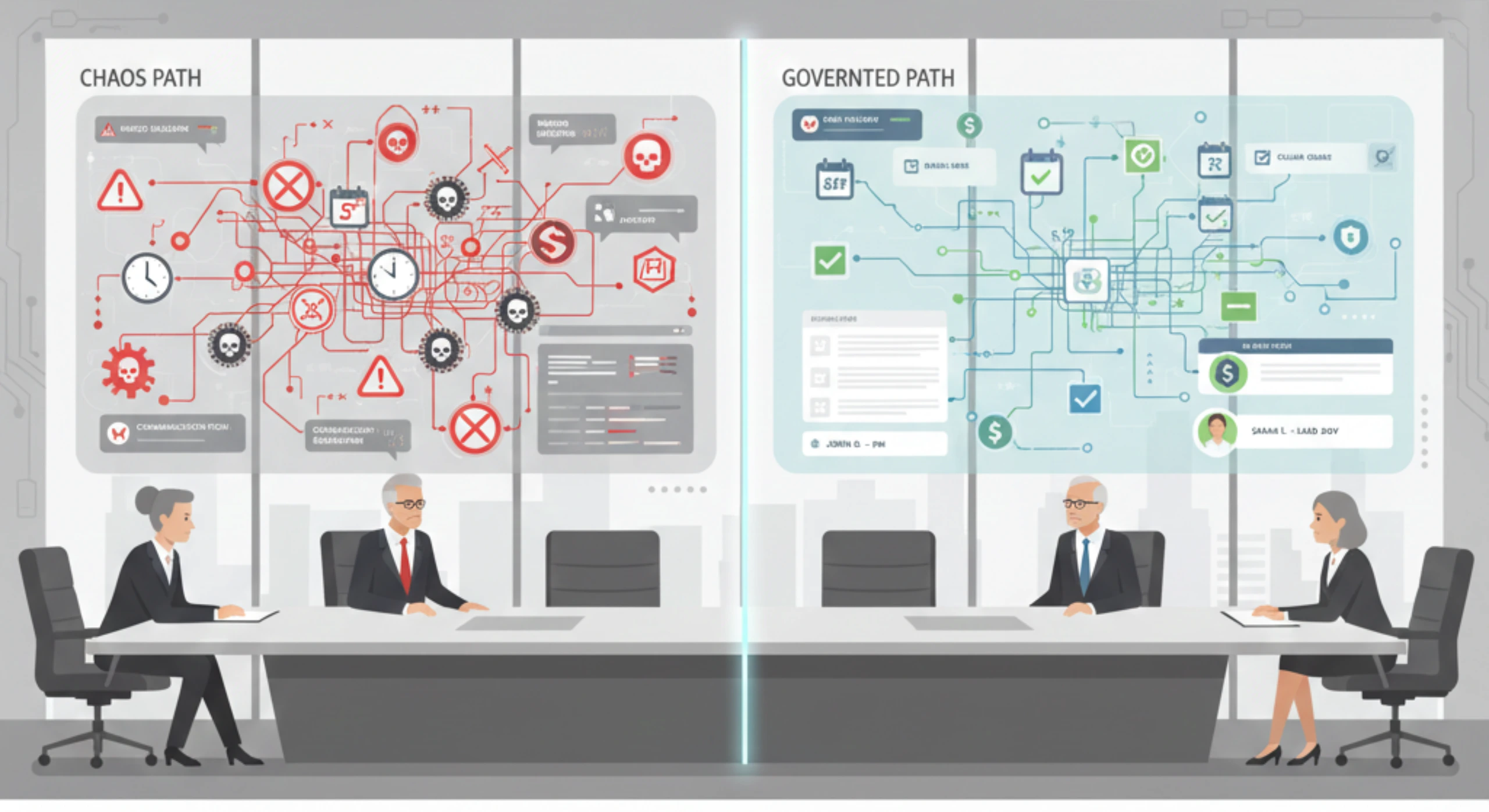
Most large enterprises today run automation. But they don’t run it consistently. A finance team builds a bot. IT builds another. Operations build three more. Each one works. Each one solves a problem. And each one creates a new island of technology that nobody else can touch.
The gap isn’t about whether automation works. It does. The gap is about whether it works everywhere, whether it keeps working when teams change, and whether it creates value that compounds instead of fragmenting.
The Problem Isn’t Technology
When a C-suite leader asks why automation hasn’t scaled, the usual answers involve platforms, tools, or integration layers. But the real issue is structural. Enterprises accumulate automation the same way they accumulate technical debt: one urgent project at a time, with good intentions and no long-term ownership model.
A regional office automates invoice processing. It saves time. Six months later, another region asks for the same thing. Instead of reusing the work, they rebuild it because the original developer left, the documentation is incomplete, or the logic was hardcoded to one specific vendor format. The problem repeats across departments, geographies, and business units.
This isn’t a failure of effort. It’s a failure of execution design. Enterprises treat automation as a series of projects when it should be treated as a capability that requires maintenance, governance, and continuous ownership.
Why Scale Breaks Down
Scaling automation across a large enterprise introduces friction that small deployments never encounter. The first bot is easy. The fiftieth bot is a governance problem. The two hundredth bot is a liability.
At scale, you face questions that single-team automation never has to answer. Who maintains this when the original builder moves roles? What happens when the underlying system changes? How do you ensure that automation in Singapore follows the same security standards as automation in London? How do you prevent one team’s process change from breaking another team’s workflow?
These aren’t edge cases. They’re the norm. And they don’t get solved with better technology. They get solved with better structure, better documentation, better handoff processes, and better long-term ownership.
Enterprises also underestimate how much institutional knowledge sits inside automation logic. A process that looks simple on paper often contains dozens of exception rules, workaround steps, and undocumented dependencies. When that knowledge lives in one person’s head or in code with no meaningful documentation, scaling becomes impossible.
The Execution Gap
The gap between pilot success and enterprise-wide deployment is where most automation initiatives stall. A proof of concept works. A business case gets approved. Then the work begins: integrating with legacy systems, aligning with compliance requirements, coordinating across time zones, managing stakeholder expectations, and ensuring that what gets built can actually be supported once the project team leaves.
This is where execution quality separates successful programs from expensive experiments. Enterprises need teams that understand not just how to build automation, but how to build automation that other people can maintain. That means structured documentation, clear error handling, realistic SLAs, and a support model that doesn’t disappear after go-live.
It also means understanding the difference between what works in a demo and what works in production. A process that runs smoothly in a controlled test environment can fail in unexpected ways when it encounters real-world data variations, system downtimes, or user behavior that wasn’t anticipated. Enterprise-grade automation has to handle these scenarios without constant manual intervention.
How Ozrit Approaches Enterprise Programs
Ozrit structures enterprise automation work differently from the start. Instead of treating each request as an isolated project, the approach focuses on building automation that can be maintained, extended, and reused across the organization. That requires senior involvement from day one, not just during the sales cycle.
When an enterprise engagement begins, Ozrit assigns a dedicated senior leader who stays involved throughout delivery and into ongoing support. This isn’t a handoff model where a salesperson closes the deal and passes the work to a junior team. The same people who design the solution are accountable for making sure it works in production and keeps working as the business changes.
The onboarding process is designed to reduce delivery risk. Before any build work starts, Ozrit’s team conducts structured discovery sessions to map dependencies, identify integration points, document exception scenarios, and align on success criteria. This isn’t a formality. It’s where most delivery problems get caught early, before they become expensive to fix.
Timelines are realistic. If a complex process will take three months to automate properly, Ozrit says three months. If it needs phased rollout across regions, that gets built into the plan. Enterprises don’t benefit from optimistic schedules that slip or from shortcuts that create maintenance problems later.
The delivery model includes structured documentation as a core requirement, not an afterthought. Every automation comes with clear logic explanations, error handling documentation, and support runbooks. If something breaks at 2 AM, the on-call team should be able to diagnose and fix it without calling the original developer.
Support That Matches Enterprise Operations
Large enterprises don’t operate nine-to-five. Critical processes run continuously across time zones, and automation failures can have immediate business impact. A payroll process that fails overnight doesn’t wait until morning for a fix. An order fulfillment workflow that stops during peak hours costs revenue by the minute.
Ozrit provides 24/7 support that reflects this reality. When something breaks, there’s a team available to respond, diagnose, and resolve the issue. This isn’t a paging service that escalates to someone who might get back to you. It’s direct access to engineers who understand the automation, the underlying systems, and the business context.
Support also means proactive monitoring. Issues get identified and addressed before they cause business disruption. When a system dependency changes, the automation gets updated. When usage patterns shift, performance gets optimized. The goal is to make automation a stable capability that the business can rely on, not a fragile layer that requires constant attention.
Building Capability, Not Just Completing Projects
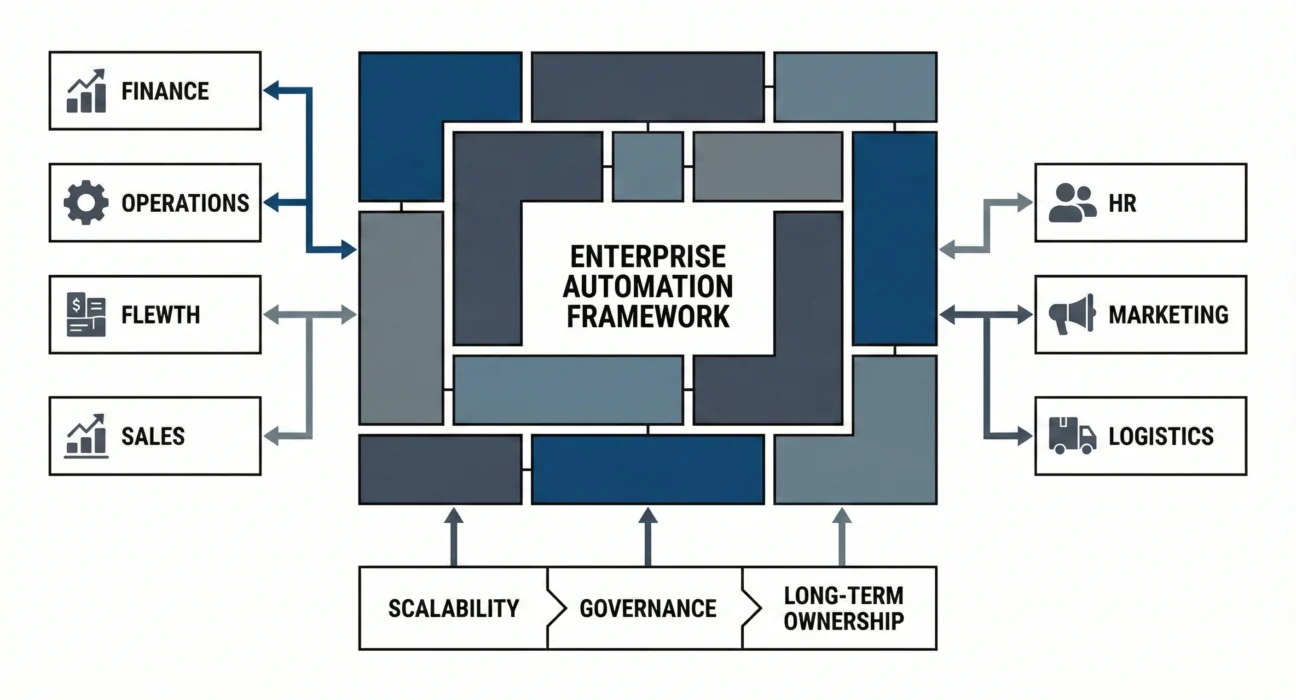
The difference between automation that scales and automation that doesn’t often comes down to whether you’re building repeatable capability or just completing individual projects. Capability means that when the next department needs similar automation, you can extend what exists instead of starting over. It means that when regulations change, you can update processes systematically instead of hunting through dozens of disconnected scripts.
This requires thinking beyond the immediate request. If finance needs invoice automation, the solution should be designed so that procurement can adapt it for purchase orders, and operations can use it for vendor management. That doesn’t mean over-engineering for hypothetical future needs. It means building with clear structure, consistent patterns, and reusable components.
It also means investing in the unglamorous work that makes automation sustainable: proper version control, testing protocols, rollback procedures, and change management processes. These aren’t exciting topics in a business case presentation, but they’re what determine whether automation still works two years after go-live.
The Real Test of Enterprise Automation
The real test isn’t whether automation works on launch day. It’s whether it’s still working two years later when the original project team has moved on, the business has changed, and nobody remembers exactly why certain logic was implemented the way it was.
Sustainable enterprise automation requires treating it as operational infrastructure, not as a collection of scripts. It requires ownership models that outlast individual employees. It requires documentation that enables knowledge transfer. And it requires partners who stay engaged beyond the initial implementation.
For C-suite leaders evaluating automation initiatives, the questions worth asking aren’t about which platform to use or how many processes can be automated. The questions are about who will own this long-term, how it will be maintained, what happens when key people leave, and whether the partner you’re working with understands the difference between delivering a project and building enterprise capability.
Automation that scales isn’t about technology sophistication. It’s about execution quality, long-term thinking, and partners who take responsibility for outcomes beyond the initial deployment. The enterprises that get this right don’t just save costs. They build competitive advantages that compound over time.