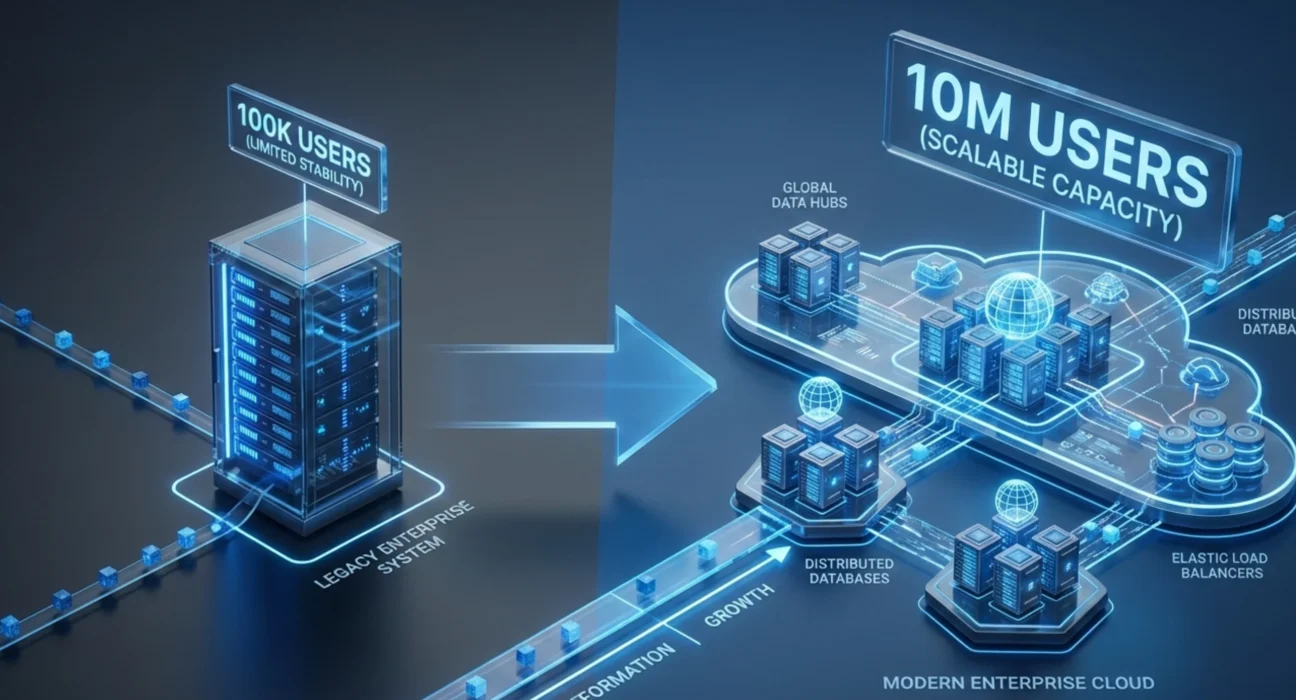
Most enterprise systems are built to solve today’s problem. A customer portal handles 100,000 users without breaking a sweat. The application performs well, the infrastructure costs are reasonable, and the team is comfortable maintaining it. Then leadership announces a major expansion. A merger brings in new customers. A product launch opens new markets. Suddenly, the target is 10 million users, and the question becomes whether the current system can scale or whether it needs to be rebuilt from scratch.
This is not a theoretical exercise. It is one of the most consequent decisions an enterprise technology leader will make. Get it wrong, and the business faces outages during peak demand, runaway infrastructure costs, or a multi-year rewrite that delays strategic objectives. Get it right, and the system becomes an enabler rather than a constraint.
The challenge is that scaling from 100,000 to 10 million users is not simply a matter of adding more servers. The technical decisions required are complex, but the execution risks are even greater. This is where many large programs falter, not because the architecture was wrong, but because the delivery was fragmented, the ownership was unclear, or the team lacked the depth to handle the inevitable problems that emerge at scale.
Why Small-Scale Architecture Does Not Survive Large-Scale Demand
A system designed for 100,000 users typically reflects sensible choices made under different constraints. The database might be a single relational instance because it is simple to manage. The application might query the database directly because the latency is acceptable. The infrastructure might sit in one region because the user base is geographically concentrated. These are not mistakes. They are appropriate decisions for the scale they were designed to serve.
The problem is that these same choices become bottlenecks at 10 million users. A single database instance cannot handle the query load. Direct database queries create contention and slow response times. A single region introduces latency for global users and creates a single point of failure. What worked perfectly well at smaller scale now becomes a constraint on growth.
The instinct is often to add more capacity. Double the database size, add more application servers, increase bandwidth. This works for a while, but it does not address the underlying architectural limits. Eventually, the system hits a ceiling that no amount of additional hardware can overcome. Response times degrade, failures become more frequent, and costs escalate without delivering proportional performance.
Rebuilding the system from scratch seems like the logical answer, but this introduces a different set of risks. A full rewrite takes months or years, during which the business is still operating on the old system. Features must be maintained in parallel. Data must be migrated without downtime. The new system must be proven at scale before the old one can be retired. Many large enterprises have started ambitious rewrites only to find themselves running both systems indefinitely because the cutover was too risky or too complex to execute cleanly.
The Architecture Decisions That Enable Scale
Designing for 10 million users requires a different approach to data, infrastructure, and failure modes. The architecture must assume that individual components will fail and that demand will be unpredictable. It must separate concerns so that bottlenecks in one part of the system do not cascade into others. It must be built with the understanding that operational complexity increases dramatically at scale, and that complexity must be managed through design rather than firefighting.
Caching becomes essential. Direct database queries are replaced with in-memory caching layers that serve the majority of read requests. This reduces database load by orders of magnitude and improves response times for users. The challenge is cache invalidation, ensuring that stale data does not persist when the underlying data changes. This requires careful design and rigorous testing under realistic load conditions.
Database architecture shifts from a single instance to distributed systems. Read replicas handle query load, allowing the primary database to focus on writes. Sharding distributes data across multiple database instances, each responsible for a subset of users or transactions. This introduces complexity in queries that span multiple shards and requires careful planning around data distribution and rebalancing as the user base grows.
Asynchronous processing becomes critical. Operations that do not need to complete immediately, such as sending emails, generating reports, or updating analytics, are moved to background queues. This keeps the user-facing application responsive and prevents slow operations from blocking other requests. The trade-off is that the system must be designed to handle eventual consistency, where updates are not immediately visible across all components.
Infrastructure must be distributed across multiple regions to reduce latency for global users and eliminate single points of failure. Load balancers distribute traffic across servers, and failover mechanisms ensure that failures in one region do not take down the entire system. This requires coordination across data centers, careful network design, and monitoring systems that can detect and respond to failures before users are affected.
The Execution Risk That Most Enterprises Underestimate
The technical decisions are complex, but they are well understood. The real risk in these programs is execution. Large-scale system design requires coordination across multiple teams, each with their own priorities and constraints. The database team must work with the application team. The infrastructure team must align with security and compliance. The operations team must be involved early enough to ensure the system can be monitored and maintained in production.
This coordination is difficult to achieve in practice. Teams work in silos, using different tools and following different processes. Requirements change as the program progresses. Technical debt from the existing system creates dependencies that were not anticipated. The result is often a delivery timeline that stretches far beyond initial estimates, with integration problems discovered late in the process when they are most expensive to fix.
Governance becomes critical. Someone must own the end-to-end architecture and have the authority to make decisions when trade-offs are required. This cannot be done by committee. It requires a senior technical leader who understands both the business objectives and the technical constraints, and who can drive decisions without endless debate. Many large enterprises lack this clear ownership, leading to programs that drift without clear direction or accountability.
Testing at scale is another common failure point. It is not sufficient to test the system with synthetic load in a staging environment. The system must be tested under realistic conditions, with real data patterns, real user behavior, and real failure scenarios. This requires infrastructure that can simulate 10 million users, monitoring that can detect subtle performance degradations, and a process for validating that the system behaves correctly under load. Few enterprises invest adequately in this testing, leading to surprises when the system goes live.
How Ozrit Approaches Large-Scale System Design
Ozrit works differently because we understand that enterprise programs succeed or fail based on execution, not just technical design. When we engage with a client on a large-scale system design program, we assign a senior team from day one. This is not a junior team learning on the job. It is experienced engineers and architects who have built systems at this scale before and who understand the trade-offs involved.
Clear ownership is established immediately. One person is accountable for the architecture and delivery, with direct access to the client’s leadership. This eliminates the coordination problems that slow down large programs. Decisions are made quickly, technical blockers are escalated and resolved, and the program moves forward with clear momentum.
We bring between 30 and 50 senior engineers to a typical large-scale program. This is not a small team stretched across too many workstreams. It is a team with the capacity to work in parallel across architecture, development, testing, and operations. Database specialists work on sharding and replication strategies. Infrastructure engineers design multi-region deployments. Application developers refactor code to support asynchronous processing and caching. Performance engineers run load tests and identify bottlenecks before they reach production.
Onboarding is structured to reduce delivery risk. New team members are brought up to speed on the existing system, the business context, and the technical roadmap. They are paired with client teams to ensure knowledge transfer and continuity. This is not a handoff where Ozrit builds something and walks away. It is a partnership where the client retains full control and understanding of the system after we leave.
Realistic timelines are set from the beginning. A program to scale a system from 100,000 to 10 million users typically takes six to nine months, depending on the complexity of the existing system and the business constraints. This includes architecture design, implementation, testing, and production rollout. We do not promise faster timelines that cannot be met. We commit to what can be delivered with high confidence, and we execute against that commitment.
Support does not end at launch. We provide 24/7 support during the initial production rollout and continue to monitor the system as load increases. Performance issues are addressed immediately, not escalated through layers of support tiers. The team that built the system is the team that supports it, ensuring continuity and rapid resolution of any problems.
Making the Decision With Confidence
Scaling a system to 10 million users is not a decision to be made lightly. It requires significant investment, clear technical leadership, and a delivery partner that can execute with discipline and accountability. The cost of getting it wrong, either through a failed rewrite or a system that cannot handle the load, is measured not just in budget overruns but in lost business opportunities and damage to customer trust.
The enterprises that succeed are those that approach the program with clarity about the risks, invest in the right team, and maintain clear ownership throughout delivery. Technology is important, but execution is what separates successful programs from those that struggle for years without delivering value.
When the business needs to scale, the technology must be ready. That readiness is not built on hope or optimism. It is built on experience, discipline, and a team that knows how to deliver systems that perform under real-world conditions. The question is not whether your system can reach 10 million users. The question is whether you have the right approach to get there with confidence.