Every year, retail executives face the same impossible choice. They know their core systems are aging. They understand the risk of running on platforms that were designed before mobile commerce, real-time inventory, and personalized customer experiences became standard expectations. But they also know what happens when systems fail during Black Friday, holiday shopping seasons, or major promotional events. The cost is measured in millions of lost revenue, damaged customer relationships, and executive careers.
This is why so many large retailers continue running on systems that are 15, 20, or even 25 years old. The technical debt keeps growing. The skilled people who understand these systems keep retiring. The cost of maintenance keeps climbing. But the fear of disruption during peak trading periods keeps modernization programs on hold, sometimes indefinitely.
The problem is not theoretical. It is a real governance and delivery challenge that gets harder as organizations get larger.
Why Legacy Modernization Fails at Enterprise Scale
Small retailers can schedule downtime, migrate during quiet periods, and recover quickly if something goes wrong. Large enterprises operate across time zones, serve millions of customers, and process transactions 24 hours a day. Their systems are connected to supply chain networks, loyalty platforms, payment processors, store operations, and customer service tools that were never designed to work together but have become deeply interdependent over decades.
Most modernization programs fail not because of technology limitations but because of execution risk. The typical approach is to run a detailed assessment, create a comprehensive roadmap, and then attempt a phased migration that takes 18 to 36 months. During that time, business requirements change, key team members leave, vendor relationships become strained, and the pressure to deliver results grows while systems remain partially modernized and twice as complex.
The real danger appears during peak trading periods. Systems that worked fine during testing suddenly behave unpredictably under full production load. Integration points that seemed stable start timing out. Database queries that performed adequately during normal operations become bottlenecks when traffic spikes. And because the old and new systems are running in parallel, troubleshooting becomes exponentially harder.
This is where most large programs get into trouble. Teams cannot roll back completely because some functionality has already moved. They cannot move forward quickly because peak season is approaching. They end up stuck in the middle, managing two complex environments with insufficient staff and incomplete knowledge transfer.
The Real Costs of Parallel Systems
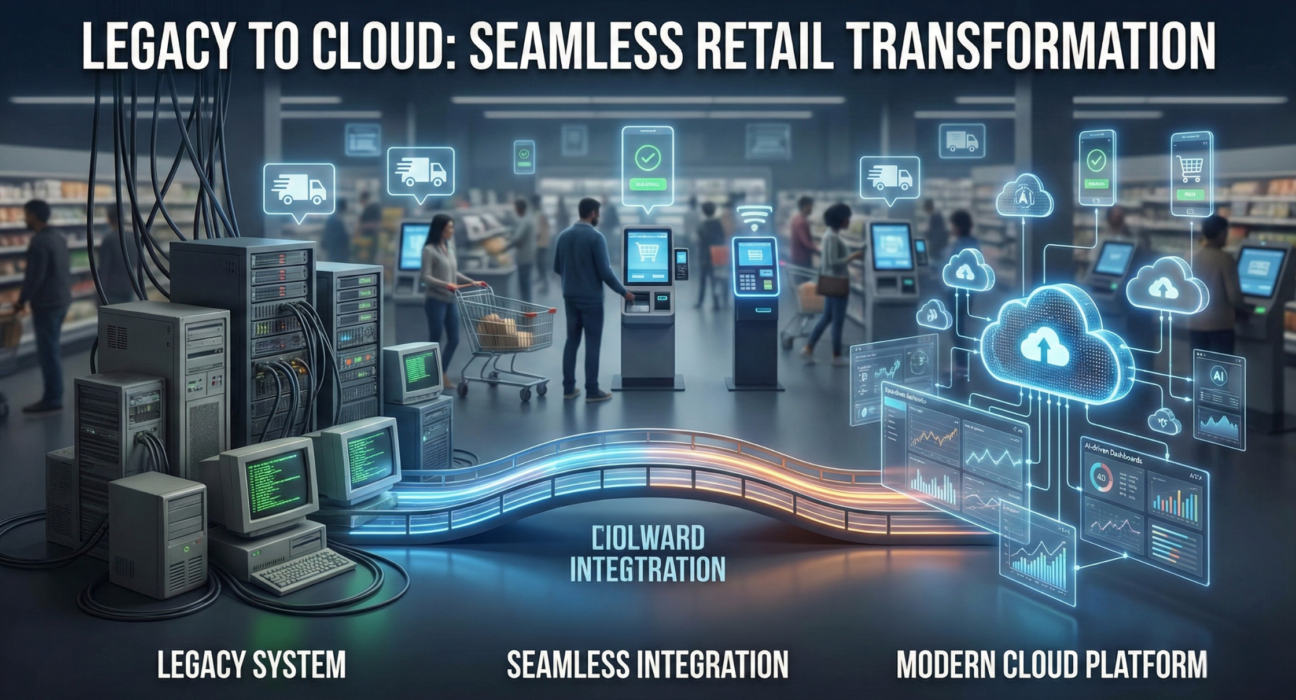
Running old and new systems in parallel is expensive in ways that are not always visible in project budgets. Development teams need to maintain code in both environments. Support staff need to understand two different architectures. Data needs to be synchronized constantly, which introduces latency and increases the risk of consistency errors. Every change requires double the effort, double the testing, and double the risk.
This is particularly difficult for retailers because their business model depends on speed. New products need to launch quickly. Pricing needs to change in response to market conditions. Promotions need to run without technical complications. When systems are split across legacy and modern platforms, every one of these activities becomes a coordination challenge that requires senior technical involvement.
The pressure increases during peak trading periods. Support teams are stretched thin. Any incident requires immediate escalation. Business stakeholders become understandably nervous about making changes. The result is that modernization work slows down or stops completely for months at a time, extending timelines and increasing costs.
How Ozrit Approaches Retail Modernization Differently
Ozrit works with large enterprises that cannot afford extended parallel operations or uncertain delivery timelines. The approach is based on reducing the period of maximum risk rather than trying to eliminate risk entirely, which is impossible in complex environments.
The first principle is direct senior involvement from day one. Programs are not handed to junior teams after the contract is signed. The same senior architects and delivery leads who participate in planning remain accountable throughout execution. This continuity matters because retail systems require constant decision-making under pressure, especially as peak seasons approach.
The second principle is accelerated knowledge transfer. Ozrit does not treat client systems as black boxes that only consultants understand. Teams work directly with internal staff from the beginning, documenting decisions, explaining architectural choices, and ensuring that support knowledge transfers in parallel with development work. This means that by the time new systems go live, internal teams already have months of hands-on experience rather than facing a sudden handover.
The third principle is realistic timeline planning around retail calendars. Modernization programs are structured to reach stable milestones well before peak trading periods, with clear rollback capabilities at every stage. This is not about moving slowly. It is about moving deliberately, with enough buffer to handle unexpected issues without impacting revenue.
Ozrit maintains a distributed team of over 320 professionals across multiple time zones, which provides genuine 24/7 coverage during critical periods. This is not theoretical support. It means that incidents during peak trading periods get immediate senior attention regardless of when they occur, and that knowledge is distributed across teams rather than concentrated in a few individuals.
Managing the Peak Season Risk Window
The most dangerous period in any retail modernization program is the eight to twelve weeks before a major peak season. Changes made during this window have limited time to stabilize before they face maximum load. Problems that appear minor during testing can become critical under production conditions.
Effective modernization programs recognize this reality and plan accordingly. Major system changes should reach production at least three months before peak periods, giving enough time to observe behavior under normal load, tune performance, and build confidence among operations teams. Minor changes can continue closer to peak dates, but only if they are isolated, well-tested, and easy to roll back.
This requires discipline. Business stakeholders always want new features as quickly as possible. Sales teams promise customers functionality that requires backend changes. Product managers have roadmaps that do not account for technical risk windows. It takes senior leadership to enforce realistic boundaries and protect system stability during critical revenue periods.
Ozrit structures delivery programs with these constraints built in from the start. Roadmaps explicitly show risk windows. Milestones are scheduled to provide adequate stabilization time. And when unexpected delays occur, the default response is to defer changes rather than compress testing or reduce quality gates.
The Economics of Faster Modernization
Extending modernization timelines beyond 18 months creates costs that compound over time. Internal teams remain split between supporting legacy systems and building new capabilities. Technical debt continues accumulating in old platforms. Opportunities to reduce infrastructure costs through cloud migration remain unrealized. And the longer parallel systems run, the more complex and fragile the overall environment becomes.
Faster modernization is valuable not because speed is inherently good but because it reduces the period of maximum complexity and risk. A program that reaches stable production in 12 months instead of 24 months cuts the parallel operations period in half, which directly reduces costs, improves team focus, and allows organizations to start realizing benefits sooner.
This requires a different approach to program governance. Instead of comprehensive planning followed by long execution phases, effective modernization uses shorter cycles with frequent production deployments. Each deployment proves that the new system works under real conditions, builds confidence among stakeholders, and provides actual feedback for subsequent work.
Ozrit’s onboarding process is designed to reach first production deployment within 12 weeks. This is not a pilot or a proof of concept. It is real functionality serving real customers, even if the scope is limited initially. This approach forces teams to confront integration challenges, performance issues, and operational concerns early, when they are easier to address.
What Success Actually Looks Like
Successful retail modernization is not measured by technology elegance or architectural purity. It is measured by whether systems handle peak season load without incidents, whether internal teams can operate independently, and whether the business can launch new capabilities faster than before.
This means that the right measure of success is often invisible. Systems that work properly do not generate escalations. Operations teams that understand the new architecture do not need constant vendor support. Business stakeholders who trust technical delivery stop asking for detailed status updates.
For large retailers, this kind of stability is what makes modernization worthwhile. It allows organizations to shift focus from managing technical risk to pursuing business opportunities. It frees up internal teams to work on differentiation instead of maintenance. And it provides the foundation for future innovation without the constant fear that systems will fail during the moments that matter most.
The goal is not to build perfect systems. It is to build systems that executives can stop worrying about, even during the busiest shopping days of the year.