At Trueway Driving School Perth’s trusted professional driving school we’ve helped hundreds of learners confidently make the switch from automatic to manual driving, and we know firsthand how daunting that first clutch pedal can feel. Whether you’ve only ever driven an automatic or you’re preparing for your driving test and want maximum flexibility behind the wheel, this comprehensive guide will walk you through everything you need to know about transitioning from an automatic car to a manual car in Perth.
Switching transmission types is one of the most common goals among learner drivers in Western Australia. And for good reason knowing how to drive a manual vehicle opens more job opportunities, gives you greater control on the road, and can even save you money on fuel. Let’s break down exactly how to make this transition successfully.
Why Perth Drivers Are Making the Switch to Manual
You might be wondering: in an age of increasingly automatic and even self-driving cars, why would anyone bother learning to drive a manual? The answer is more practical than you might think.
Greater Employment Opportunities
Many industries in Perth including mining, logistics, agriculture, and emergency services require employees to operate manual vehicles. According to a 2023 survey of Australian employers in transport-related sectors, over 60% of driving roles still listed manual transmission competency as either required or preferred.
More Vehicle Flexibility
Imagine travelling overseas or renting a car interstate, only to find that the only available vehicle is a manual. Knowing how to drive stick shift means you’re never stuck. In Europe and many parts of Asia, manual cars still dominate the market, so this skill travels with you.
Better Driver Awareness
Driving a manual forces you to be more engaged with your vehicle. You develop a deeper sense of road speed, engine behaviour, and gear selection skills that can genuinely make you a safer, more attentive driver overall.
Potential Fuel Savings
While modern automatics have largely closed the gap, manual vehicles can still offer better fuel economy in certain driving conditions, particularly at highway speeds. For Perth commuters dealing with rising fuel prices, this is worth considering.
Understanding the Key Differences: Automatic vs Manual
Before jumping into the transition process, it helps to understand what actually separates the two transmission types and why it takes some adjustment.
The Clutch: Your New Best Friend (and Biggest Challenge)
In an automatic car, the gearbox does all the work for you. In a manual, you control gear changes using a clutch pedal (the third pedal to the left of the brake). Coordinating your left foot on the clutch while your right foot manages the accelerator and brake is the core skill you need to develop.
Think of the clutch like a handshake engage it too fast and things get awkward (stalling), too slow and you waste energy (clutch wear). Finding that “biting point” the sweet spot where the clutch plate begins to grip the engine is the foundation of smooth manual driving.
Gear Selection
In an automatic, the car shifts gears based on speed and load. In a manual, you decide when to shift. This requires you to listen to your engine, read your RPM gauge, and develop an instinctive feel for when to change up or down.
General guide for Perth road conditions:
| Gear | Typical Speed Range |
|---|---|
| 1st | 0–20 km/h |
| 2nd | 15–35 km/h |
| 3rd | 30–55 km/h |
| 4th | 50–80 km/h |
| 5th | 80+ km/h |
Hill Starts
For many learner drivers, hill starts are the trickiest part of transitioning to manual. Without an automatic’s built-in hold, you need to coordinate the handbrake, clutch, and accelerator simultaneously to prevent rolling backwards. It sounds complicated, but with practice especially guided practice it becomes second nature.
Step-by-Step: How to Transition from Automatic to Manual
Here’s a structured, practical roadmap for making the switch smoothly.
Step 1 – Understand the Mechanics First
Before getting in the car, spend time understanding how a manual gearbox works. Watch videos, read diagrams, and ask your instructor to explain the mechanics. Understanding why you stall helps you correct it faster.
Step 2 – Start in a Safe, Low-Traffic Environment
Your first few sessions should be in a quiet car park or a low-traffic area. This removes the pressure of other road users while you master the basics: starting, stopping, and changing between 1st and 2nd gear.
Step 3 – Master the Biting Point
Practice finding the biting point of the clutch repeatedly until it feels natural. This single skill underpins everything else in manual driving.
Step 4 – Progress to Residential Streets
Once you’re comfortable with basics, progress to quiet suburban streets. Practise smooth take-offs, stopping at intersections, and gear changes through gears 1-4.
Step 5 – Tackle Hills and Highways
With a foundation in place, work on hill starts and higher speed highway driving. These conditions test your clutch coordination and gear-selection judgment under real-world pressure.
Step 6 – Drive in Diverse Conditions
Before your driving test or solo driving, make sure you’ve practised in various conditions: heavy traffic, inclines, wet roads, and roundabouts. Perth’s road network offers all of these within a short distance.
Common Mistakes When Switching to Manual (And How to Avoid Them)
Even confident automatic drivers make predictable errors when switching to manual. Being aware of them in advance puts you a step ahead.
Riding the Clutch
One of the most common habits new manual drivers develop is resting their left foot on the clutch pedal between gear changes. This causes premature clutch wear and reduces your control. Once you’ve changed gear, move your foot completely off the clutch pedal.
Stalling at Intersections
Stalling is part of learning every manual driver has done it. But it tends to happen most at traffic lights when drivers panic and release the clutch too quickly. Stay calm, restart the engine, and take it slowly. Your examiner understands stalls happen during learning.
Incorrect Gear Selection
Driving in too high a gear (known as “lugging” the engine) or too low a gear (over-revving) is both inefficient and potentially damaging. Pay attention to your RPM gauge and learn to associate engine sounds with gear selection.
Looking Down at the Gear Lever
Many learners look at the gear lever to confirm they’re in the right gear. With practice, you’ll develop muscle memory and won’t need to look. Your eyes should always stay on the road.
Why Trueway Driving School Is Perth’s Top Choice for Manual Driving Lessons
When it comes to making the automatic to manual transition, the quality of your instruction makes an enormous difference. Trueway Driving School has built a reputation as one of Perth’s most trusted and effective driving schools, and here’s why learners consistently choose them.
Experienced, Patient Driving Instructors
All instructors at Trueway Driving School are fully licensed, accredited, and experienced in teaching both automatic and manual transmission. They understand the specific challenges faced by learners switching from automatic and tailor their teaching approach accordingly. A great driving instructor in Perth doesn’t just tell you what to do they help you understand why, building genuine competence rather than test-day habits.
Specialised Manual and Automatic Driving Lessons
Trueway Driving School offers dedicated manual driving lessons in Perth and automatic driving lessons in Perth, so you can progress at your own pace and switch between lesson types as your goals evolve. Whether you want to start on automatic and gradually transition to manual, or you’re going straight to manual, their team has a structured program for you.
High Pass Rates
True Way Driving School maintains one of the highest driving test pass rates among driving schools in Perth, a testament to the effectiveness of their instruction method and the thoroughness of their test preparation process.
Flexible Scheduling for Students and Working Adults
Whether you’re a secondary school student, university student, or working professional, Trueway Driving School offers flexible lesson times including weekends and evenings so learning to drive fits around your life, not the other way around.
Lessons in Your Comfort Zone
Lessons can begin close to your home, school, or workplace, helping you become familiar with local roads and reducing travel-related stress before lessons even begin.
What to Expect During Your First Manual Driving Lesson in Perth
Walking into your first manual driving lesson in Perth with realistic expectations helps enormously. Here’s what a typical first session looks like:
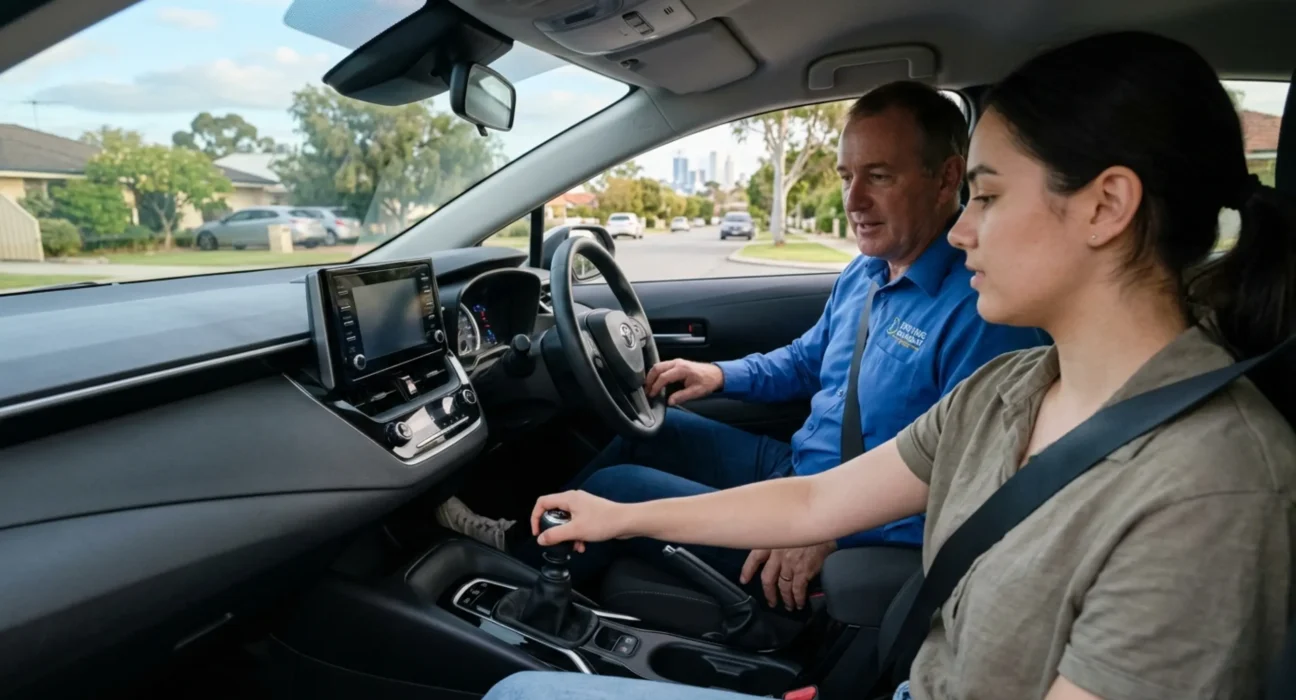
The first 10 minutes are usually spent in a stationary vehicle, getting familiar with the controls where the clutch is, how the gear lever feels, and how to identify the biting point without moving.
The next 20-30 minutes involve slow, controlled movement in first gear forward and stop, forward and stop. Your instructor will guide you on clutch control and help you feel when you’re approaching a stall.
The final 20 minutes typically involve your first real gear changes, moving between 1st and 2nd gear in a safe, low-traffic environment.
Don’t expect perfection in lesson one. Most learners stall multiple times in their first session and that’s completely normal. Progress accelerates quickly once your muscle memory starts developing, usually by the second or third lesson.
Manual vs Automatic Driving Test in WA: What You Need to Know
In Western Australia, the driving test you take determines your licence conditions. This is a crucial point that many learner drivers in Perth overlook.
- If you pass your driving test in an automatic vehicle, your licence will be restricted to automatic vehicles only.
- If you pass your driving test in a manual vehicle, you are licensed to drive both manual and automatic vehicles.
This means that if you ever intend to drive a manual car, it’s worth putting in the effort to complete your test in one. The test itself is the same road rules, same manoeuvres but the demands of clutch control add an extra layer of complexity.
Trueway Driving School can help you prepare specifically for the manual driving test in Perth, ensuring you’re test-ready for the conditions and routes common in your local area.
Conclusion:
Making the switch from automatic to manual driving is one of the most rewarding steps you can take as a driver. It expands your opportunities, sharpens your skills, and gives you a deeper connection to the road. The transition doesn’t happen overnight but with the right guidance, it happens faster than you’d expect.
If you’re a learner driver in Perth ready to make the switch, Trueway Driving School is here to guide you every step of the way. From your very first clutch pedal to confidently passing your driving test, their experienced team is ready to help.
Whether you’re looking for a trusted driving school in Perth, structured driving lessons in Perth for beginners, or a smooth pathway through automatic driving lessons in Perth before stepping up to manual Trueway Driving School has a program built for you.