Augmented reality and virtual reality are no longer experimental technologies reserved for gaming studios and research labs. They have moved into retail, manufacturing, healthcare, real estate, education, and enterprise training, and business leaders are now asking a practical question: what are the actual AR/VR development benefits for a company like mine?
This article breaks down the real, practical advantages of investing in AR/VR development, where it makes the most sense to apply it, what it costs to get started, and how to choose the right development partner. Whether you’re a startup founder exploring a new product idea or an enterprise IT manager evaluating a training simulation, this guide will help you understand where AR/VR fits into your technology strategy.
What Are AR and VR, and Why Does the Difference Matter for Business Planning?
Augmented reality (AR) overlays digital content – images, data, or 3D models – onto the real world, usually through a smartphone, tablet, or smart glasses. Virtual reality (VR) replaces the real world entirely with a fully digital, immersive environment, typically experienced through a headset.
The distinction matters because it changes your development approach, budget, and hardware requirements:
- AR is generally faster and cheaper to build, works on devices customers already own, and is well suited to marketing, retail, and field service use cases.
- VR requires dedicated hardware and more complex development, but delivers deeper immersion, making it ideal for training, simulation, and design visualization.
Understanding this difference early helps you avoid choosing the wrong technology for your business goal.
Top Benefits of AR/VR Development for Businesses
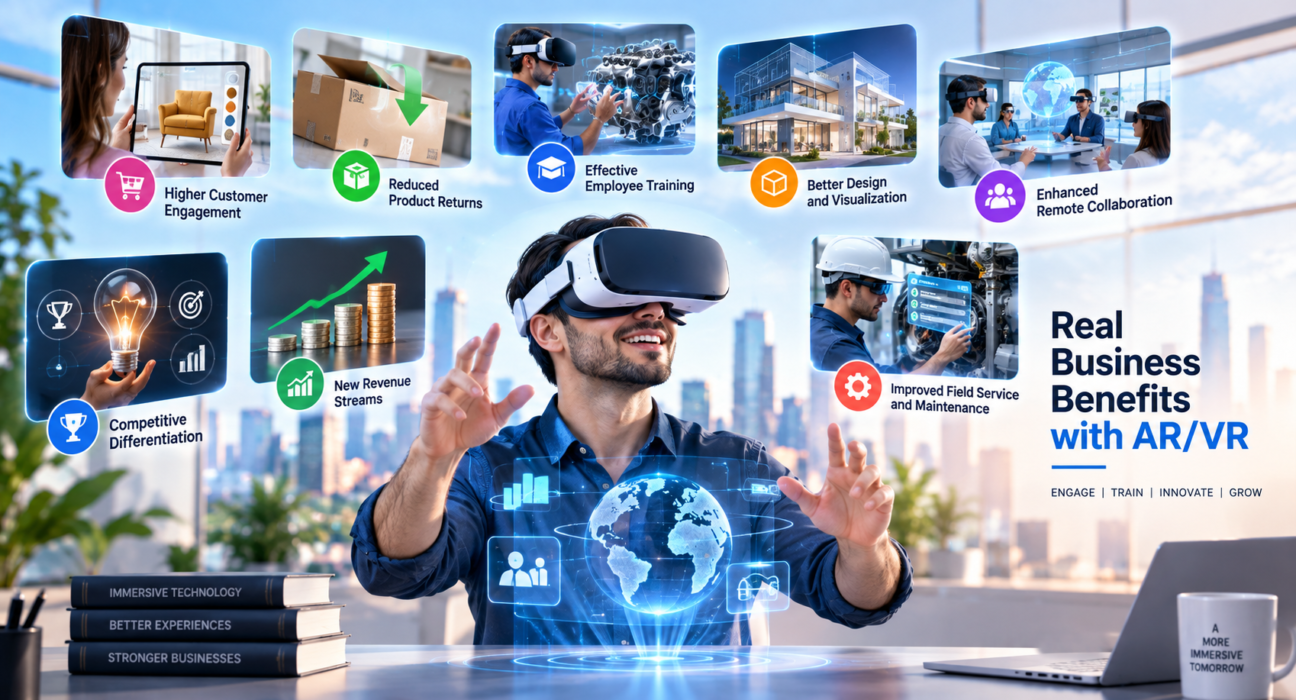
1. Improved Customer Engagement and Conversion
AR lets customers interact with products before buying them. Furniture retailers use AR apps to let shoppers see how a sofa looks in their living room. Beauty brands let customers “try on” makeup virtually. This kind of interactive experience keeps users engaged longer and can reduce hesitation at the point of purchase, since customers feel more confident about what they’re getting.
2. Reduced Product Returns
One of the most measurable AR/VR development benefits for e-commerce and retail businesses is a drop in returns caused by mismatched expectations. When customers can visualize size, fit, color, or placement accurately before ordering, there’s less guesswork – and fewer disappointed customers sending products back.
3. More Effective Employee Training
VR-based training simulations let employees practice high-risk or high-cost scenarios safely – think equipment operation, emergency response, surgical procedures, or customer service role-play. Trainees can repeat scenarios as many times as needed without real-world consequences, which often leads to faster skill acquisition compared to traditional classroom or video-based training.
4. Better Design, Prototyping, and Visualization
Architecture, engineering, construction, and product design teams use VR to walk through 3D models before anything is physically built. This helps teams catch design flaws early, collaborate more effectively across locations, and present concepts to clients or stakeholders in a far more compelling way than 2D drawings or renders.
5. Enhanced Remote Collaboration
AR and VR platforms increasingly support shared virtual spaces where distributed teams can meet, review 3D models, or work through problems together as if they were in the same room. This is particularly valuable for manufacturing, engineering, and design teams working across different offices or countries.
6. Competitive Differentiation
Adopting AR/VR early in your industry can position your brand as innovative and forward-thinking. Interactive product demos, immersive marketing campaigns, or AR-enhanced customer support can set a business apart from competitors still relying on static websites and traditional service channels.
7. New Revenue Streams
Some businesses are building entirely new offerings around AR/VR – virtual showrooms, immersive training-as-a-service platforms, virtual real estate tours, or branded VR experiences. For companies willing to invest in development, this can open revenue channels that didn’t exist a few years ago.
8. Improved Field Service and Maintenance Support
AR is widely used to guide field technicians through repairs by overlaying instructions, diagrams, or remote expert guidance directly onto the equipment they’re working on. This can shorten resolution times and reduce the need to send senior specialists on-site for every issue.
Which Industries Benefit Most from AR/VR Development?
| Industry | Common AR/VR Use Case | Primary Benefit |
|---|---|---|
| Retail & E-commerce | Virtual try-on, product visualization | Higher conversion, fewer returns |
| Real Estate | Virtual property tours | Faster buyer decisions, reduced site visits |
| Manufacturing | AR-guided assembly and maintenance | Reduced errors, faster training |
| Healthcare | Surgical simulation, patient education | Safer skill-building, better patient understanding |
| Education & Training | Immersive learning modules | Higher retention, safer practice environments |
| Architecture & Construction | 3D walkthroughs, design review | Fewer costly design changes |
| Automotive | Virtual showrooms, design prototyping | Lower prototyping costs, better customer experience |
How Much Does AR/VR Development Cost?
Costs vary significantly depending on complexity, platform, and scope. Broadly:
- Simple AR mobile experiences (product visualization, basic filters) tend to be the most affordable starting point.
- Custom AR apps with 3D modeling and device integration cost more due to design and engineering time.
- VR training simulations or enterprise applications are typically the most expensive, given the need for custom 3D environments, interaction design, and hardware compatibility testing.
Exact pricing depends heavily on your chosen development partner, project scope, and the platforms you’re targeting (iOS, Android, standalone headsets, etc.). It’s worth requesting detailed quotes from a few vetted companies rather than relying on rough industry averages, since scope differences can significantly change the final cost.
Key Factors to Consider Before Starting an AR/VR Project
- Define the business problem first. Don’t build AR/VR because it’s trendy – build it because it solves a specific customer or operational problem.
- Choose the right technology. AR is often more accessible and cost-effective for customer-facing use cases; VR suits training and simulation-heavy needs.
- Plan for hardware requirements. VR projects may require your team or customers to have compatible headsets, which affects adoption.
- Think about long-term maintenance. AR/VR apps need updates as devices, operating systems, and 3D content evolve.
- Evaluate development partner expertise. Look for teams with a demonstrated portfolio in AR/VR specifically, not just general app development.
How to Choose the Right AR/VR Development Company
Not every software development company has genuine AR/VR expertise – it requires specialized skills in 3D modeling, spatial computing, and platform-specific SDKs (like ARKit, ARCore, or Unity/Unreal Engine). When evaluating potential partners, look for:
- A portfolio of completed AR/VR projects relevant to your industry
- Experience with the specific platforms you need (mobile AR, headset-based VR, or both)
- A clear development and testing process for immersive experiences
- Transparent pricing and realistic timelines
- Post-launch support and update plans
Because this is a specialized niche, businesses often spend considerable time researching and shortlisting agencies. Platforms like GoFirms can help simplify this process by allowing businesses to research and compare technology and software development companies, including those with AR/VR and immersive technology experience, in one place. This makes it easier to shortlist providers based on relevant expertise rather than starting from a blank search.
Frequently Asked Questions
What is the main benefit of AR/VR development for businesses? The main benefit depends on the use case, but common advantages include improved customer engagement, reduced product returns, more effective employee training, and better design visualization. Businesses typically see the strongest results when AR/VR is applied to a specific, well-defined problem rather than used as a generic add-on.
Is AR or VR better for a small business? AR is generally more accessible for small businesses because it often runs on smartphones customers already own, requiring less hardware investment. VR usually makes more sense for businesses with training, simulation, or design visualization needs, since it typically requires dedicated headsets and more complex development.
How long does it take to develop an AR or VR application? Timelines vary based on complexity. Simple AR features can take a few weeks to a couple of months, while custom VR applications with detailed 3D environments and interactions can take several months. Your development partner can provide a more accurate estimate based on your specific requirements.
Do customers need special equipment to use AR features? Most AR experiences run on standard smartphones and tablets using built-in cameras and sensors, so customers typically don’t need extra equipment. VR experiences, on the other hand, generally require a headset, which is an important adoption factor to consider.
Can small and mid-sized businesses afford AR/VR development? Yes. Simpler AR applications, such as product visualization tools, are often within reach for small and mid-sized businesses. Costs scale with complexity, so it’s best to start with a clearly scoped project and expand based on results.
How do I find a reliable AR/VR development company? Look for a company with a demonstrated portfolio in AR/VR specifically, relevant industry experience, and clear communication about process and pricing. Researching and comparing multiple companies – for example, through a platform like GoFirms – can help you evaluate options before committing to a partner.
What industries benefit most from AR/VR technology? Retail, real estate, manufacturing, healthcare, education, architecture, and automotive are among the industries seeing the most practical benefits, particularly for product visualization, training, and design review use cases.
Conclusion
AR/VR development benefits are most valuable when applied with a clear purpose – whether that’s helping customers visualize products, training employees more effectively, or improving how design and engineering teams collaborate. The technology has matured enough that businesses of many sizes can now realistically evaluate it, not just large enterprises with big innovation budgets.
The most important first step is defining the specific problem you want AR or VR to solve. From there, choosing a development partner with real, relevant experience makes the biggest difference in outcome. If you’re exploring your options, researching and comparing software development and technology companies through a platform like GoFirms can be a practical way to find a team suited to your project’s scope and industry.