Your new customer mobile app is ready for launch. Marketing has prepared the campaign. Customer support is trained. The app looks impressive in demonstrations. Then, three weeks before the planned release, your technical team reports a problem.
The app needs real-time product availability data from your inventory system. Nobody planned for this integration properly. The inventory system doesn’t expose the necessary data in a format the mobile app can consume. Building the integration will take four months, not the two weeks remaining. The launch date is impossible.
This scenario repeats across enterprises with depressing regularity. Not because technical teams are incompetent, but because integration complexity is consistently underestimated and poorly managed.
If you’re leading a mid-to-large enterprise, particularly one operating in India’s complex multi-system environment, you’ve likely encountered integration challenges. Legacy systems that weren’t designed to share data. Vendor platforms with limited connectivity options. Custom applications built without considering how they’ll interact with other systems. Each new business initiative requires connections that nobody planned for.
This article addresses a technical architecture decision that has significant business implications: API-first development. Not as a technology buzzword, but as an approach that fundamentally changes how enterprises manage integration complexity and enable business agility.
Why Integration Remains an Enterprise Problem
Despite decades of investment in integration technologies, most enterprises still struggle with system connectivity. Understanding why helps explain what needs to change.
The point-to-point integration trap
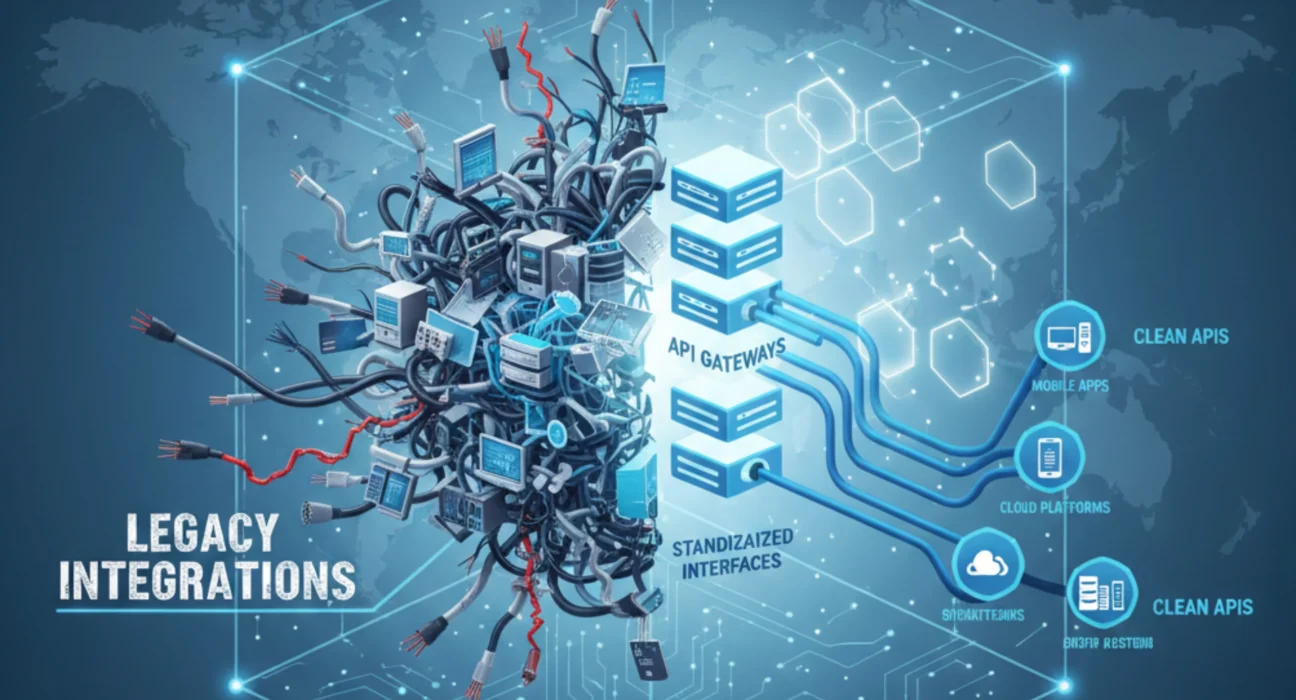
When a new system needs data from existing systems, the typical approach is building direct connections between them. Customer portal connects to CRM. CRM connects to order management. Order management connects to inventory. Inventory connects to warehouse systems.
Each connection seems reasonable individually. Collectively, they create geometric complexity. With 10 systems and point-to-point integration, you potentially have 45 different connections to build and maintain. With 20 systems, that number becomes 190.
Each connection is unique: different protocols, different data formats, different error handling, different authentication approaches. When source systems change, every connection to them potentially needs updates. The maintenance burden grows continuously.
This isn’t theoretical complexity. It’s the reality most large enterprises live with: hundreds of integration connections, each with its own quirks, maintained by different teams, creating brittleness and risk across the technology landscape.
The database integration legacy
Many enterprise integrations were built when the expedient approach was direct database access. System A reads data directly from System B’s database. System C writes directly to System D’s tables.
This creates tight coupling and hidden dependencies. When System B’s database schema changes for valid business reasons, System A breaks unexpectedly. There’s no contract or interface defining what’s exposed, just implicit dependencies buried in code.
Database integration also creates performance and security issues. Systems accessing databases directly can impact performance. Security controls become difficult to enforce when multiple systems have database-level access.
Yet many Indian enterprises still have significant database integration due to legacy systems and historical decisions. This technical debt constrains agility and increases risk.
The integration as afterthought pattern
In many programs, integration is considered after core functionality is built. “We’ll worry about integration later” is a common refrain during design discussions.
Then later arrives and integration complexity becomes apparent. The data you need isn’t in the format you expected. The source system has performance limitations that prevent real-time access. Security requirements weren’t considered. The integration takes as long as building the original functionality.
This pattern creates predictable program delays. Integration becomes the bottleneck that extends timelines and increases costs beyond original estimates.
Vendor platform limitations
Commercial platforms often have limited integration capabilities. They expose some data through standard interfaces but not everything you need for your specific use case. Custom integration requires vendor professional services at premium rates. You’re constrained by the vendor’s roadmap and priorities.
This is particularly challenging for global enterprises operating in India who implement international platforms that weren’t designed for local requirements: GST integration needs, local payment gateway connections, India-specific regulatory reporting.
What API-First Development Actually Means
API-first development is an architectural approach where systems expose their capabilities through well-defined interfaces from the beginning, rather than having integration added later.
Design interfaces before implementation
In traditional development, you build functionality and then create ways for other systems to access it. In API-first development, you design the external interface first, get agreement on it, and then build the underlying functionality.
This reversal seems subtle but has significant implications. It forces thinking about how functionality will be consumed before it’s built. It creates contracts between systems that reduce coupling. It makes integration a first-class concern rather than an afterthought.
Standardized, documented, versioned contracts
API-first development creates explicit contracts for system interaction. These contracts specify what data is available, in what format, with what security controls, and with what performance characteristics.
Documentation is part of the contract. Not separate documentation that becomes outdated, but specification that defines both what the system does and how to use it.
Versioning is built in from the start. When capabilities need to change, new versions are introduced without breaking existing integrations. This allows evolution without the brittleness that plagues traditional integration.
Business capability exposure, not technical access
Good APIs expose business capabilities, not technical implementation. Instead of providing database access, an API offers “get customer order history” or “check product availability.” The underlying implementation can change without affecting consumers.
This abstraction reduces coupling and enables change. You can replace the inventory system entirely, and as long as the API contract remains stable, consuming systems aren’t affected.
Self-service integration enablement
When systems expose well-documented APIs, new integrations can be built without involving the team that built the source system. Development teams can discover what’s available, understand how to use it, and build integrations independently.
This dramatically accelerates program delivery. Instead of integration being sequential work dependent on coordination across teams, it becomes parallel work that teams can do autonomously.
The Business Case for API-First Architecture
For C-level executives, the question isn’t whether API-first development is technically superior. It’s whether the business value justifies the investment and organizational change required.
Reduced time to market for new initiatives
When your technology landscape is built on well-defined APIs, new business initiatives that require system integration can move much faster.
Want to launch a mobile app? The APIs your internal systems expose make it straightforward to access the data and capabilities needed. Want to integrate with a new partner platform? Standard APIs reduce integration complexity from months to weeks.
This agility has direct business value. Markets move quickly. Competitive threats emerge. Regulatory requirements change. Organizations that can respond quickly to these changes have advantages over those constrained by integration complexity.
Lower total cost of integration
While API-first development requires upfront investment in interface design and implementation, it reduces total integration cost over the system lifecycle.
Reusable APIs mean integration work done once benefits multiple initiatives. Reduced coupling means fewer integration failures when systems change. Standardization reduces the specialized knowledge required for maintenance.
For CFOs evaluating technology investment, API-first architecture shifts costs from ongoing operational integration work to upfront strategic investment that pays dividends across multiple initiatives.
Risk reduction through decoupling
Tightly coupled systems create cascading failure risks. When one system fails or needs maintenance, all directly connected systems are potentially impacted.
APIs create boundaries that contain failures. When done properly, consuming systems can handle temporary API unavailability gracefully. Changes to internal implementation don’t ripple through the entire technology landscape.
This risk reduction matters for business continuity and operational stability.
Vendor independence and flexibility
When your business capabilities are exposed through APIs rather than being locked inside vendor platforms, you have more flexibility to change vendors or bring capabilities in-house.
The customer data you need is available through your own API layer, not just through the CRM vendor’s proprietary interface. If you decide to switch CRM platforms, the impact is contained to the integration layer rather than affecting every system that consumes customer data.
This flexibility has strategic value, particularly for enterprises managing long-term vendor relationships and technology evolution.
Practical Implementation Challenges
API-first development isn’t just a technical decision. It requires organizational change and governance that many enterprises struggle with.
The coordination challenge
In traditional development, teams build systems independently. Integration happens later through coordination when needed.
API-first development requires coordination upfront. Teams need to agree on API contracts before building. This requires governance processes for API design, review, and approval.
Many enterprises lack these processes. Technical teams are accustomed to autonomy. Creating meaningful API governance without bureaucracy that slows everything down is genuinely difficult.
The documentation and discovery problem
APIs are only valuable if people can find them and understand how to use them. This requires infrastructure for API discovery: catalogs or portals where developers can search for available capabilities.
It also requires maintaining accurate, current documentation. This is challenging when systems evolve continuously. Documentation that’s outdated or incorrect is worse than no documentation because it creates false expectations.
Enterprises implementing API-first architecture need to invest in the tooling and processes for API discoverability and documentation maintenance. This is often underestimated in planning.
The legacy system reality
Most enterprises have significant legacy systems that weren’t built with API-first principles. These systems need to be integrated with modern API-based architectures.
Building APIs for legacy systems is possible but requires effort and expertise. You’re creating new interface layers on systems that may be poorly documented and maintained by teams with different technical approaches.
This is particularly relevant for Indian enterprises where core banking, ERP, and other critical systems are often mature platforms with limited modern integration capabilities.
The security and governance complexity
APIs that expose business capabilities create security concerns. Who should have access to what data? How is authentication and authorization managed across different consumer types—internal applications, partner systems, mobile apps?
API governance needs to address these security questions consistently. Ad-hoc security decisions for each API create inconsistency and risk. But creating security frameworks that work across diverse use cases requires expertise and investment.
Getting API-First Development Right
Organizations that successfully implement API-first architecture approach it as a capability-building exercise, not just a technical project.
Start with business capability mapping
Before designing APIs, understand what business capabilities need to be exposed. Customer data access. Order processing. Inventory visibility. Payment processing. Reporting and analytics.
This business capability view ensures APIs are designed around what business needs rather than technical convenience. It also helps prioritize: not all capabilities need API exposure immediately.
Establish API design standards
Consistency matters enormously. When APIs follow similar design patterns, naming conventions, error handling approaches, authentication methods they’re easier to understand and use.
This requires organization-wide standards for API design. Not rigid rules that prevent appropriate variation, but guidelines that create consistency where it matters.
Many enterprises adopt industry standards like RESTful API design principles or OpenAPI specifications as foundation for their standards.
Create dedicated API platform capability
API-first architecture requires infrastructure: API gateways for routing and security, developer portals for discovery and documentation, monitoring and analytics for understanding usage and performance.
This infrastructure should be treated as shared platform capability, not something each team builds independently. The platform team provides tools and services that make API development and consumption easier for everyone.
At Ozrit, we’ve found that enterprises with dedicated API platform teams and infrastructure have far more success with API-first development than those treating it as just another development practice.
Invest in developer experience
APIs are products consumed by developers. Making them easy to discover, understand, and use determines whether they get adopted or teams build workarounds.
This means investing in documentation, code samples, testing environments, and support. Good developer experience isn’t optional nice-to-have, it’s essential for API adoption.
Implement API lifecycle management
APIs need governance throughout their lifecycle: design review before implementation, testing to verify they work as specified, monitoring to understand how they’re used, versioning when changes are needed, deprecation when they’re superseded.
This lifecycle management requires processes and tooling. Organizations that try to manage it informally struggle as the number of APIs grows.
The Multi-Vendor Program Context
API-first development becomes particularly important in programs involving multiple vendors, which describes most enterprise digital transformations.
Contract definition before vendor selection
When you select vendors without clear API requirements, you’re at the mercy of whatever integration capabilities they provide. This often leads to expensive custom integration work.
Better to define what API capabilities you need as part of requirements, evaluate vendors partly on their API maturity, and make API compliance part of contractual obligations.
This requires bringing API architecture thinking into procurement processes, not just technical implementation.
Integration ownership and accountability
In multi-vendor programs, who’s responsible for building integrations between Vendor A and Vendor B systems? Often this falls into gaps with everyone assuming someone else is handling it.
API-first architecture creates clearer accountability. Each vendor is responsible for exposing their capabilities through defined APIs. Integration between systems becomes more straightforward because both sides have clear contracts.
This doesn’t eliminate all coordination challenges but reduces the custom integration work that creates delays and cost overruns.
Vendor platform augmentation
When vendor platforms don’t expose all the capabilities you need through their standard APIs, API-first architecture provides a framework for augmentation.
Build a wrapper layer that exposes additional capabilities through your organization’s API standards. This contains the platform-specific complexity and presents consistent interfaces to consuming systems.
This approach reduces vendor lock-in and provides flexibility to change platforms later without massive integration rework.
API-First Development and Legacy System Modernization
For enterprises with significant legacy systems, API-first architecture creates a path to modernization without big-bang replacement.
The strangler pattern approach
Rather than replacing legacy systems completely, gradually move capabilities to modern platforms while maintaining integration through APIs.
The legacy system continues to operate, but APIs abstract its direct access. New capabilities are built on modern platforms. Over time, the legacy system’s footprint shrinks as capabilities migrate, but the transition is gradual and controlled.
This risk-reduction approach is particularly valuable for mission-critical systems where big-bang replacement creates unacceptable business risk.
Creating digital experience layers
Many legacy systems have valuable functionality but poor user interfaces. API exposure of that functionality allows building modern interfaces mobile apps, web portals, conversational interfaces without replacing the underlying systems.
This enables digital transformation initiatives that improve customer and employee experience without requiring complete system replacement.
Data accessibility without database integration
API exposure of legacy system data eliminates the need for direct database access. This reduces coupling, improves security, and makes the legacy system more maintainable.
Yes, building APIs for legacy systems requires investment. But that investment pays dividends across multiple initiatives that need data access, and it reduces the technical debt that database integration creates.
Measuring API-First Success
How do you know if your API-first investment is delivering value? Several indicators matter for business leadership.
Integration time reduction
Track how long new integrations take to build before and after API-first adoption. Reductions of 50-70% in integration time are common when well-designed APIs exist versus custom integration with systems that don’t expose APIs.
This time reduction translates directly to faster time-to-market for business initiatives.
API reuse metrics
An API used by multiple consumers indicates value. If APIs are built but not reused, you’re creating overhead without benefit.
Track how many consumers use each API. High-value APIs with multiple consumers demonstrate that API-first investment is enabling business capabilities broadly, not just solving point problems.
Integration failure reduction
API-based integration with clear contracts and proper error handling should be more reliable than point-to-point custom integration.
Monitor integration reliability: how often do integrations fail, how quickly are failures detected, how long does recovery take. Improvements in these metrics demonstrate risk reduction value.
Developer productivity indicators
When developers can find and use APIs easily, productivity improves. Measure time from integration requirement to working solution. Survey developers about ease of integration.
Improved developer productivity reduces program timelines and costs.
The Leadership Role in API-First Adoption
Technology teams can’t drive API-first adoption alone. It requires leadership commitment and governance changes.
Architectural vision and investment
API-first architecture requires upfront investment that doesn’t immediately deliver visible features. Building APIs, creating developer portals, establishing governance processes—these create capabilities that enable future value rather than delivering features directly.
This investment requires executive support because it competes with feature development that has more visible business impact.
Cross-team coordination and governance
API standards and governance necessarily cross team boundaries. No single team can impose standards on others without organizational authority supporting it.
Leadership needs to establish governance processes that balance autonomy with consistency, enabling teams to move quickly while ensuring API approaches that work across the enterprise.
Vendor relationship management
When vendor platforms need to expose APIs they weren’t designed to provide, or when their API capabilities don’t meet your standards, that requires vendor relationship management at appropriate levels.
Technical teams can explain requirements to vendor technical teams. But when vendors push back or require additional investment, that escalation needs leadership support.
Cultural change around integration
API-first development represents cultural change from “we’ll integrate later if needed” to “we design for integration from the start.” This requires consistent messaging from leadership about integration importance.
When teams know leadership cares about integration strategy and will hold them accountable for API-first principles, behavior changes. When it’s treated as technical preference rather than organizational priority, adoption struggles.
Choosing Partners for API-First Programs
Not all technology partners have equal API-first maturity. When evaluating partners for enterprise software delivery, API capabilities should be an assessment criterion.
API design capability
Building good APIs requires specific expertise. Poor API design creates brittle integration that defeats the purpose.
Evaluate whether potential partners have demonstrated API design capability, understand RESTful principles or other API standards, and can design APIs that balance business needs with technical sustainability.
Integration architecture experience
API-first development is part of broader integration architecture. Partners should understand how APIs fit into an overall integration strategy, when to use APIs versus other integration patterns, and how to design integration layers for enterprise scale.
Organizations like Ozrit that position around enterprise program management and delivery maturity tend to have more sophisticated integration architecture expertise than those focused primarily on feature development.
Platform and tooling knowledge
API infrastructure gateways, developer portals, monitoring, security requires specific platform knowledge. Partners should be familiar with enterprise API management platforms and able to recommend appropriate tooling.
Delivery at enterprise scale
API-first architecture in large enterprises is different from smaller environments. The number of APIs, the diversity of consumers, the governance complexity, the security requirements all scale differently.
Partners should have experience delivering API-first programs at enterprise scale, understanding the organizational and technical challenges that emerge.
Moving Forward with API-First Architecture
API-first development isn’t just a technical architecture pattern. It’s a strategic capability that enables business agility, reduces integration costs, manages technical risk, and provides vendor flexibility.
But realizing these benefits requires more than adopting API technology. It requires governance processes, organizational coordination, investment in platform capabilities, cultural change, and sustained leadership commitment.
For enterprises planning large-scale digital transformation or IT transformation strategy, API-first architecture should be a foundation decision, not a tactical implementation detail. How your systems expose capabilities and integrate with each other fundamentally shapes what business initiatives you can execute and how quickly you can move.
The question isn’t whether to adopt API-first principles the benefits are clear for enterprises managing complex IT programs and scaling enterprise systems. The question is whether you’re prepared to make the organizational and governance changes required to implement API-first architecture effectively.
That implementation requires acknowledging that integration is a first-class architectural concern, not an afterthought. It means investing in capabilities that enable other capabilities rather than directly delivering features. It means establishing governance that balances consistency with autonomy. It means choosing technology partners who understand enterprise execution challenges, not just development.
The enterprises that navigate complex technology programs successfully are increasingly those that have invested in API-first architecture. Not because the technology is sophisticated it isn’t, conceptually. But because it creates the foundation for managing integration complexity at scale, enabling business agility, and reducing the technical debt that accumulates when integration is treated as a series of tactical decisions.
This capability doesn’t develop overnight. It builds through sustained investment, organizational learning, and commitment to architectural principles even when they conflict with short-term pressures for rapid feature delivery.
That long-term thinking investing in capabilities that compound value over time rather than optimizing for immediate feature output is what separates organizations that successfully scale their technology landscapes from those that accumulate integration debt until it becomes a strategic constraint.
The choice isn’t whether to manage integration complexity. Every enterprise deals with that. The choice is whether to manage it strategically through architectural investment like API-first development, or tactically through endless point solutions that create escalating maintenance burden and brittleness.
For enterprises serious about technology risk and governance and long-term sustainability of their technology investments, API-first architecture is increasingly not optional. It’s foundational infrastructure for managing the integration complexity that defines modern enterprise technology landscapes.