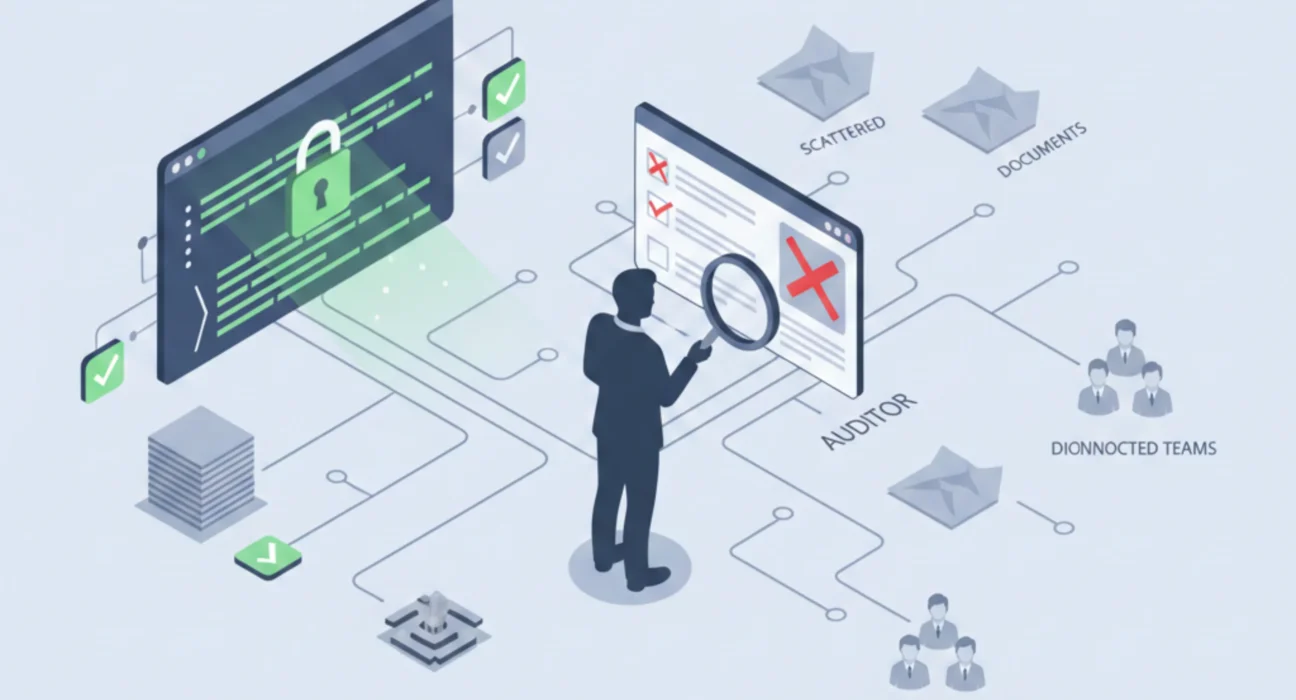
Most enterprise security reviews begin with the same assumption: if the code is secure, the review will pass. Senior leaders approve budgets, teams work through remediation backlogs, and everyone expects a straightforward outcome. Then the review stalls. Not because of a critical vulnerability, but because the auditor can’t verify who approved a particular change three months ago, or because the documentation describes a process that doesn’t match what actually happens in production.
The failure isn’t technical. It’s procedural. And at enterprise scale, procedural failures are far more common than code vulnerabilities.
Why Process Becomes the Problem
Large enterprises operate across multiple teams, time zones, and technology stacks. A single application might touch infrastructure managed by one team, APIs owned by another, and data governed by a third. Security controls exist, but they’re often implemented differently across divisions. One team uses Jira for access requests. Another uses ServiceNow. A third still relies on email approvals with manager sign-off.
When an auditor arrives, they don’t just scan the code. They trace the entire chain of decisions, changes, and approvals that brought that code into production. They need to see evidence that your stated security controls actually function as described. If your policy says all production access requires written approval, they’ll ask to see those approvals. If your runbook describes a specific incident response process, they’ll want proof it was followed during the last real incident.
This is where most reviews falter. The code might be sound, but the paper trail is incomplete, inconsistent, or simply missing. Teams operated under time pressure. Approvals happened verbally. Documentation was written after the fact to satisfy a compliance checkbox. The gap between policy and practice becomes visible, and the review stops moving forward.
The Documentation Trap
Every enterprise has security policies. Most are comprehensive, well-intentioned, and largely ignored during day-to-day execution. Teams know the policies exist, but they also know that following every step exactly as written would slow delivery to an unacceptable pace. So they develop workarounds. Informal approvals. Faster paths for urgent changes. Reasonable shortcuts that keep the business moving.
The problem emerges during the audit. Auditors don’t evaluate intent or reasonableness. They evaluate evidence. If the policy says changes require security sign-off within 24 hours, but the actual practice is a quick Slack message to the security lead, that’s a finding. If the disaster recovery plan describes quarterly tests, but the last test happened eight months ago, that’s a gap. The organization might be perfectly secure in practice, but it can’t prove it on paper.
This creates a secondary problem. Teams scramble to backfill documentation, reconstruct approval chains, and retrofit evidence to match the written policy. This work consumes weeks of senior engineering time, delays the review, and often produces documentation that still doesn’t satisfy the auditor because it’s clearly retrospective. The review that should have taken six weeks stretches to four months.
Scale Amplifies Every Gap
These problems exist at any company size, but they become critical at enterprise scale. A mid-sized company might have 30 engineers and one security team. Communication happens naturally. Everyone knows the process because everyone works together. An enterprise has 3,000 engineers across twelve countries. The security team in London might not know how the team in Singapore actually handles access requests. Policies written by headquarters don’t account for regional compliance requirements or local tooling constraints.
Coordination becomes the challenge. Security reviews require input from infrastructure teams, application owners, compliance groups, and business stakeholders. Each group has different priorities, different reporting lines, and different definitions of what constitutes sufficient evidence. Getting everyone aligned on a single consistent story is harder than fixing the code.
The timeline pressure makes it worse. Enterprises often face external deadlines: regulatory filings, customer contract requirements, board commitments. When a security review blocks a major release or a strategic partnership, the pressure to resolve findings quickly becomes intense. But rushing the documentation work usually creates new problems. Teams provide incomplete answers, auditors ask follow-up questions, and the cycle repeats.
What Actually Works
The enterprises that pass security reviews efficiently don’t have perfect code. They have consistent processes that generate evidence automatically. Access requests go through a formal system that logs every approval. Code changes trigger automated checks that document exactly what was scanned and when. Incident response follows a template that captures required information in real time, not weeks later when someone remembers to update the wiki.
This requires investment before the review starts. You can’t build evidence infrastructure while the auditor is waiting for answers. The tooling needs to be in place, the teams need to be trained, and the processes need to be running long enough to generate a credible history. Most enterprises know this intellectually, but they defer the work because it feels like overhead. Then the review arrives and the cost of not having done it becomes obvious.
The other factor is ownership. Security reviews involve too many people for diffused responsibility to work. Someone senior needs to own the entire process, understand what evidence is required, know where gaps exist, and have authority to make teams prioritize remediation work. Without that single point of accountability, the review fragments into dozens of small tasks that all seem important to someone else.
How Ozrit Approaches Enterprise Security Reviews
Ozrit works with enterprises specifically on these complex delivery challenges. We don’t just write code or fix vulnerabilities. We take ownership of the entire security review process from initial scoping through final sign-off.
When we engage on a security review, a senior leader from our team becomes the central point of contact. That person works directly with your auditors, your internal security team, and your business stakeholders to understand exactly what evidence is required. They map that back to your existing systems and identify gaps early. If you need documentation updated, we write it. If you need process improvements implemented, we do that work. If you need technical remediations completed, our engineers handle them.
This matters because most consulting firms send junior analysts to do the groundwork. You end up managing the consultants instead of having them manage the problem. Our model is different. Senior people with enterprise experience lead the engagement. They’ve been through these reviews before. They know what auditors ask for, what answers satisfy them, and how to structure evidence so it withstands scrutiny.
We also commit realistic timelines upfront. A typical security review engagement with Ozrit runs eight to twelve weeks depending on scope. We staff the project properly from day one. Our team includes security engineers, technical writers, and process specialists who work together as a unit. You’re not waiting for approvals or dealing with staffing changes mid-project.
For large programs, we provide 24/7 support because enterprise security reviews don’t pause for time zones. If your auditor in New York asks a question at 9 AM Eastern and needs an answer by end of day, our team responds immediately. If a critical finding emerges over the weekend before a board meeting, we’re available to address it.
The onboarding process reduces delivery risk significantly. We spend the first week understanding your environment in detail: your tooling, your team structure, your existing documentation, and your specific compliance requirements. We don’t use generic templates or assume your organization works like the last client. We build a detailed execution plan specific to your situation, review it with your team, and get explicit agreement on deliverables before significant work begins.
This approach consistently delivers results. Enterprises work with us because they need certainty. They need to know the review will complete on schedule, the findings will be addressed properly, and the business can move forward. We provide that certainty through clear ownership, senior involvement, and structured execution.
The Real Cost of Failed Reviews
When security reviews fail or drag on indefinitely, the impact extends far beyond the immediate delay. Strategic initiatives get postponed. Customer commitments get missed. Competitive opportunities disappear. Board confidence in the technology organization erodes. The CIO or CTO ends up spending hours each week managing a problem that should have been resolved months ago.
The financial cost is substantial but often hidden. Engineering teams redirect their time from product development to documentation cleanup. External consultants bill hundreds of hours reviewing the same material repeatedly. The opportunity cost of delayed launches or lost partnerships can reach millions of dollars for major enterprise initiatives.
More importantly, failed reviews create organizational scar tissue. Teams become risk-averse. Future projects get over-specified with compliance requirements that slow everything down. Innovation suffers because leadership loses confidence in the organization’s ability to deliver complex technical work on schedule.
Building Long-Term Capability
The goal of any security review engagement should be more than just passing the immediate audit. It should leave your organization better equipped to handle the next review independently. This means improving your documentation practices, strengthening your evidence generation systems, and training your teams on what auditors actually need to see.
Enterprises that invest in this capability building reduce their long-term costs significantly. The second security review is faster than the first. The third is routine. Eventually, security reviews become a predictable part of the delivery process rather than an emergency that consumes executive attention.
This requires treating process work as seriously as technical work. It means allocating budget for tools that generate audit evidence automatically. It means training engineers to document decisions as they make them, not weeks later. It means building templates, checklists, and runbooks that make the right process the easy process.
The enterprises that do this well understand something important: security reviews are fundamentally about demonstrating control. Not perfect control, but consistent, documented, verifiable control. The code matters, but the process that governs the code matters more. Get the process right, and the reviews become manageable. Get it wrong, and even excellent code won’t save you.